
from The Presidential Committee on Northern Economic Cooperation, 2019
I began this series of blog posts with a simple question: What happened to the Korean language the Koryo saram must have spoken?
In documenting the maintenance of the Korean language among the Koryo saram, my previous blog posts covered broad themes in the history of the Koryo saram (blog post 1) and language usage in formal institutions (blog post 2). This final blog post will look at language – its maintenance, use in mixed conversation, and ultimate shift to Russian – as it indexes elements of Koryo saram identity and culture.
Examining identity and culture is “messier” than identifying the number of Korean-language newspaper publications or comparing grammar points between dialects. This post is not meant to give a clean definition of Koryo saram identity. Nothing short of work with actual members of the community could come close to such a feat. Instead, this post offers insights into the many elements of culture that either carry the language physically or else honor it symbolically.
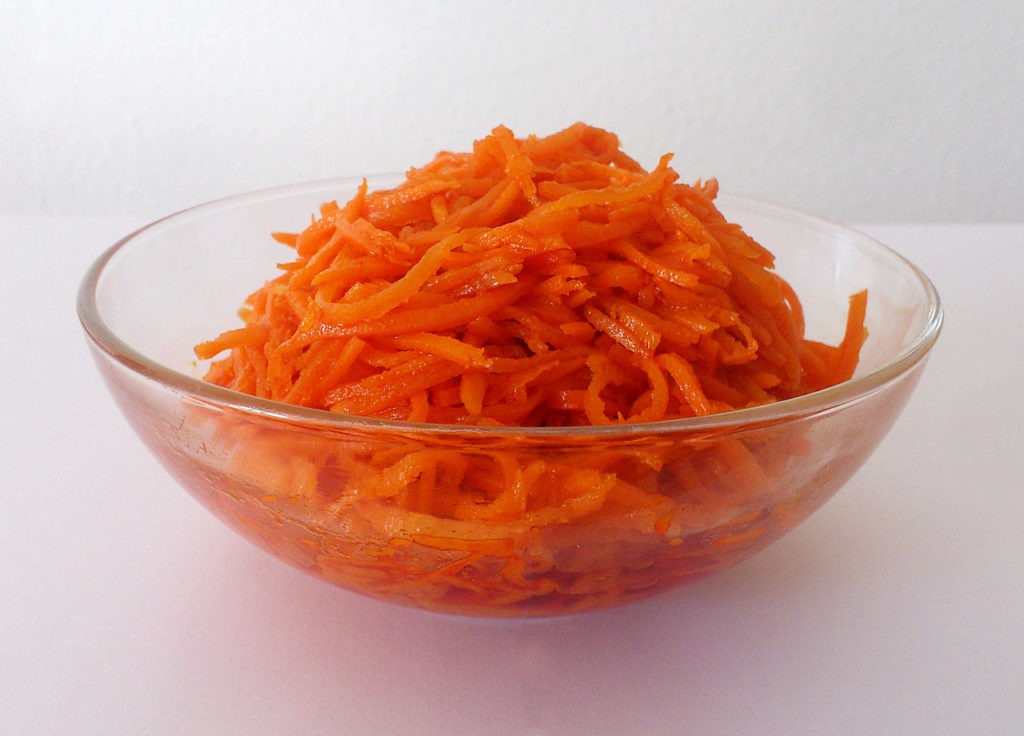
Certain things like food or ceremonies maintain a connection to the language even after it has ceased to be spoken. These items are very much alive and well in Koryo saram communities, and continue to give them their unique flavor – some, literally.
Measuring Language Vitality
As someone whose native language is everywhere (for now, anyway), it can be hard to understand why a community would stop speaking their language from one generation to the next.
One of the best ways to measure the degree of language vitality in a speech community is by understanding rates of intergenerational transmission: Basically, look at how the language is being passed on to younger generations, if it is being passed on at all. This analysis can be applied to an entire language (so, all Korean varieties spoken anywhere in the world), or it can be used to analyze language use within a specific community. This blog post will adopt the latter scope, using the Expanded Graded Intergenerational Disruption Scale (EGIDS) as it is illustrated below.
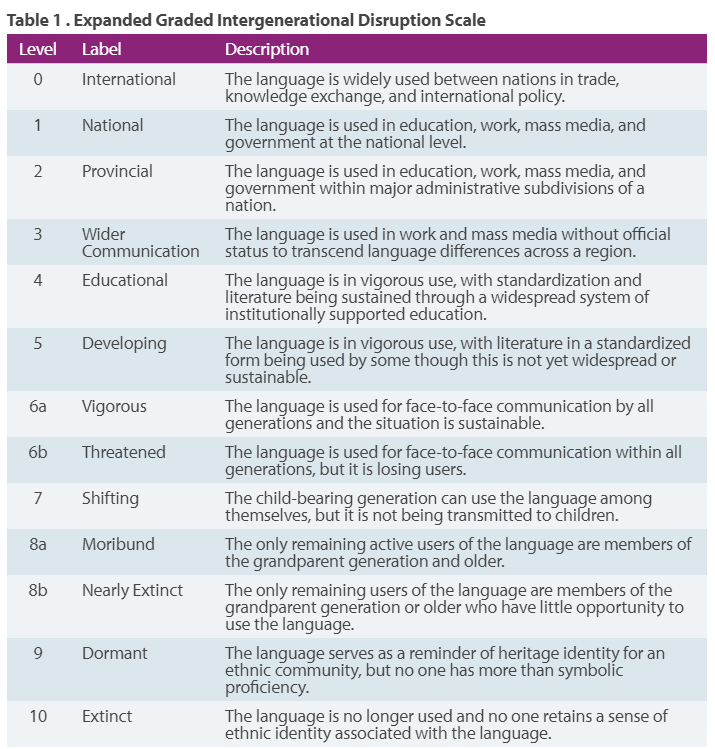
As a note, this scale, as well as the organization that constructed it (Ethnologue by SIL), are not at all uncontroversial in linguistic circles (see Cornwall 2019). Still, it provides useful reference points from which to begin work on language at the community level.
We can use this scale to locate the position of Koryo mar at various points in time. The language has never been on either extreme. It was never an international language (0), and this blog post will argue that it is nowhere near extinct (10).
Koryo saram – Understanding the Generations

In reading about the Koryo saram over the past few months, I have grown accustomed to seeing Koryo saram introduced by generation. Someone will state their name and then say what generation of Koryo saram they are. I have not found a neat, widely accepted classification of the different generations, and I suspect that many Koryo saram would disagree amongst themselves, similar to how many cannot agree exactly on when “Gen X” ends and “Millenials” begin. The most consistent theme that divides the generations is a linguistic one. I have been able to surmise the following:
- First Generation – The Koryo saram who have a conscious memory of the forced migration to Central Asia and spoke Korean as their first language. They received some or all of their language in Korean. They spoke Korean well into adulthood.
- Second Generation – The first generation of Koryo saram to know Central Asia as their place of birth. These Koryo saram were educated in Central Asia. While some can understand Korean, many cannot speak it (this is often called a “passive speaker”). The overwhelming majority of Koryo saram in this generation did not pass on the Korean language.
- Third Generation – The generation who grew up hearing Korean occasionally, often around their grandparents. These Koryo saram received their education in Russian. Some among this generation also came of age after the fall of the Soviet Union, allowing them a sudden increase in access to the Republic of Korea.
- Fourth Generation – The generation who are coming of age now. They do not speak Korean at all but have access to it via social media/direct educational campaigns from South Korea.
This division of the generations tracks nicely (perhaps too nicely!) with EGIDS. Given the catastrophic events of 1937, I consider the Korean language among the Koryo saram to have been Threatened (level 6b) in the years immediately following their forced displacement. As this first generation came of age and starts bearing children, the stability of their society in Central Asia increases, but their use of the Korean language decreases, a result of necessity. Survival on the steppe and later, in kolkhozes and larger Soviet society, demands the use of a common language (most often Russian) in daily life.
While second generation children may have grown up hearing the language at home, their education has been entirely in Russian. Furthermore, the opportunities to use Korean outside of the domain of the household rapidly diminish. By the time the second generation starts bearing children, the language is Shifting (level 7). With transmission no longer regularly occurring, the third generation is only able to hear the language around their grandparents (Moribund, 8a), and finally, once their grandparents begin to pass on, the language is on track to near extinction (8b).
This drastic change in the sociolinguistic environment does not take long at all. In the case of the Koryo saram, it happened over the span of 50 years or less. The forced migration violently disrupted language transmission. In addition to many people dying, education was interrupted for several years. The Koryo saram were dispersed throughout Central Asia, and severely restricted in terms of movement until 1949. This stifled vertical (intergenerational) and horizontal (intragenerational, among communities and extended families) transmission of the language.
Attitudes toward the Korean Language
In 1995, the South Korean Ministry of Public Information and Communication (now, part of the Korea Communication Commission) published a study entitled “Korean Community Consciousness Survey” as part of its 50 year anniversary of liberation from Japanese control. The study was aimed at gauging the perceptions of Korean communities in South Korea, the United States, Japan, and the CIS countries. I am assuming the Koryo saram constitute the bulk of the respondents in the CIS countries.
One question asked respondents to indicate their position on the following statement:
“The Korean language (hangul) is one of the most superb languages in the world.” (한국어(한글)가 세계에서 우수한 언어이다)
The responses were as follows:
| Korea | USA | Japan | CIS | |
|---|---|---|---|---|
| Strongly Agree | (57.9%) | (33.5%) | (30.2%) | (3.5%) |
| Mostly Agree | (36.1%) | (20.5%) | (39.2%) | (10.0%) |
| Mostly Disagree | ( 5.1%) | (15.2%) | (19.2%) | (36.1%) |
| Strongly Disagree | ( 0.2%) | (26.6%) | ( 5.3%) | (30.7%) |
| Don’t know/ No Response | ( 0.7%) | ( 4.2%) | ( 6.2%) | (19.7%) |
Clearly, at that moment in time, views on the prospects of the Korean language in the CIS countries were bleak, with only 13.5% responding positively to the statement.
For my purposes, I wish the “Don’t know” and “No response” categories had been separated, for I feel that a clear number in the “Don’t know” category would index the distance between respondents and the language.
This perception, if at all representative of the Koryo saram population, would greatly corroborate the account I gave above regarding language shift through the generations. In 1995, those who would have been answering the questionnaire were likely to have been mainly those belonging to the second and early third generations.
Korean-Russian Code Switching
One item that the EGIDS does not cover is the presence of code-switching. Code-switching refers to alternating between two or more languages in a conversation. For pragmatic reasons, it necessarily means that both the speaker and interlocutor(s) have some knowledge both/all systems.
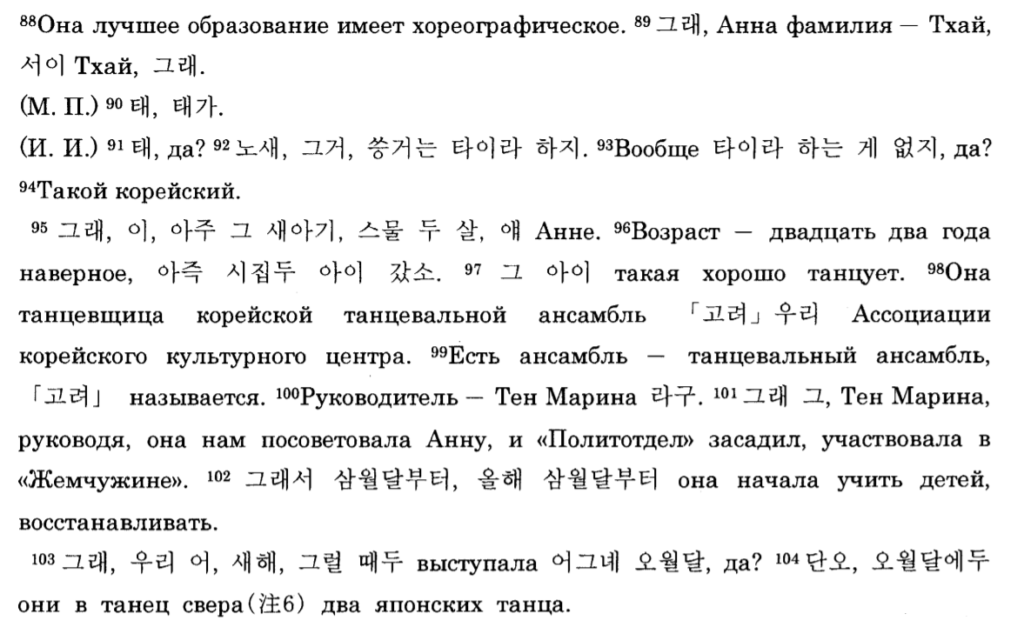
What follows is an example of such code-switching in a conversation between two Koryo saram in Tashkent in 2002. The speakers are listed here as KMP (Kim Maksim Petrovich) and PII (Park Ivan Ivanovich). This text was taken from Yanagida’s (2005:116-117) larger study of what he terms “Korean-Russian Mixed Code” [朝鮮語・ロシア語混用コード]. Even though they were born in the Russian Far East in 1936 and 1937, respectively, Yanagida classifies the two male speakers as belonging to the second generation of Koryo saram. The reasoning is largely linguistic, as they would have had very little exposure to Korean outside of the home, their entire education being conducted in Russian.
My English translation follows. It is based largely on the Japanese translation in Yanagida (2005) and, as such, I especially encourage Russian speakers to be critical of it, as I have very few intuitions on how Russian phrases are best rendered into English. In the translation, Korean elements are indicated in bold.

KMP: (That’s not a university) It’s a technical institute.
PII: That’s the Choreography Institute that had the Cultural Institute as its base. She’s receiving the best education a dancer can get. Yes, Anna’s family name is Tkhai – her family name is Tkhai, yes.
KMP: Tae, it’s Tae.
PII: Tae, right? In Russian it’s, when you write it, it’s Tkhai. Usually you don’t say “Tkhai”, right? That’s so Korean. Yeah, she, she’s really young, 22 years old, this Anna. She’s definitely 22 years old, and not even married yet. This girl dances so well. She is a dancer in our Koryo saram Cultural Center Association’s Korean dance ensemble “Koryo.” The ensemble has a dance troupe, and it is called “Koryo”. The director is named Ten Marina. Yes, so Ten Marina is directing, and she recommended Anna to us, “Politotdel” recruited her, and (Anna) participated in “Zhemuzhina” [Eng: Pearl]. Then, from March, from this March onward she began teaching children and rebuilding. Yes, so our, um, New Year – even at that time, she performed, in May or something, right? At the Tano Festival [Eng: Dragon Boat Festival], in May they brought two Japanese dancers into their dance.
Certainly, analysis of this singular textual extract could constitute its own blog post. What I will relay here are only a few key takeaways.
The first item to note is a generalization: Code-switching is not random. In this text, the Korean items appear in entire phrases, revealing syntactic structures that I find fascinating… but which are not entirely relevant to this blog! In any case, it is important to understand
Second, speaker PII speaks more fluidly in Russian. A quick look at the distribution of Russian and Korean words within the text seems to confirm this. More than this, there is a noticeable lack of repair constructions in the Russian text, whereas the Korean pieces often start, stop, and start again (ex: “Then, from March, from this March onward..”). It is as if the speaker is gaining their footing in the language.
Third, and perhaps most relevant to the present discussion, is the use of Korean to index Korean cultural items, as to express the emotion behind the words. Things like the Tano festival, “our New Year”, and month names are all in Korean. So is the fixed expression regarding Anna not being married, a phrase which literally translates as “to go to the husband’s home”.
Furthermore, speaker PII’s correction of the pronunciation “Txai” for what in Korean is pronounced “Tae” indicates the speaker’s firm separation of spheres of Koreanness, one which is invoked when around non-Koreans (where a Txai pronunciation is acceptable) and one which is invoked around fellow Koreans, where the correct pronunciation is expected.
As a note, English speakers tend to do the same thing to Korean names. For example, many people – even ethnic Koreans when around non-Koreans – pronounce the surname “Choi” as if it rhymes with “boy”. In South Korean pronunciation, the surname should almost rhyme with “say”.
Taken as a whole the text shows a relatively recent example of how Koryo mar actually functions within the Koryo saram community.
A Return to Korea? Which Korea?
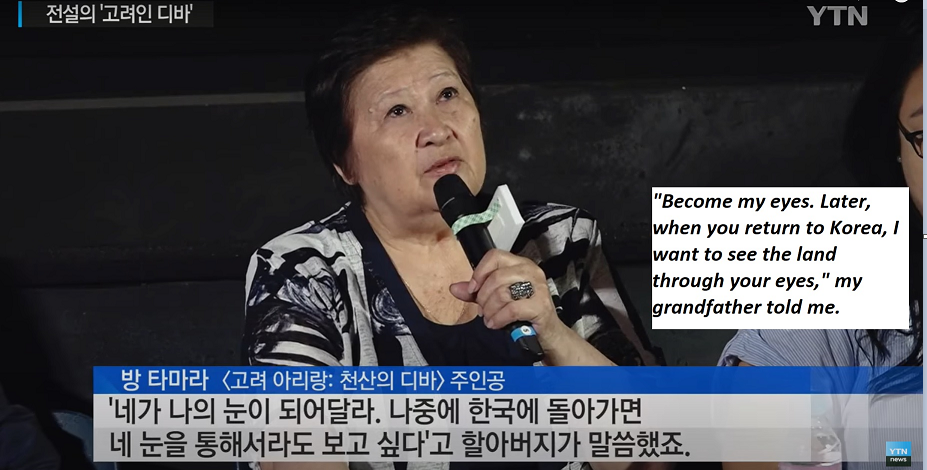
The Koryo saram today are constantly connected to the concept of “Korea”, a place and a name that have undergone considerable changes throughout the past two centuries alone. Furthermore, no place on the Korean Peninsula has titled itself “Koryo” since 1392, when the Koryo (or, Goryeo) Kingdom fell and the kingdom of Joseon rose. Indeed, even today, neither side of the peninsula uses the term “Koryo” in reference to themselves. North Korea refers to itself as Joseon or, officially – Joseon Minjujueui Inmin Konghwaguk (조선민주주의인민공화국) “The Democratic People’s Republic of Korea”. South Koreans refer to themselves as Hangukin or Hanguk saram, with the official name of the country being Daehan Minguk (대한민국) “Republic of Korea”. The languages of both sides – which are largely mutually intelligible – have many names: Munhwa-eo “cultured language” (NK), Joseon-eo “Joseon language” (NK), Hanguk-eo “Korean language” (SK), Hangukmar “Korean speech” (SK), and many others.
Looking purely at terminology, the Koryo saram stand out within the discursive space of “Koreanness”, and so does their language, Koryo mar. Certainly, from the South Korean side, this distinction is often maintained. Koryo saram are very often referred to as Koryo-in and less frequently as “Central Asian Koreans”.
A question I have not been able to directly answer is the following: How has the bifurcation of the Korean Peninsula affected Koryo saram understanding of “homeland”? Certainly, this question is still being addressed on the peninsula itself.
The case of the Koryo saram is unique, however, because up until the late 1980s, North Korean media was constituted the majority of media they received from “home”. The situation is now completely reversed.
A small exchange from the same code-switching men from above shows how Koryo saram themselves may perceive/not perceive what “Korea” is:

PII: Yes, Anna, on the 26th of this month, went to Koryo for some training for three months.
KMP: Hanguk [South Korea].
PII: Yuzhnaya Koreya [South Korea] is Hanguk [South Korea], yes.
For this three, three months, of training, she’ll go there and learn dancing and such.
Between the two speakers, three names for a place on the Korean peninsula are invoked. The first is the name “Koryo”, which speaker KMP quickly corrects. Here, “Koryo” is not to be equated with “Hanguk” (Korean for “South Korea”). However, “Yuzhnaya Korea” (Russian for “South Korea”) is to be perceived as “Hanguk”. I truly wonder what place “Koryo” refers to in speaker PII’s mind.
The “Kyopo” (F4) Visa
South Korea
Source: Yonhap News
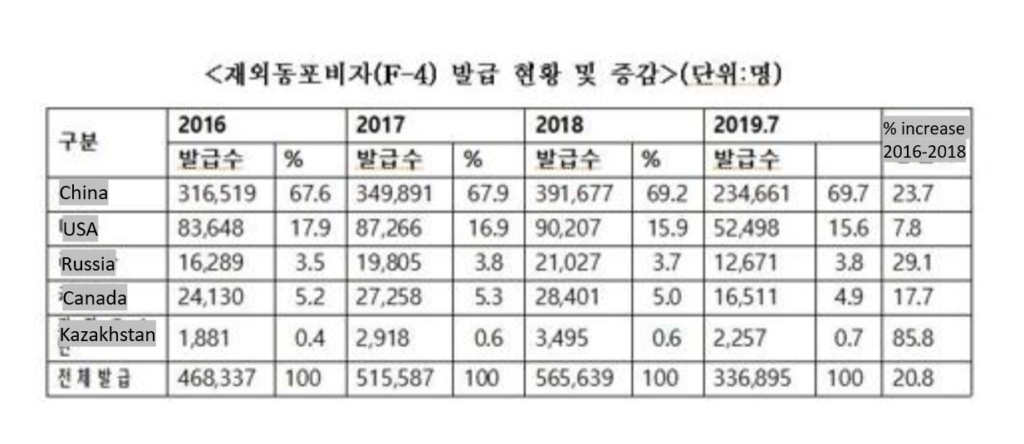
South Korea has a special visa reserved for “overseas” (kyopo) Koreans who do not hold citizenship, but who have a parent or grandparent who did. F-4 visa holders do not need a work contract prior to visa application and, upon receipt of the visa, can stay in Korea for up to three years with opportunities to renew the visa. This visa scheme clearly sees value in incorporating non-citizen co-ethnics into the greater “Korean” fold.
The chart above shows the countries of recent F-4 visa recipients. Many of these proportions are unsurprising, with ethnic Koreans in China comprising nearly 70% of all new visas across all of the years in question. The rightmost column has the most interesting information, however. It reports that, from 2016-2018, the number of F-4 visas issued to ethnic Koreans in Kazakhstan (many of whom are likely Koryo saram) has increased by about 86%. Looking at the raw numbers, the increase is only about 1600 more individuals. Proportionally, this is an increase that dwarfs that of any other group.
A Korea for Everyone
There is another avenue along which Korean culture reaches out to its diasporic communities, the likes of which I am sure the Korean government could not have seen coming. Recent years have seen enormous growth in Korean language learning among the Koryo saram, growth that also mirrors the explosion of Korean language learning throughout the world. The force behind this trend is none other than the Hallyu Wave, a multi-billion dollar industry out of South Korea that generates seemingly unstoppable currents of musical content, TV shows, films, food, beauty products and so much more.

Source
Yes, I have been waiting to include a picture of them since the beginning
Koh and Baek (2020) examine at the connection between K-pop and Kazakhstani Koryo saram identity. In a series of interviews with girls aged 14-22 (they regret that they could not find any male participants), the researchers asked questions about their relationship to K-pop and Korean culture. Many of the girls relayed stories of not liking their Korean identity when they were younger, but now that K-pop and its culture has reached Kazakhstan, they have come to view Korea in a more positive light.
Still, Koh and Baek insist that “Members of the younger generations of the Soviet Korean diaspora appreciate both national and global contexts through K-pop,” and that “Korean-Kazakh listeners are not vastly different from the general audience of K-pop in this sense” (18-19). Indeed, K-pop wields an uncanny global appeal and in this way, can relate personally to Koh and Baek’s findings.
Concluding Remarks
I have tried to avoid too many judgment statements throughout my blog posts, but I feel I can say it loudly now: I am completely in awe of the Koryo saram. Their story is one of survival and success. This success is not measured in terms of some kind of “smooth assimilation” or “model minority/nationality” status. Instead, I feel it is representative of their ability to thrive when they were never meant to.
In my opinion, speaking Koryo mar or other Korean varieties is not what makes an individual a Koryo saram. Though the disappearance of any language variety is something I personally mourn, I view it as a natural consequence of major societal trauma. I am overjoyed to see the Korean language re-entering Koryo saram society. Still, with their language shift to Russian, it is not as though the Koryo saram lost their voices; they crafted new ones.
I have so much more to say about the Koryo saram. I feel like, with every blog post, I’ve spent more time figuring out what to pick and what to cut out than I have actually researching or writing. My work has approached the Koryo saram almost exclusively from an angle of “Korean-ness”. I hope to expand this approach in the future.
Bibliography
Cornwell, Sarah E. “Language Classification in The Ethnologue and Its Consequences.” Proceedings of the Annual Conference of CAIS / Actes Du Congrès Annuel de l’ACSI, July 18, 2019. https://doi.org/10.29173/cais1104.
Koh, Ho Youn, and Kyungmin Baek. “The Korean Diasporic Identity in the Context of K-Pop Consumption: The Case of Young Female Diaspora Members in Kazakhstan.” Journal of Asian Sociology 49, no. 1 (2020): 1–28. NetCommons.
柳田 賢二 [Yanagita Kenji], “タシケント郊外旧コルホーズ「ポリトオッジェル」在住高麗人2世の朝鮮語・ロシア語混用コードについて.” 東北アジア研究, no. 9 (March 28, 2005): 111–42.