[Note to readers: This post is by Xin Li, who asked me to post it for him due to internet issues. Any mistakes in posting are mine, with apologies. Dr. Kamp]
In my final blog, I will discuss BRI, the role of Chinese nationalism, and Chinese migrant workers through the reflection of a conversation I had with Mr. L, who prefers not to disclose his name, position, or company. Mr. L has extensive experience in international marketing of Chinese petroleum products and has directly involved in BRI projects. He heard about the paper I’m writing, and was kind to accept my suggestion to have a conversation about his experience working with BRI projects overseas.
To many Chinese people, state-owned companies are mysterious, even though they are everywhere. Older generations believe having a job at a state-owned company is the same as having a lifetime stable career. To millennials like me, state-owned companies are for old people and unmotivated young people, unless they work for a state-owned bank. Then that might be a different story. Mr. L has been working in the petroleum industry for over four decades and has seen the drastic changes that have happened in the industry, business practices, and international markets.
Mr. L’s first trip abroad was more than ten years ago to Central Africa. It was an eye-opening experience for him. Upon his arrival, he was escorted by two local security guards to his residence. It was heavily guarded because of the civil unrests and constant civil wars ongoing in the country and neighboring countries. He had to call security wherever he went, and security guards usually carried guns with them. China doesn’t allow owning a gun, so it was a new experience for him. Interestingly, being surrounded with guards with guns made him feel safer. This experience is critical to mention because over the past decade and more, Mr. L and his team have accumulated so much experience working abroad. Hence, several years ago, when they got a project through BRI in Kazakhstan, it was no new experience. According to Mr. L:
“It was easier to cope with governmental relationship and finances for sure. BRI projects have more financing channels and foreign governments are more likely to participate. You know, the BRI announcement was made in Kazakhstan, so the country already had a certain level of openness to the projects.”
From my previous blog, due to the numerous channels and interests from domestic and international financial institutions, BRI projects are easier to acquire finances, which usually put these projects at a head start. However, problems also prevail, such as the Hambantota Port in Sri Lanka. Regardless of Chinese government’s intention to seek financial returns on BRI projects, there are plenty of other practical problems to analyze as BRI projects go abroad. In the following sections, I will discuss Chinese overseas workers conditions and the background of BRI in the context of Chinese nationalism.
Chinese Workers Conditions
Coming back to Mr. L’s experience, he mentioned a change in Chinese workers in overseas projects over the past decade or so. On his first trip, the crew was 80% Chinese workers and 20% workers from hosting countries. Mr. L’s company brought workers, chefs, engineers, lawyers, and governmental affairs specialists to build the project in Central Africa. In his recent project in Kazakhstan and other BRI projects, Mr. L said,
“We run into a lot of problems with Sinophobia. In the past, people were welcoming to Chinese workers and companies. In recent years, they have become more suspicious of our goals and actions when we show up. For example, I used to be able to sign a contract with another government and have more than 70% Chinese workers on a project. Nowadays, I’m lucky if I can get 50% Chinese workers. The hosting countries are definitely also taking the opportunities to put their people into work.”
It is reasonable for hosting countries to want to create more opportunities for their workers. However, Mr. L mentioned the difficulties from the management perspectives from China:
“We absolutely understand that, but we don’t have enough people who speak a common language and can provide training. Languages skills take time to gain and soft skills such as communication even take longer. However, it will be very beneficial to China and the world once we are past these hurdles and gain a better understanding of each other.”
Besides lack of managers with language and culture skills, there is also a problem at home. China started to have a discussion about the protection of Chinese overseas migrant workers under the BRI framework. Over the past years, Chinese government has realized the current legal protection of overseas migrant workers is insufficient and have a lot of room of improvement. According to Yuhe Yang (2020), there are two major problems in the current Chinese legal system. First, although the Constitution “respects and protect human rights” and it is usually used as the legal basis for protection of overseas workers, there is a lack of rules, regulations, and clear steps of implementation. Second, the current legal framework pertains to businesses as legal entities, and does not clearly provide guidance on the protection of individual workers overseas. [1]
Chinese migrant workers conditions reflect a problematic concern: is China really ready to take on such an initiative? After all, many BRI projects turned out to be unsuccessful, and participating countries are facing a massive number of debts. The Khorgos Gateway in Kazakhstan, one of the BRI featured projects, has failed to deliver the results. Although Kazakhstan government put every effort to make it work, it ended up being sold to a co-ownership model with a Chinese state-owned company. In another case, Pakistan faces similar problems, especially in building China-Pakistan Economic Corridor. The country is turning to China for more loans to boost its economy.
What is making China decide to take on this massive initiative? I looked at multiple sources and government propaganda. The words “nationalism” and “rejuvenation” constantly showed up. In the next section, I will focus on the big picture and discuss Chinese nationalism, its education agenda, and its relationship to BRI.
Chinese Nationalism, Culture Exportation, and BRI
The definition of Chinese nationalism education is complicated, as it varies from generation to generation, and from leader to leader. However, the gist never changed: China needs to rejuvenate and gain back its lost glory during Dynasty China. When asked about the reason behind starting BRI, Mr. L shared his understanding:
“On a grand level, China has been wanting to regain its past glory for decades. We have been the victim of western invasions for such a long time and these wars set back our progress in the past. It also opened our eyes to the world because China was not a very open country in history, other than through trade. The Silk Road in history was a success, hence it makes sense for this government to consider doing something similar. China is also not happy with America’s dominance in the current world order. Western values are very different from our values, so it’s not easy to always follow what America thinks. Looking at this trade war started by Donald Trump, it alarmed us as businesses that we need to do better. It must have alarmed the government as well. That’s why there are many more projects being pushed forward through BRI by the Chinese government.”
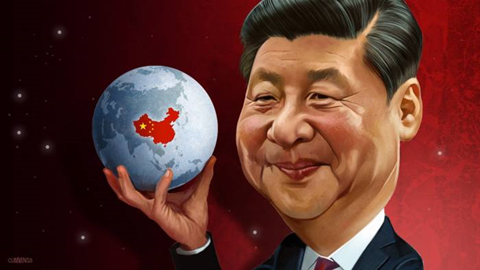
Merriam-Webster defines nationalism as “loyalty and devotion to a nation”. Yet a search of “nationalism” in Chinese yields numerous pages of interpretations of Chinese nationalism under Xi Jinping. In an analysis by Nannan Feng (2020) at the School of Marxism in Beijing Normal University, Feng provided detailed interpretations of the doctrines of nationalism education in the new era. While it is not always clear what “the new era” means, it is generally believed to be under a new leadership. Under Xi, nationalism education follows the doctrine and theory of “four integrations”: the integration of theories and practices, the integration of ethnicities and globalization, the integration of historical moments and modern times, and the integration of all people and all processes. [2]
(Photo credit: Financial Times)
In case you are as confused as I was when I first heard the concept, Feng (2020) provided a sophisticated explanation of what these integrations mean, especially on the fourth one. “The integration of all people and all processes” mean that people of all ages should participate in nationalism education, and “all processes” mean different education levels and work places. The idea is that, during the same year, even though nationalism education is provided to 100% of the Chinese people, there will be people who enter the school system or workforces the following year. Hence, the government wants to make sure that “all processes” are included every year, so that people can have the same amount of nationalism education.
(Cartoon showing Young Pioneers elementary students salute to the Chinese flag)
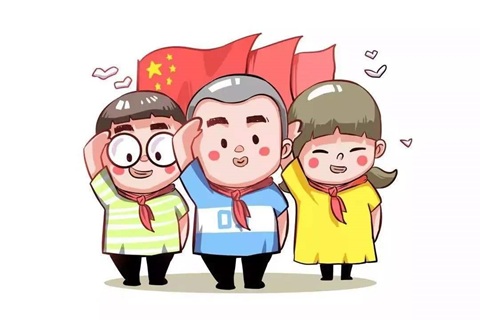
In terms of the content of Chinese nationalism education, it’s important to point out that the line is blurry between “loving the nation” and “loving the party”. The nationalism education intentionally identifies the Communist Party and China as the same entity, hence to love the country means to love the Party, which means to love the government. From a young age, students strive to become a Young Pioneer member and then to join the Youth League. Being able to join the Communist Party in high school is considered a great honor and is extremely rare.
(Cartoon showing Young Pioneers elementary students salute to the Chinese flag
A common way to educate the mass on nationalism is to remind them of historical events on social media. Every once in a while, propaganda from the Party would focus on remembering the times when China was a victim of western invasions. The content of such propaganda is also self-reflective, such as pointing out that the reason of being invaded was because of a lack of technological progress and not being assertive enough. Therefore, a large portion of nationalism education is to highlight and praise all the achievement China has accomplished in the past decades under the leadership of the CCP.
To this end, you can see that nationalism is instilled into each Chinese person. With a blurring line between the nation and the party, many people support efforts such as BRI without a question asked. Recalling my previous blog, there is a pillar of BRI being “people-to-people connection” and BRI has drawn many international students to come to China to learn Chinese. Although their achievements are not frequently celebrated, the exportation of soft power is slowly being seen through BRI. Chinese nationalism is a catalyst for the Chinese government to invest abroad and expand its influence, because China has been the “victim of Western suppression” for many years. Based on the logic of Chinese nationalism, since China has developed its economy to become the second largest in the world, it should have its place in the world and be supportive of developing countries. This is an argument heard over and over in public speeches from the Chinese government.
The paradox is that preserving and “exporting” one country’s identity and culture counters the efforts to do business overseas. Host countries want to preserve their cultures and do not want Chinese companies to come in and take away their culture and identity. Kazakhstan had multiple anti-China protests in the past few years, yet Kazakhstan is one of the most important partners of China in BRI. These sentiments against Chinese are barely mentioned in Chinese media or scholar articles. However, Chinese government is not unaware of these problems. Hanxun Gao (2020) discussed in her article about the new framework to co-build the future with Central Asian countries. Gao pointed out the current problems of the Chinese government, especially a lack of understanding of hosting countries’ cultures. This new framework was being debated among scholars from China and Central Asian countries. Gao stated although the scholars came from different educational background and held a variety of ideologies and approaches, the agreement was that BRI projects should benefit hosting countries, instead of Chinese companies. [3] This is a critical development and pivot in BRI projects and can be a turning point as to BRI’s success in the future. If the Chinese government has sincerely adopted this new framework and will be building projects in the interest of hosting countries, will there be less “exportation” of Chinese culture? It is difficult to have an answer given the current status quo.
Ending
There are so many aspects that can be studied about BRI. Given the restriction of my sources, I was not able to find much criticism of BRI, although I know there is plenty constructive criticism offered in non-Chinese sources. I hope this blog provided you with an authentic Chinese perspective on BRI, and gives you some understanding of Chinese nationalism being the basis for Chinese government’s confidence in going all out in foreign investments. It is yet to see the future and development of BRI, but if Chinese government does not solve the paradox of “exporting” its culture and adaptation into hosting countries’ culture, there could potentially be dangerous consequences and results. Money can only serve your purpose to a certain length. Being honest and sincere is the key to doing businesses in the long term.
References:
[1] Yuhe Yang. (2020). 一带一路倡议下我国海外务工人员法律保护现状研究 “Research on Current Legal Protections of China’s Overseas Workers under Belt and Roald Initiative”. 法制与社会 Law and Society.
[2] Nannan Feng. (2020). 新时代爱国主义教育 “四个统一”理论蕴含 “In-depth Explanations of the Four Integration Theory in Nationalism Education in the New Era”. 学校党建与思想教育 Party Leadership and Ethics Education.
[3] Hanxun Gao. (2020). 中亚国家高质量共建一带一路的认知与思考 “Recognition and Reflection on Building Belt and Road Initiative of High Quality with Central Asian Countries”. 北方谕丛 The Northern Forum.