Introduction
How is a Tajik woman portrayed in the story of Tajikistan and Central Asia in general? How much this notion of lack of geopolitical interest in the country and zero economic resources is creating a vacuum around the Tajik woman? How invisible are they? What does it take to bring the voice of women and children to the forefront of research, interest, and study? Throughout this course I put a lot of thought into finding a way to capture the story of Tajik women, their livelihood and the impact of a global phenomenon such as the labor migration on their status abroad and at home. My desire is to contribute (someday!) to an ethnographic research and document the lives of mountainous, resilient, Tajik women. I have to admit that this very blog post is nowhere near the quality I would like for it to be but it does capture the data I have looked at which support the theories of labor migration discussed in De Haas, the challenges faced by women throughout history and across the world who are either forced or choose to leave their homes. I am also hoping to draw on research done in Tajikistan to present data on gender dynamics in the country.
Tajikistan’s Gender Inequality Rating
Before going into labor migration, I wanted to understand how gender inequality is looked at in Tajikistan and who are the key players in looking at improving the quality of lives of women and children in the country. In 2016 in collaboration with Ministry of Labor and Social Protection of Tajikistan, other NGOs focusing on gender dynamics in the country, Asia Development Bank (ADB) produced a report on Country Gender Rating in Tajikistan. According to this report, in 2014, Tajikistan takes 102nd place out of 142 countries rated by the Global Index of Gender Inequality as part of the Worldwide Economic Forum.
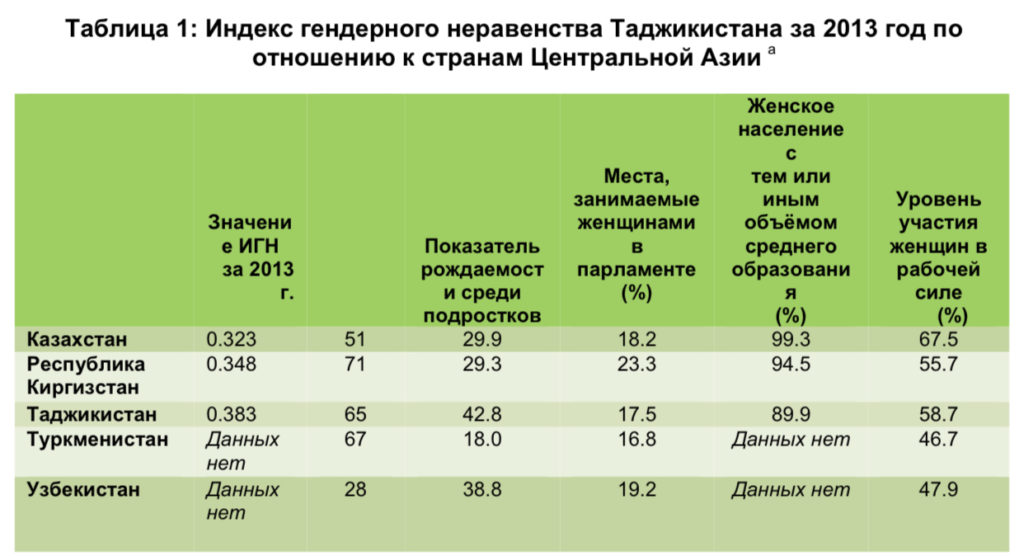
This report is very comprehensive and touches on legal and social protection of women in the country and describes the structure of the government dealing with gender questions in the country. In 2015 it was reported that only 19% of women held positions in both higher and lower parliamentary chambers, 40% of all local-municipal chairs were elected women throughout the country. Women disproportionately represent health (58.7%) and teaching (53.7%) occupations which are low paying sectors. In 2013 woman’s pay is reported as only 63.3% of man’s pay but is reported to be improving in the past decade or so. Gender discrimination is observed throughout the informal employment sectors throughout the country because just as it is mentioned by De Haas, women in Tajikistan are not seen unfortunately, as the “breadwinners” of the household. ADB reports that around 36% of households include multi-generational members where the gender roles around that country are strictly patriarchal with top to bottom decision making and 34% of women reported that they have zero decision making power in the homes of their husbands. 90.9% of women reports abuse from within the family with minor wives being prone to the most abuse. This report touches on many human rights violations in the country concerning women and children. There is extreme lack of trust in the legal system as well as absence of legal and human rights education. The actual number of divorces in the country should be a lot higher than reported 1 in 14 marriages because the informal, traditional practice of “talak” a word pronounced by a man three times constitutes an “official” form of divorce and many migrant workers exercise this via phone/text that leads to their wives and children being kicked out of the house.
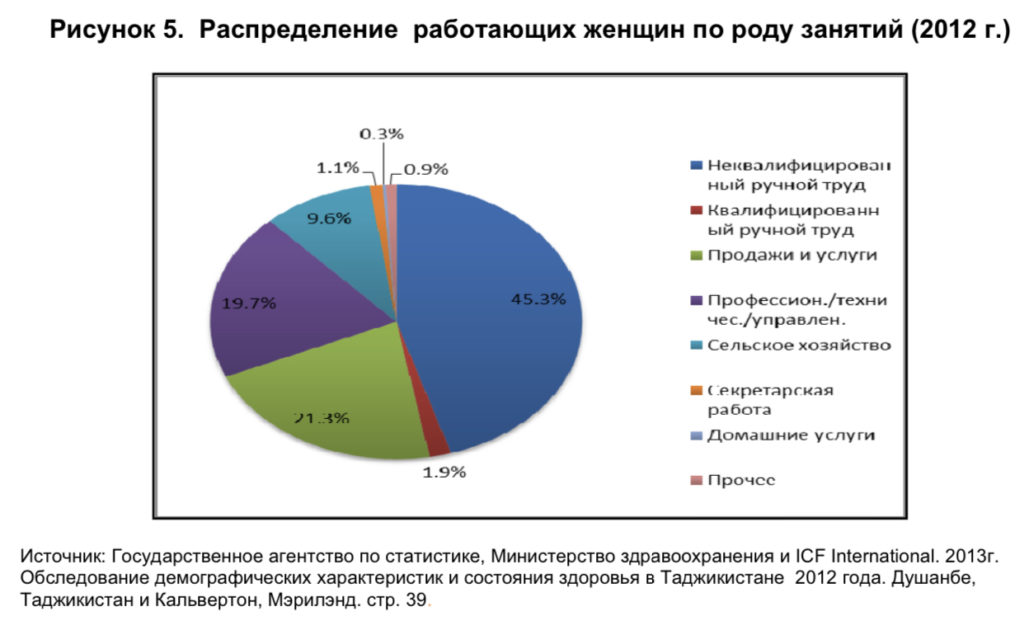
This inequality is well demonstrated by a short film called “Mardikor”, portraying four Tajik women whose husbands have either left them before migration or divorced (talak) over the phone. In the ADB reports, migration and women impacted by migration are concentrated in the rural areas of the country such as the town shown in this film called Bokhtar. These women depend on construction, handyman work on daily basis and around 100 women will gather in the Bokhtar bazaar in the mornings in hopes of landing a job for the day, those who are successful will make around $2.9 for the day to feed themselves and their children. These four women are the head of their households but are hurt by the society’s inability to see them as one and accommodate their needs. You can see in the diagram below that the largest portion of the pi chart includes non-qualified handy-work taken by women in 2012 (45.3%) a direct support of the story of these four women.
Tajikistan’s Labor Migration
As we learned in this course throughout the readings and lectures that migration does not just happen one way, it is an ongoing process with factors based on each individual story, some are forced to leave the country, some choose to go, and others are simply joining family by circumstance. In this month of December, ADB came out with an assessment and recommendations for Tajikistan on Strengthening Support for Labor Migration. They are breaking down the analyses and recommendations based on stages involved in labor migration such as, pre-departure, post-arrival, and return.
ADB states that in 2019, Tajikistan received $2.7 billion in remittance, equivalent to 33.4% of gross domestic product (GDP.) Reflecting on De Haas’s theory of push and pull factor, this report supports the idea by stating that the “Tajik economy is not creating enough jobs for its rapidly growing labor force. Every year about half a million Tajiks leave the country for overseas employment, the majority of them male (85.5% in 2019) and short-term seasonal migrants (75%)” with Russia being the most popular destination. These numbers are a strong indication of the fact that the country will continue to rely on migration.
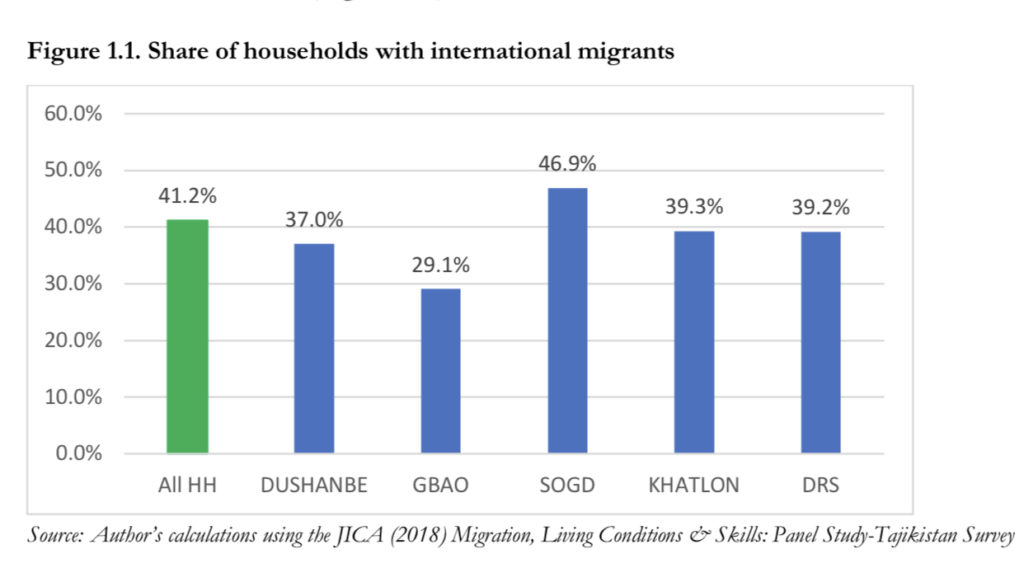
ADB along with Tajik government is taking steps in helping make migration more beneficial for migrants and their families while ensuring their social protection. The report basis their recommendations on the migration procedures in Bangladesh, Indonesia, Nepal, and other ASEAN countries but has gone through an intensive analysis of the demographics of who Tajik migrant are and what are their needs based on interviews of 189 men. (table 2.3.)
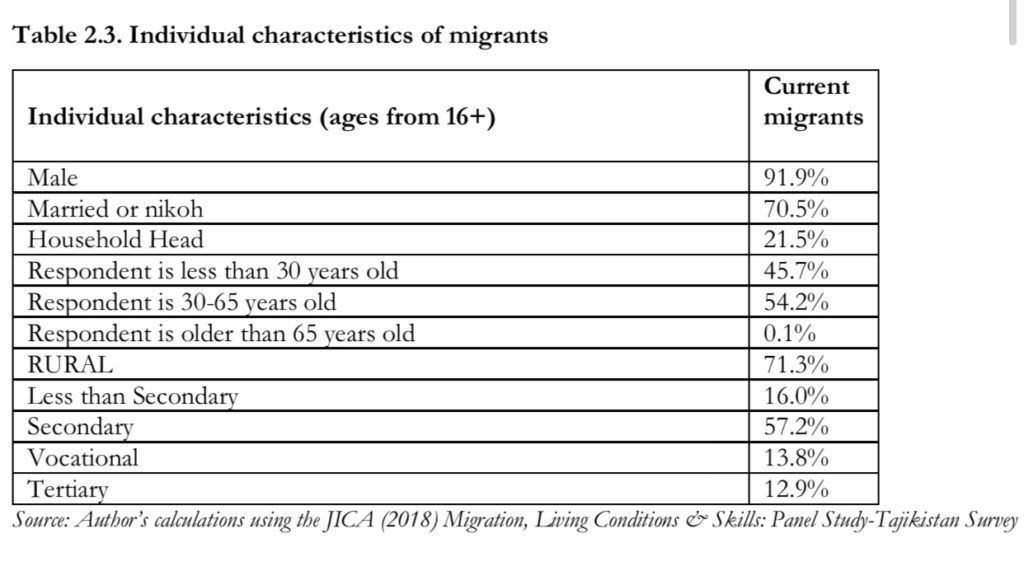
I find it curious that there are no women interviewees in this study as the social protection component includes the well-being of the migrant families. Nonetheless, it reports that in the last 5 years, only 12%-16% of women were part of the international migration numbers provided by TajStat, the Tajik government Statistics department with women’s participation in the labor force reported at 33%. The report indicates a gradual rise in the female migration at 77, 013 women in 2019, which is 24% more than in 2018. The report finds that migration agencies and government support of migrants at all stages is very weak and requires trained, quality human resources to provide services to migrants and their families.
These services as ADB describes are systems developed by NGOs in partnership with the governments to ensure the needs of migrants are met and the flow of migration is managed in the origin country so that migrants are not blindly arriving to destination countries without proper documentation, training and necessary contact information. For example, ADB recognizes that Tajikistan should take full advantage of digitization to support migrant workers by the use of cell phones: 6.9 million of the total population of 9.1 million are mobile users and the find that only 2.95 million are internet users, this is very low compare to 44% of the population of Asia and the Pacific.
Since both reports were established by ADB, I am hopeful that the focus on labor migration and social protection of migrants will result in better support for women and their children.
Modernization and Traditionalism in Tajikistan that feeds inequality
Sergey Abashin an ethnographer based in Russia produces one of the most in-depth analyses of a small village in Tajikistan known as Oshoba in the Ferghana Valley populated by ethnic Uzbeks. This particular work is a testimony of the authors transformation as a researcher himself but also a documented shift in the lives of the villagers who have gone through enormous and rapid change from pre-soviet to during soviet and now post-soviet settings.
What this work demonstrates the most for those of us trying to understand the region or the countries in Central Asia is that the nature of research, methods of anthropological examination and ideas of ethnography during the Soviet Union were in ways restricted to reports on farming and production numbers without looking at livelihood, women, children those outside of the kolkhoz (farming organization.) It explains the lack of information on households, women and children of Central Asia during the soviet time. As Abashin realizes during his initial research for this book that it was only towards the end of and at the onset of the collapse of the union that western ideas of ethnography and anthropology became known or disputed over by Russian/Soviet researchers and writers which shatters his confidence in undertaking the writing of the book to begin with; he chooses to take the time (10 years) to understand these new ideas better and produce material hoping with this new approach. Given the political shift in the region, his idea for the book must reflect that as well but also now includes a little bit more detail on post-soviet life in Oshoba.
He finds that this small village undergoes transformation into modernization and traditionalism simultaneously because he argues that the definition of modern based on Anglo-European definition isn’t complex enough and that it is possible for these societies to continuously conserve traditions, go away from some traditions and turn back to others based on political, economic and religious shifts. In this table below, ADB indicates that in 2007 there was not much difference in poverty level based on gender but there is definitely a higher risk of ultra poverty for households headed by female.
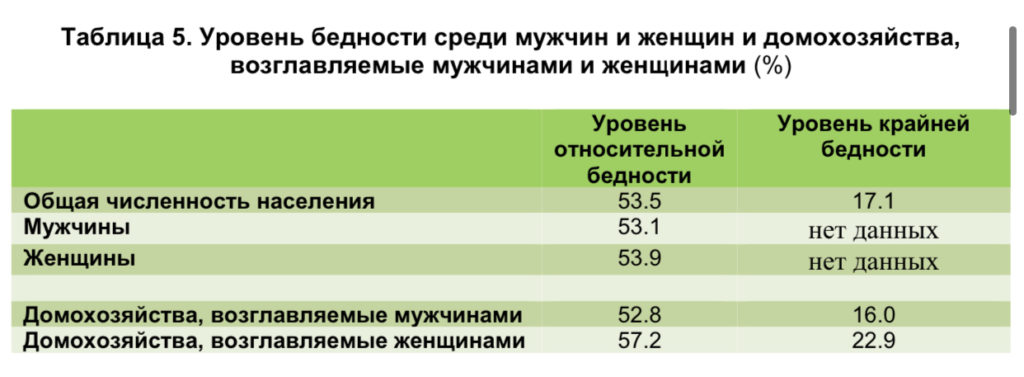
In the case of the Tajik/Uzbek woman as mentioned in the book, Soviet Union’s unfinished project of modernization concerning female empowerment events such as the civil unrest, economic crises have transformed the woman’s status in the village with the society finding itself unprepared to deal with these changes such as a female being the head of the household, a man divorcing his wife using a phone and/or women choosing to become the breadwinners of the families and travel overseas for employment.
References:
- Aziatskiy Bank Razvitia, 2016, Stranovaia gendernaia ocenka po Tadzhikistanu, Filipini
- Asia Development Bank, 2020, Strengthening Support for Labor Migration in Tajikistan, Assessment and Recommendations, Philippines
- Mardikor, “Мардикор” 2020, Short film on the lives of 4 working Tajik women, Tajikistan
- De Haas, et. al, 2020, The Age of Migration, The Guilford Press, USA
- Abashin, S, 2015, Sovetskiy Kishlak, Mezhdu kolonializmom i modernizatsiei. Novoe literaturnoe obozrenia, Moskva.
- All images, graphs, and tables are from the two above referenced Asia Development Bank reports.