Throughout my blog posts this semester, I have attempted to explore the relationships between historical migration events, the folk narratives remembering those events, and how these narratives are exploited by modern states to build nationalist mythologies. I have compared nation building through the use of mythic histories in Turkey and Kyrgyzstan. This theme is particularly interesting in the case of Kazakhstan, where the issue of national identity has been the focus of the post-independence government.
Introduction
For my final post this semester, I will be examining a particularly interesting use of a Kazakh “folk song,” which supposedly remembers a period of forced exile in Kazakh history, in the building of modern Kazakh nationalist history and identity. The “Barefooted Flight” [Kazakh “Aqtaban Şubırındı”] is a cornerstone of Kazakh cultural history. It was a period of several years in the 1720s during which the Dzungar (Jungar, Zungar) Khanate, potentially aided by Kalmyks, slaughtered two-thirds of the Kazakh population and forced them to flee northwards. Because these events led to the strengthening of Kazakh-Russian relations, Russian historians cited these Kazakh-Dzungar conflicts as the source of Kazakh ethnogenesis, and idea which has persisted through the Soviet era to native Kazakh histories in the present day. However, the actual historical records which relate to the Barefooted Flight paint a much more complicated picture than is presented in popular Kazakh histories. The contents of this blog post were largely informed by Michael Hancock Parmer’s 2017 Ph.D. dissertation for the Indiana University Department of Central Eurasian Studies, “Running Until Our Feet Turn White: The Barefooted Flight and Kazakh National History.”1
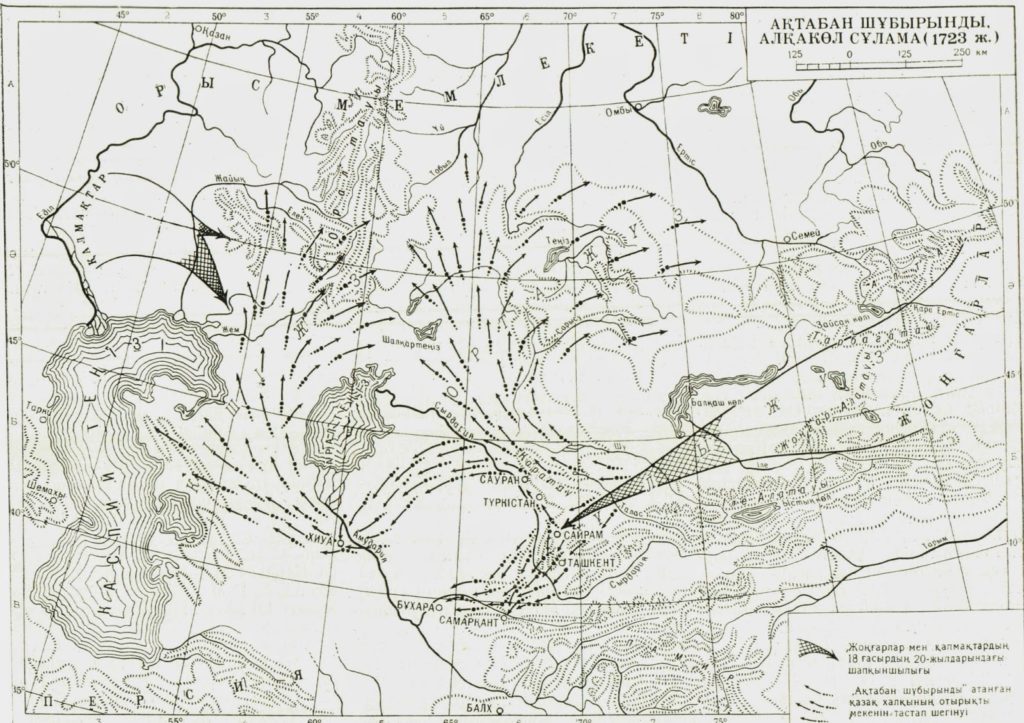
Accessed from https://hancockparmer.com/research/2
Beyond historical scholarship, the Barefooted Flight also plays a major role in Kazakh popular cultural memory. Kazakhstan’s most famous historical leaders and heroes (Biys and Batirs) arose from the tribulations of the 1720s. These characters and the events surrounding them continue to inspire Kazakh pop culture including children’s cartoons, famous novels, and folk songs. The accepted facts of the Barefooted Flight are taught nearly identically from the standardized primary school curriculum to university-level history textbooks. Like any nationalist historical narrative simplified for public consumption, there are clear “good guys” and “bad guys.” Just like students in the U.S. are taught that the scrappy colonial heroes kicked out the oppressive British royalists, children in Kazakhstan are taught that their ancestors barely escaped the brutal Dzungars and fled north before returning victoriously to their homeland.
In previous posts, I have examined historical migration events that are largely overlooked in Western literature, such as the 1916 Central Asian Revolt and Russo-Manchu border negotiations. As such, I felt it appropriate to focus my blog posts on providing historical context so that readers could better understand the circumstances in which the migrations occurred. I believe that a combination of this context along with the examination of related folk narratives helps us to better understand the lived experiences of the people who suffered these events. However, I will be taking a different approach for the analysis of the Barefooted Flight, Elim-ay, and Kazakh nation-building through migration. The available sources regarding the Dzungar-Kazakh conflicts of the 1720s are scant and leave much room for interpretation. Instead, I believe that the analysis of the how this history is taught and presented in folk and popular culture is provides much more meaningful insight into modern Kazakh cultural memory than an in-depth historical study of the Barefooted Flight itself.3
Popular Culture and Education
Of the presentations of the Barefooted Flight in Kazakh popular culture, the animated short film “Ottan jaralğandar” [“Created from Fire”] provides a simple but profound insight into how Kazakh children are exposed to the Dzungar-Kazakh conflicts. It was posted to YouTube by user Айзада нурай in 2012 under the title “Kokbalak,” and has since been viewed just over 151,000 times.4 The film begins with the funeral of the Kökbalaq [“Blue-leg”], the protagonist Alıbay Khan’s horse and companion. The majority of the film depicts Alıbay’s role in the Dzungar-Kazakh conflicts. His father and the rest of his tribe are slaughtered by the Dzungars, who go on to wreak havoc throughout Kazakh territory. The film culminates with a massive battle between the Kazakhs under a white flag and their enemies under a black banner, during which Alıbay duels and kills the Dzungar leader who killed his father, reclaims his father’s sword from his fallen opponent, and leads the Kazakhs forces to victory.
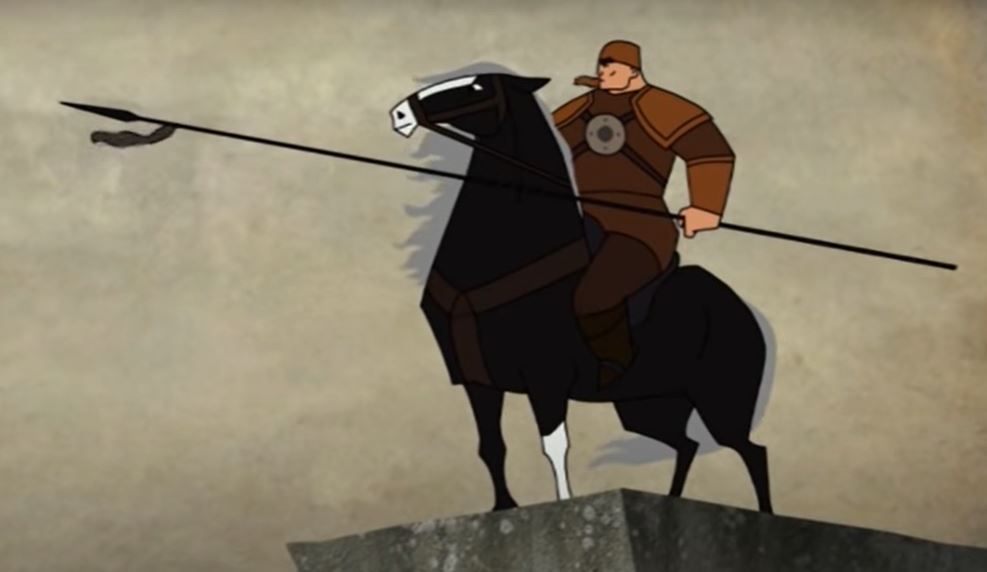
The film is presented with a simplicity reminiscent of fairy-tales, and its target audience is almost certainly young children. The story is simple: the evil Dzungars are brutally conquering the Kazakh homeland, and the heroes Alıbay and Kökbalaq must stop them. Unlike some fairy-tale inspired children’s cartoons, there is no apparent moral or lesson. Despite this, it is still etiological: it introduces children to a simplified, moralized version of Kazakh history.
The Dzungars are regularly dehumanized throughout the film. They are presented as having gray skin, jagged teeth, cruel weapons, and proportions more monstrous than human. In fact, their style is reminiscent of the antagonist Huns from Disney’s animated 1998 film Mulan. The running cosmological framework of the film is the three-star motif, which the opening shot of the film explains represent the man [adam], the horse, [jılqı], and the wolf [qasqır].
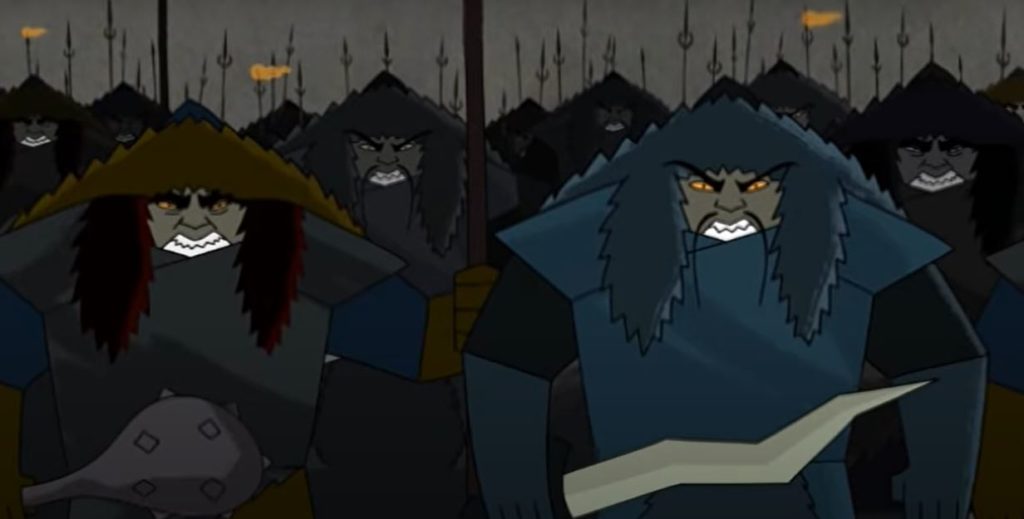
The film clearly uses this theme to imply the idea that the man, represented by Alıbay, and the horse, represented by Kökbalaq, must defeat the wolf, depicted both as an actual wolf and the leader of the Dzungars. The young Alıbay first rescues the foal Kökbalaq from a wolf whose pack slaghtered his herd, while the Dzungar leader is simultaneously killing Alıbay’s father. The young Alıbay kills the wolf with a spear, and Alıbay Khan later mirrors this action by killing the Dzungar leader with a spear.
Interestingly, the film closes with an aged Alıbay completing a battle-scarred Kökbalaq’s funeral by lighting his pyre, stating that “We were all created from the fiery body of Tengri and all of us will return to fire.”5 This notably non-Islamic sentiment emphasizes the ethnic nationalist tone of the film, focused on purely ethnic Kazakh-ness rather than the struggle of Muslim Kazakhs against infidel (Buddhist) Dzungars.
The simple good-versus-evil narrative version of history seen in this cartoon is continually reinforced by Kazakhstan’s standardized history curriculum. While students are taught the rudimentary ideas about the Barefooted flight in primary school, they do not truly study it until secondary school. Students are required to learn Kazakh history beginning in fifth grade, the first year of lower secondary school, and it is taught every consecutive year until the final year of higher secondary school, eleventh grade.6
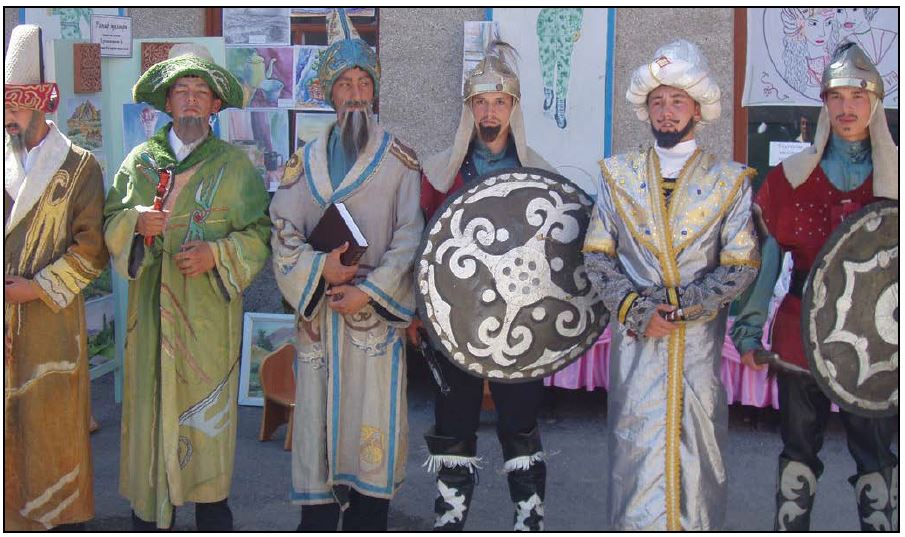
Generally, Kazakh students are taught that following the Kangxi Emperor’s death and the resulting weakness of the Qing Empire, the Dzungar Khanate took the opportunity to expand west into “Kazakhstan” (see my previous post for more on the Kangxi Emperor’s relationship with the Dzungar Khanate). While poor leadership and overwhelming odds resulted in the exile known as the Barefooted Flight and the deaths of two thirds of the Kazakh population, leaders like Alıbay Khan led the survivors and prevented their extermination. Despite the efforts of these heroes, the Barefooted Flight eventually resulted in Kazakhstan’s annexation by the Russian Empire.7
While the complexities of the historical events surrounding the Barefooted Flight far exceed the scope of this post, suffice it to say that Kazakh students are presented with very biased interpretations of the sources. Perhaps the most notable pitfall of these lessons is the anachronistic presentation of modern borders existing essentially unchanged since the distant past. In most textbooks, the so-called Kazakh “homeland” is depicted as slightly exceeding Kazakhstan’s modern borders.8 The perpetuation of this idea is very likely an intentional by the Kazakh state, as will be seen in the discussion of modern Kazakh migrations and diaspora below.
Elim-ay and Shifting Memory
It is not just children and students who are exposed to this particularly nationalistic version of Kazakh history. In modern Kazakh culture, the popular folk song “Elim-ay” is most commonly associated with the Barefooted Flight thanks to its prevalence in historical documentaries. The title of this song is best translated into English as “Oh, my people,” although the word “el” has complex meanings in Kazakh depending on context, and the song appears in Russian translations as both “Oh, my motherland” and “Oh, my long-suffering people.” The song functions as a lament for both the Kazakh people and homeland, although its actual relationship with the Barefooted Flight is convoluted at best and outright fabricated at worst.9
While Kazakh history textbooks regularly cite Elim-ay as originating from the suffering brought on by the 18th century Dzungar-Kazakh conflicts, it is also used to represent other historical instances of Kazakh exile and oppression. For example, it is used in this YouTube video, which features a version of Elim-ay playing over footage from a documentary about famines caused by collectivization in the 1920s.10 Michael Hancock-Parmer’s English translation of these lyrics are as follows:
The nomads come over the Black Mountains, O! / with the travelers comes an empty camel, O! / O my people! O my people! / What kind of time is this, O! / The bird of happiness has flown from Alash, O! / O my people! O my people! / Sand and dust falls from the blue sky, O! / Worse than the coldest days of winter, O! / O my people! O my people! //11
Clearly, the lyrics of this variant of the song (as well as those of many others) are quite ambiguous when it comes to the actual historical events to which they refer. This ambiguity is only heightened by the strange historiography surrounding the song. Early 20th century scholarship concerning this song presented two competing ideas. In 1927, Mukhamedzhan Tynyshpaev published an article with the song lyrics in Arabic script Kazakh and his own Russian translation. Although he gave no title, author, or provenance for the song itself, he definitively placed the its origin with the Barefooted Flight of the 1720s. The English translation from the original Kazakh is:
The nomads come over the Black Mountains / with the travelers comes a lonely camel. / It is bad to be parted from one’s family / tears dripping from black eyes. / What kind of time is this? A crushing time / a time when happiness and wealthy [sic] have flown. / The traces of our flight throws up a cloud of dust / greater than a blizzard in January. / What kind of time is? A time of chaos / will such times come again?! / Leaving one’s relatives in a dark place / causes a flood of tears to flow. //12
However, a 1911 history of Kazakhs and other Turkic peoples by Shakarim Qudaiberdiev presented a starkly different idea. Although the text of the song (again untitled) accompanied a description of the 1723 Kazakh-Dzungar war, he claimed that by the 18th century, the song was already an ancient, established part of Kazakh oral tradition. While the historical record given for the song is very different, the lyrical themes and rhyme scheme are relatively similar to the two later publications. The English translation of this text, again from the Kazakh original, reads as:
The nomads come over the Black Mountains / with the travelers comes a lonely camel. / It is hard to be parted from one’s family, / tears dripping from dark eyes. / What kind of time is this? A crushing time, / when all happiness and wealth is lost. / The traces of our flight throws up a cloud of dust, / greater than a blizzard in winter time. / What kind of time is? A time of chaos, / a time of panic and destruction. / Leaving behind one’s family and home / causes a flood of tears to flow. //13
The earliest textual record of this song (in the form of a poem) was recorded in Kazakh in Arabic script in 1875. The English translation is as follows:
The nomads came over the Black Mountains / with the travelers comes a lonely camel. / How awful to part from one’s family, / tears dripping from black eyes. // What kind of time is this? A crushing time, / when the bird of wealth has flown. / From the sky swirls white dust, / worse than the coldest day of winter. // What kind of time is this? A time of chaos, / a time of panic and destruction. / Son from father, girl from mother, / their parting tears fill a lake. // How many crushing trials you sent, God, / and how hard is the dark earth. / My soles ache when I walk on foot, / God, could you not even spare a horse? //14
While the actual text of the poem is remarkably similar to the early 20th century publications, what makes it interesting is that it also includes an actual interpretation of the phrase “Barefooted Flight.” Sultan Axmed Jäntörä, who recorded the poem, claimed that the term was generic, given to any forced migration, with the word “atqaban,” lit. “white sole” referring to the unique difficulty of this kind march as opposed to more regular nomadic movements.15 So, in reality, it seems that both the song Elim-ay and the phrase “Barefooted Flight” were very unspecific prior to Soviet-era histories. It is almost ironically fitting, then, that despite Elim-ay currently being taught as almost exclusively referring to the Barefooted Flight of the 1720s, it is popularly associated with other “Barefooted Flights” of the early to mid-20th century, including the 1916 revolt.
Identity the Oralman Project, and Final Thoughts
Having briefly examined the prevalence of past migration events, regardless of their actual historical veracity, I will now explore how the identity represented in these cultural memories impacts modern political realities in Kazakhstan. As of 1991, ethnic Kazakhs only made up 40.1% of Kazakhstan’s population, a fact which compelled President Nazarbayev to institute the so called “Oralman” project. This set of policies aimed to recruit members of the Kazakh diaspora, mainly from China and Mongolia, but also Europe and Turkey, to migrate “back” to the Kazakh “homeland.”16 While the economic and societal result of this project were mixed, the way in which it presented ideas of Kazakh ethnic and geographical identity reflect many of the themes present in modern narratives of the Barefooted Flight.
At this point, it is clear that not only nationalist histories, but also the folk narratives that support them play integral role in the development of national identities in Central Asia and beyond. Interestingly, many of these narratives share similar roots, such as 17th-18th century diplomatic relations between the Russian, Qing, and Dzungar empires leading to both the Buryat folk song Shildei Zanggi and (at least some versions of) the Kazakh folk song Elim-ay. Similarly, these narratives are often compared to each other, as demonstrated by a YouTube comment posted on the cartoon depicting the Dzungar-Kazakh conflicts.

There are still many questions that I have pertaining to these themes. What determines the popularity of these historical events and folk narratives in public memory? Are modern nationalist versions of these events and narratives intentional manipulations by government bodies, or do they arise naturally within the circumstances that nations find themselves in? How are these folk memories perpetuated (or not) in cultural groups without independent states, such as Buryats? All of these questions warrant further research. That being said, oral folk traditions, mythic histories, and modern nationalist identities are all inextricably linked and continue to evolve with their respective political and cultural landscapes.
Notes
- Michael Hancock-Parmer, “Running Until Our Feet Turn White: The Barefooted Flight and Kazakh National History” (Ph.D., United States — Indiana, Indiana University, 2017).
- Michael Hancock-Parmer, “Michael’s Research,” The Hancock-Parmers (blog), April 18, 2015, https://hancockparmer.com/research/.
- For an in-depth analysis of the history and Soviet historiography of the Barefooted Flight, see Michael Hancock-Parmer, “The Soviet Study of the Barefooted Flight of the Kazakhs,” Central Asian Survey 34, no. 3 (July 3, 2015): 281–95.
- Aday Abel’denov, “Ottan jaralğandar” [“Created from Fire”], YouTube video, August 11, 2012. https://www.youtube.com/watch?v=dwEOZHhpA_c
- Translation from Hancock-Parmer, “Running Until Our Feet Turn White,” 34.
- Hancock-Parmer, “Running Until Our Feet Turn White,” 34-9.
- Hancock-Parmer, “Running Until Our Feet Turn White,” 39-41.
- Hancock-Parmer, “Running Until Our Feet Turn White,” 42.
- Hancock-Parmer, “Running Until Our Feet Turn White,” 77.
- Zauresh, “Халық әні Елім – ай Kazakh folk song ” Elim-ai ””, YouTube video, October 20, 2014. https://www.youtube.com/watch?v=snCRREiAmA8
- Hancock-Parmer, “Running Until Our Feet Turn White,” 79.
- Hancock-Parmer, “Running Until Our Feet Turn White,” 90-2.
- Hancock-Parmer, “Running Until Our Feet Turn White,” 92-4.
- Hancock-Parmer, “Running Until Our Feet Turn White,” 94.
- Hancock-Parmer, “Running Until Our Feet Turn White,” 96.
- Alexander C. Diener, “Kazakhstan’s Kin State Diaspora: Settlement Planning and the Oralman Dilemma,” Europe-Asia Studies 57, no. 2 (March 1, 2005): 327–48.
- Акмат Тилек Уулу, Re: “Ottan jaralğandar” [“Created from Fire”], YouTube video, 2019. https://www.youtube.com/watch?v=dwEOZHhpA_c