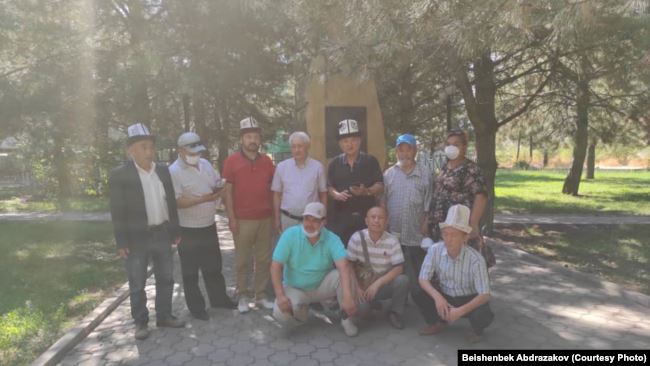
On August 7th of this year, in the midst of the COVID-19 pandemic, a group of approximately 30 people gathered in Bishkek to commemorate the 104th anniversary of the Urkun with readings from the Quran.1 Despite the dangers currently associated with public gatherings, many people in Kyrgyzstan clearly feel a strong sense of importance in remembering and honoring these historical events. Despite its importance in Kyrgyz and Central Asian historical memory, the events of the 1916 Central Asian Revolt which led to the Urkun are largely unmentioned in both popular and academic history outside of Russia and countries of the foreign Soviet Union. So what was the Urkun, and how did it establish race dynamics between Russians and Kyrgyz in the early 20th century?

The Urkun and the 1916 Central Asian Revolt
The Urkun (үркүн, ürkün), most commonly translated into English as “the Exodus,” was the mass flight of Kyrgyz people from their land into western China to escape brutal Imperial Russian military reprisals. These reprisals came as a result of attacks by Kyrgyz on Russian colonial settlements, which were themselves part of the larger context of what is now called the 1916 Revolt of Central Asia. In short, this regional upheaval was ignited by an imperial order revoking the draft exemption status enjoyed by subjects native to Russian Turkestan. In the face of the combined economic strains of the First World War and an increasing flow of Russian agricultural settlers pushing Central Asians from the most productive land, this order was enough to drive many communities across Turkestan to violently revolt against the Imperial Russian presence.3 Despite arguments of economic, nationalistic, or even religious motivations, the Urkun was ultimately an incredibly violent clash on the basis of ethnic divisions.
While these revolts led to mass violence across Turkestan, both among Russians and Central Asians, the Kyrgyz people experienced extreme suffering. Exact numbers vary (often due to political bias), but current academic estimates place Russian civilian losses at approximately 3,000. On the other hand, it is estimated that approximately 250,000 Kyrgyz people were forced to flee to China. The harsh conditions of this migration along with the brutal military reprisals led to the death of around 150,000, though some estimates place the death toll as high as 270,000.4 Regardless of the exact numbers, this unimaginable tragedy holds a major place in Kyrgyz history. However, from the early Soviet era to present day, the discussion of the Urkun in an historical context has never been without issue.
A Century of Historiographical Debate
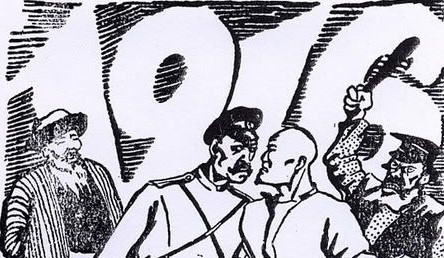
From the earliest Soviet histories until the present, the academic discussion of the Urkun has been fraught with debate. In the years immediately following both Urkun and the October Revolution, some Soviet scholars sought to prop up the revolt as an example of a pan-imperial class movement. While some viewed the violence against Russian settlers as an anti-colonial strike against the Empire, others went so far as to claim that the revolt was actually Russian and Central Asian peasants rising up against their respective economic oppressors. Russian scholars who argued that the revolt was an act of national determination did exist but were later forced to retract their ideas. As time went on, the unspoken rules surrounding the discussion of the 1916 revolts increased in severity.6 Despite the Soviet ideals of anti-racism, the residual ethnic tensions left by these clashes clearly lingered. From the slurs thrown at Central Asian migrants in the Russian SFSR to the discomfort of Russians living in Kyrgyzstan, clearly the violence of the past was not easily forgotten.7,8 The violence of 1916 very likely set the precedent for race relations between Kyrgyz and Russians for most if not all of the 20th century
2016 marked the centennial of the 1916 Central Asian Revolt and Urkun. Still, a full hundred years after they took place, the debate raged on over how to define these events. Some Kyrgyz people sought President Putin’s attendance at the centennial ceremonies, as well as an apology on the behalf of Russia itself. Many wish for the international community to define the Urkun as a genocide. Others claimed that Western scholars were placing too much blame on Russia in order to discredit them, emphasizing the mutual violence of the revolt. The debates surrounding the Urkun are not, however, purely semantic. The Kyrgyz economy is very dependent upon Russia, with a massive proportion of its working population regularly migrating there for work. How Kyrgyz officials handle their interpretation of the Urkun could have serious consequences for diplomatic relations. Akylbek Jumanaliev, the director of the Institute of History and Cultural Heritage at the Kyrgyz National Academy of Sciences, saying,
“We must take into account our current and future situation. Russia’s leaders appear to be protesting the genocide, not wanting to tarnish [their] image… On the one hand, we can agree. We have socio-economic and other ties with Russia, and we receive assistance. If we fail to speak up, we can create a lot of obstacles for ourselves.”9
Clearly, the ethnic tensions created by the Urkun continue to linger in the present, even if they more regularly take the form of academic discourse or diplomatic language policy. From 104 years ago until today, the Urkun and the debates surrounding it have been deeply intertwined with the migration of Kyrgyz people.
Notes
- “Бишкекте Үркүндүн Курмандыктары Эскерилди,” Азаттык Υналгысы, accessed October 3, 2020, https://www.azattyk.org/a/30769970.html.
- Sorneguer, Monument Urkun, October 7, 2016, https://commons.wikimedia.org/wiki/File:Monument_Urkun.jpg.
- Alexander Morrison, Cloé Drieu, and Aminat Chokobaeva, “Editor’s Introduction,” in The Central Asian Revolt of 1916: A Collapsing Empire in the Age of War and Revolution (Manchester: Manchester University Press, 2020).
- Jipar Duishembieva, “From Rebels to Refugees: Memorialising the Revolt of 1916 in Oral Poetry,” in The Central Asian Revolt of 1916: A Collapsing Empire in the Age of War and Revolution (Manchester: Manchester University Press, 2020)
- Bayaly Isakeev, Kirgizskoe Vosstanie 1916, 1932.
- Morrison, Drieu, and Chokobaeva.
- Jeff Sahadeo, Voices from the Soviet Edge: Southern Migrants in Leningrad and Moscow (Ithaca: Cornell University Press, 2019).
- Victor Agadjanian, Lesia Nedoluzhko, and Gennady Kumskov, “Eager to Leave? Intentions to Migrate Abroad among Young People in Kyrgyzstan,” The International Migration Review 42, no. 3 (2008): 620–51.
- Eleonora Beishenbek kyzy, “Үркүн: Орусиянын Маалымат Соккусу Башталды,” Азаттык Υналгысы, accessed October 4, 2020, https://www.azattyk.org/a/kyrgyzstan_history_russia/27873696.html.
I had never heard of this particular event before– I think it’s important that you wrote about this topic and I found your blog quite interesting. I like how how tied the Urkun with modern politics of migration between Kyrgyzstan and Russia, though by the sounds of it, it doesn’t seem realistic to avoid the subject. In your personal opinion, does the Urkun constitute genocide?
.
Hi Audrey, thanks for your comment. Questions over whether an even should be defined as a genocide are very important, but are also incredibly sensitive and give rise to intense debate. I am by no means qualified to give my opinion one way or another on this question. The editors of “The Central Asian Revolt of 1916: A Collapsing Empire in the Age of War and Revolution,” my most referenced source, had this to say about it:
“The sheer disproportion in the number of dead on the Central Asian side – at least 150,000, as opposed to just over 3,000 Russian settlers – cannot adequately be accounted for under the ‘mutual tragedy’ rubric put forward by some Russian historians, but nor (in the editors’ view) does it amount to the genocide claimed by some nationalists in Kyrgyzstan and Kazakhstan” (Chokobaeva et al. 20).
Like Audrey, I had never heard of this! I’m very interested in the historiographical aspect of your post. Countries often try to smooth over their role in tragic events such as this one. I’m interested in knowing how this is taught in Russian textbooks in schools. What version do they present? Depending on what the answer is, it may have the effect of reproducing ethnic stereotypes and racism in Russian school-aged children.
I’m glad you have read this very new collection on the topic of the Urkun! The 1916 uprising against conscription did not produce mass death or mass flight in other parts of Central Asia, though it did result in Kazakh vs Russian violence and death in Semirechie. Which leaves me wondering: why did Kyrgyz flee en masse? What made them decide that they needed to go to China? Was it Russians shooting into Kyrgyz auls? Was it the spread of news about such events? Was it soldiers showing up to carry out conscription? Is there a clear explanation?