What role does an imagined homeland have in influencing one’s sense of belonging?
This summer, I had a rather odd experience with this exact dynamic. My younger sister, an avid Tik Tok user, showed me a short clip on the platform of a Ghanaian official speaking out against racial injustice in the US and instructing her African-American brothers and sisters to “come home, and build a life in Ghana”. I had heard of the “Year of Return”, an initiative put on by the Ghanaian government (specifically, the Ministry of Tourism, Arts, and Culture and the Ghana Tourism Authority) aimed at commemorating the 400th anniversary of the arrival of enslaved peoples into the Americas. But this was the first time I had heard someone welcoming me anywhere. The feelings this woman’s words stirred up were intense, to say the very least, even though I am very aware of the adjustments I would have to make to be assimilated into Ghanian society. Nonetheless, the image of a home and homeland to come back to – an image many Blacks in the Americas have been routinely denied – was all too enticing…
The Kazakh “Return Home” in Numbers
Did Kazakhs in diaspora communities feel this same call?
In 1991, the newly independent Kazakhstan was facing a twofold population crisis. On the one hand, Kazakhstan – literally, the place/land of the Kazakhs – had only 40.1% of its population as “Kazakhs”. On the other, as was the case for many other formerly Soviet states, Kazakhstan was witnessing a mass exodus of ethnic Russians, Germans, and Ukrainians (among others) back to their own ethnic homelands. To combat this rapid depopulation and further legitimize Kazakhstan and its inherent “Kazakh-ness”, the government of Kazakhstan, under the direction of then-president Nursultan Nazarbaev, issued an open call to all ethnic Kazakhs [1] to return to Kazakhstan. Though there were an estimated 4.1 million ethnic Kazakhs spread across diaspora communities throughout the world, only about 500,000 had heeded the call home. Perhaps the call to return practical or “stirring” enough to inspire more movement.
The government of Kazakhstan imposed quotas to control the flow of state-sponsored returning immigrants. The quota was placed on the level of the household, rather than on raw numbers of individuals. Ethnic Kazakhs are still able to return to Kazakhstan outside of the quota system; these migrants simply do not receive government assistance in their resettlement. In 2005, oralmans represented 33% of all immigrants into the country [2].
Not all oralman have stayed in Kazakhstan, however. For example, of the several tens of thousands of Kazakhs that left Mongolia in the 1990s, several thousands have either petitioned to or are in the process of returning to Mongolia. I believe these Kazakhs have created a multidirectional migration corridor, wherein Kazakhs on either side of the border have direct contacts with those on the other, and move back and forth. A push-pull analysis links economic conditions and work/educational opportunities to movement on either side. I am not sure that it is this straightforward. The following statement seems to reflect this:
“Rather than assimilating fully into life in Kazakhstan, Mongolian Kazakhs have emerged as a transnational community whose members identify with both Mongolia and Kazakhstan.”
Barcus & Werner, 2010: 211
As Barcus and Werner claim above, the movement of Mongolian Kazakhs into Kazakhstan has not been unidirectional, despite the intentions of the Kazakhstani government. I am not sure if it is decidedly circular, either. I think the lack of assimilation to either side of the border allows a certain freedom of opportunity for movement.
Mongolian Kazakhs
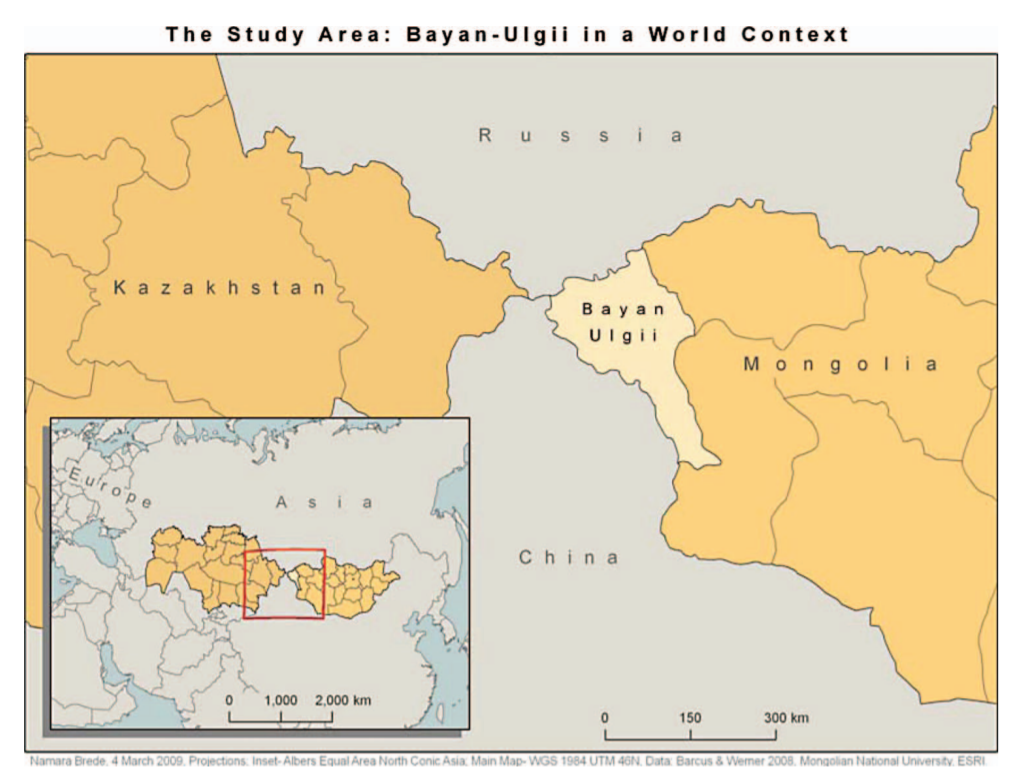
Prior to the first decade of the 2000s, the overwhelming majority of oralman came from Mongolia. These Kazakhs had moved from Xinjiang into what would become the independent Mongolian People’s Republic (1924-1992) in the mid-1800s.
Kazakhs are the largest ethnic minority in Mongolia, making up 4.3% of the total population[3]. Around 78% of these Kazakhs live in Bayan-Ulgii aimag (province), the westernmost aimag in Mongolia. Bayan-Ulgii does not directly border Kazakhstan; instead, about 40 miles of China or Russia separate Mongolia and Kazakhstan from one another. Nearly half of the total population of ethnic Kazakhs in Mongolia have left Mongolia for Kazakhstan since the 1990s.
The Mongolian Kazakhs represent a unique type of migration. Perhaps influenced by the Kazakhstani government’s quota system operating on the household level, Mongolian Kazakhs in particular are known to move as groups of many households. In some cases, groups of several tens of households moved together from Mongolia to Kazakhstan. I would assume that this style of migration does not just open up a migration corridor; it in fact transplants entire social systems from one location and/or jurisdiction to another. I would like to do more research into if these groups were kept together, or if they were separated and resettled. At this point, I do not see why they would have been separated by that government of Kazakhstan.
The Language of Returning Home
Whereas an imagined return home envisions a welcomed return to an anterior state, any “return” is predicated on the fact that this movement occurs at a later point in time. Though those returning are known to have changed, the “home” to which they are returning must also have changed as well. The linguistic landscape of 1990s Kazakhstan exemplifies this entirely, with Russian, not Kazakh, being the primary vehicle of communication in cities and in trade environments.
Naturally, oralmandar migrating from non-Russian speaking states (such as Mongolia, China, and Afghanistan) are put at an immediate disadvantage in Kazakhstan. Though they have come back to live with their ethnic kinsmen, they are immediately barred from certain jobs and institutions on linguistic grounds (to say nothing of their rights related to legal status). This could allow for a Soviet-style “first among equals” status for Kazakhstani Kazakhs, with the other “equals” being non-Kazakh Kazakhstanis, oralman, and other migrants.
“The integration [of the oralmans] into social and cultural domains is also hampered by insufficient Russian language skills, which still prevails since the country is multiethnic and is needed for everyday communication.”
The Status of Oralmans in Kazakhstan: Overview, UN Development Program, Almaty, 2006
The report from which the above quote was taken is now nearly 15 years old, so there likely have been further steps taken to encourage linguistic (and thereby social) integration since that time. Still, the same report notes that, in addition to lacking requisite Russian language skills, many oralman are also unfamiliar with Kazakh as it is written in the Cyrillic script.
Though I would love to do more concrete work with the language of Mongolian Kazakhs and that of Kazakhstani Kazakhs, for now, I will have to rely on the observations of other researchers and inferences about the nature of the various contact situations the Kazakh language has been subject to throughout the past century or so.
The Kazakh language in Kazakhstan is known to have been strongly influenced by Russian. In more direct terms, this equates to heavy borrowings from Russian, especially in the areas of the lexicon which are related to technology, government, economics, and state ideology. Furthermore, high degrees of Russian-Kazakh bilingualism, coupled with the privileged position of the Russian language make for a very different Kazakh language that many of the oralman, themselves minorities in their points of origin, speak and understand.
Nowhere is this Russified Kazakh language seen more clearly than in an anecdote given as part of scholar Anna Genina’s Ph.D thesis. Part of Kazakhstan’s Language Law decrees that all public signage must be given in both Kazakh and Russian. Genina recounts how, when driving around with a local contact and his son, she sees a sign that reads paterler astynda kilt in Kazakh. Genina’s contact tells his young son to not read that sign, for it will “spoil” his Kazakh. Indeed, from the Kazakh alone, the meaning of the sign is incomprehensible. The contact then remarks that the sign is a direct translation from the Russian kvartiri pod kluch (lit., “apartments under key”), a phrase that means finished, ready-to-move-in apartments. The Russian makes perfect sense; the Kazakh calque is a construction neither used nor understood by non-bilingual Kazakh speakers. Though a comical example, this anecdotes represents a reality of language contact: it is messy, and it can be exclusionary.
Footnotes
[1] Diener (2005) problematizes the classification of “ethnic Kazakhs”, commenting on how this determination was put forth by elites within Kazakhstan rather than through scientific samplings.
[2]The Status of Oralmans in Kazakhstan: Overview, UN Development Program, Almaty, 2006
[3] Barcus & Werner, 2010
References
Barcus, Holly & Cynthia Werner. “The Kazakhs of Western Mongolia: transnational migration from 1990–2008”. 2010. Asian Ethnicity, 11:2, 209-228, DOI: 10.1080/14631361003779463
Diener, Alexander C. “Kazakhstan’s Kin State Diaspora: Settlement Planning and the Oralman Dilemma.” Europe-Asia Studies 57, no. 2 (2005): 327-48. Accessed October 4, 2020. http://www.jstor.org/stable/30043873.
Genina, Anna. “Claiming Ancestral Homelandsː Mongolian Kazakh migration in Inner Asia”. Ph.D diss., The University of Michigan, 2015.
Haas, Hein De, Stephen Castles, and Mark J. Miller. The Age of Migration: International Population Movements in the Modern World. London: The Guilford Press, 2020.
The Status of Oralmans in Kazakhstan: Overview, UN Development Program, Almaty, 2006. https://web.archive.org/web/20110722144403/http://www.undp.kz/library_of_publications/files/6838-29587.pdf
Kazakh oralmandar from Mongolia have the advantage of already knowing cyrillic, which should make learning cyrillic Kazakh easier. Russian borrowings also happened in Mongolia. Of course, Kazakh is supposed to be transitioning into latin. The challenge is much greater for Kazakhs from Xinjiang, who write mostly in Arabic script and borrow their foreign words from Chinese.
As tends to happen, the adults are unlikely to fully adapt linguistically, while children growing up in Kazakhstan will become fully assimilated.
Have you seen The Eagle Huntress? It is filmed among Kazakhs in Mongolia. And here’s a link to a new ethnographic film (in Russian) where a Kazakh ethnographer (friend of mine) Alima Bissenova goes to visit Kazakhs in Mongolia. https://www.youtube.com/watch?v=Rm1l_EoAju4
Hey Corrina, thanks for the interesting post! I find it odd that the Kazakh government went through all the trouble of courting and inviting the oralman back and did absolutely nothing to integrate them into the new society. Now, these Mongolian Kazakhs are asking to leave and don’t seem to have any attachment to their ethnic “homeland.” I wonder if the oralmans from Uzbekistan have had a similar experience, or because of the poor economic conditions in Uzbekistan, have found it easier to integrate into Kazakh society.
Oralmans from Uzbekistan are not enrolled in the government support program (so on that note, harder–they are not officially oralman), but they grew up in the same kind of society and use Russian in the ways that Kazakhs in Kazakhstan use Russian. The transition is nowhere near as big for Kazakhs moving from Uzbekistan to Kazakhstan–I’ve known some, and they assimilate quicly.