Since the Fall of the Soviet Union, ethnonationalism in Russia has been on the rise. While demographic data points to a labor shortage in Russia, ethnonationalist policies make it extremely difficult for labor migrants from places such as Central Asia to fill labor shortages. Millions of Central Asian migrants from CIS countries have moved to Russia within the past 20 years, but in doing so, millions have faced corrupt labor policies, xenophobia, discrimination, poor living conditions, and dangerous work conditions. This model of Central Asian labor migration to Russia fits De Haas’s description of historical-structural theories.
Under Soviet times, the USSR was able to capitalize off of propagandic slogans such as “Friendship of the Peoples”. This “Friendship of the Peoples” slogan was convenient for an imperialistic government composed of 15 different republics. The Soviet Union could function under the notion that they were less racist, and therefore better than the West. Undoubtedly, this concept that the Soviet Union brought together various ethnic groups as “friends” with little to no racial tension was propped up by the state visits of African American scholars such as Langston Hughes, and with bilateral relationships with African nations such as Ghana.
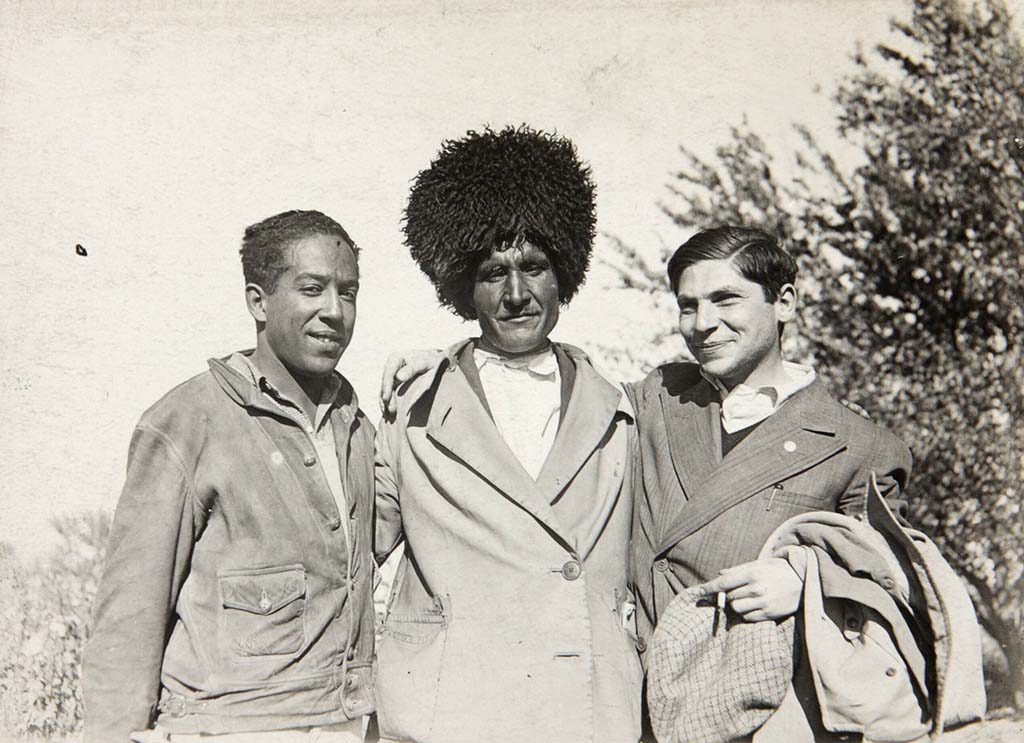

While the Soviet Union could uplift their “Friendship of the Peoples” concept with the enrollment of West African exchange students in Soviet universities, scholars such as Sahadeo have revealed the false pretenses of this propaganda. In reality, Africans in the Soviet Union were heavily discriminated against. In addition, although there may have been a “friendship” weaving through the Soviet Union’s different republics, this friendship was not synonymous with equality. Loyalties fell to ethnic groups, and it was obvious that Russian was viewed as supreme and at the top of the social caste system. While ethnic groups such as Kyrgyz and Tajiks were required to learn Russian and read Russian authors, ethnic Russians were not required to learn about any culture other than the “best” culture, Russian.
Because the “Friendship of the Peoples” concept was propagandic in nature, the Fall of the Soviet Union led to 15 new nations which strictly followed the concept of nation-state. Each post-Soviet nation had to undergo its own process of nation-building. This was largely done by uplifting national languages and building nationalist concepts around the idea of historic heroes. In Russia, there was no longer a need to hide behind an idea of tolerance or friendship, and as a result, ethnonationalism could grow unhindered.

In a report published by the Center for OSCE Research, Rahmonova-Schwarts discusses xenophobia in Russia. The report references data from a 2005 survey administered by the Levada Analytical Center. Survey results demonstrate the public’s xenophobic attitudes, showing that 57% of people surveyed voted in favor of prohibiting residents from the Caucuses in their district or city, and 53% voted for prohibited residents from Central Asia. The state is also reluctant to crackdown against violent acts of racism against migrants. Rahmonova-Schwarts refers to a court ruling in 2006 where a group of youths suspected of murdering a 9-year-old girl from Tajikistan were merely charged with “hooliganism” (Rahmonova-Schwarts, 2007).
Other scholars have taken a hard look at the history of ethnonationalism in Russia. Kolsto’s chapter in “The New Nationalism” studies the nationalist movement in Russia since the Fall of the Soviet Union. Kolsto argues that, while leaders such as Putin have always been nationalists, there has been a new movement of ethnonationalism in Russia. As a result, Russian conservatives have often classified Putin as too welcoming of immigrant labor. Also included in Kolsto’s research is an analysis of groups such as DNPI. DNPI was banned in 2010, but later reemerged and combined with a different nationalist group to form “Russkie”, an “ethno-political association” (Kolsto, 2016).
Due to the high barriers and xenophobia that Central Asian migrants face, there is no way that this migratory flow could fit a positive, Neo-Classical migration model. Instead, it is clear that migration between Central Asia and Russia is a result of imperialism, capitalism, and “unequal terms of trade between developed and underdeveloped countries” (De Hass, 48).
De Hass argues that, within this model, businesses in developed nations have an interest in accessible a cheap, “expendable” labor force. Central Asian migrants can be hired or fired at will, are easily swindled, and even get injured or die while working with no formal social network to protect them from harm. In the case of Russia, policy-makers easily scapegoat Central Asian migrants because of pre-existing xenophobia held by the dominant race (“ethnic”, Slavic-looking Russians), which has only grown over the past couple of decades. Meanwhile, the Russian business community benefits from Central Asians willing to make the dangerous journey to earn unfair wages which are still higher than what they would be earning back home.
De Haas, Hein, Stephen Castles, Mark J. Miller. The Age of Migration: International Population Movements in the Modern World. 6th edition. New York: Guilford Press. ISBN 9781462542895
Kolsto, P. (2016). “The Ethnification of Russian Nationalism. In The New Russian Nationalism. Edinburgh University Press. Edited by Kolsto, P. and Blakkisrud, H. (pp. 18-45).
Rahmonova-Schwartz, D. (2007) “Destination Russia: Migration Policy Reform and Reality,” Centre for OSCE Research, http://www.core-hamburg.de/CORE_english/pub_ osce_inh_0sce_inh_06.htm
Sahadeo, Voices from the Soviet Edge Ch 2, 35-62.
African propaganda image pulled from: https://www.rbth.com/history/331238-ussr-africa-relations-friendship
Racism is something one can experience in interpersonal relations and in institutional relations. Discrimination is a word that we use with institutional actions. Were institutions discriminating against African students in the Soviet years? or were they experiencing racism? or both?
I wonder whether Levada has more recent data about Russian xenophobia?
Levada allows for a search. Here’s a page of recent links in response to my search for xenophobia. https://www.levada.ru/en/tag/xenophobia/