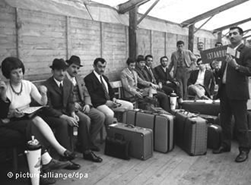
In The Age of Migration, Hein De Haas takes the reader on a journey into the Guestworker Program in the Federal Republic of Germany (FRG) that arose in the 1950s. This allowed the FRG to recruit millions of foreign workers over two decades to accommodate the labor needed due to industrial expansion and low birth rates. With this wave of immigration, the Federal Republic of Germany quickly became a receiving country, meaning they received migrants to fulfill labor needs. The vast labor increase stimulated productivity that translated into the economic boost the Federal Republic of Germany was looking for.
When considering the acts of migration themselves and the effects each had on individual populations, how were the Germans able to better adapt and therefore succeed than other groups including Chechens? Their presumed working conditions and later economic success was not seen by the Chechens a decade earlier. After arriving in Kazakhstan (1944), Chechens waited an extended period of time before receiving work assignments and land allotments; therefore, they did not receive any of the harvest from that year. Thanks to this deprivation, Chechens carried resentment in addition to being physically weak and unable to perform certain jobs.
Variance amongst living and working conditions and therefore economic growth was not limited to outside German borders. While both German states introduced family policy with an intergenerational contract in which those of working age support retirees, low birth rates and immigration raised concern of a shrinking labor force. Each state shared history, language and culture, but their ideologies and political system differed. At this time, the FRG created the Guestworker Program, bringing a new labor force from neighboring countries to stimulate the economy and became known as the German Miracle.
The German Democratic Republic (GDR) was less fortunate shouldering financial burdens it was unprepared to take on while recovering from a depleted and underdeveloped work force. The prospective solution came from a new social policy built on the idea of increasing production and decreasing consumption. However, as the living standards continued to fall behind, GDR residents migrated internally to the more prosperous FRG; this increased social division caused their eastern neighbors to take drastic measures. The GDR built the Berlin Wall to stop internal migration and help equalize Germany’s resources and labor force.
Despite both German states using family policy to vamp up its domestic workforce, the approaches were quite different. The GDR thought to increase its workforce by luring women to work by offering generous benefits including maternity packages, though perhaps to the resentment of older women not offered these benefits during their time of child bearing age and to working non-mothers. Other benefits advertised included a family allowance and the babyjahr, one year of leave after birth with the promise of their job at the conclusion. With the unpredictability of pregnancy, foreign workers were often brought in to fill the labor shortages due to maternity leave, although the German Democratic Republic was unprepared for a flood of Polish workers, who carried burdens, such as job training and high salaries the state could ill afford.
Paul Adams, in his article Family Policy and Labor Migration in East and West Germany, mentions that despite low birth rates and a labor shortage, unlike East Germany, the Federal Republic of Germany did little to encourage women to have children. Comparing this situation to the opposite, in terms of populations and government encouragement, China comes to mind. Between 1979 and 2015, the Chinese government enforced a one child only policy to control population growth. The promotion of this program came in the form of propaganda, television and music to name a few. Regardless of opposite needs and different time frames, I find it interesting that the approaches to meet the wants of the state by all three nations were so different.
West Germany’s Guestworker Program caught the interest of Turkish migrants, who after a treaty was signed by both nations in 1961, found themselves working in FRG and chose to stay despite a lack of job security. Collecting unemployment benefits outshone the alternative of returning home to political repression. Once the term guest transitioned to a more permanent residence, their families joined them, thus increasing the Turkish population in the FRG. Continued migration of Turks became easier once their homeland found itself further economically integrated with West Germany among other nations as a member of the European Economic Community.
In conclusion, the reality of migratory populations compared with how their migration was distorted, perhaps to encourage voluntary migration to fulfill labor needs, was a common denominator amongst all forms of migration. Migration has many faces and many outcomes. In the aforementioned examples, the migrants traveled across international borders to satisfy a need, whether of themselves or of their receiving country; however, forced migrants did so out of compulsion whereas voluntary migrants fled due to lack of economic opportunity, escaping political turmoil or even climate change or family reunification or a combination of the four. In the case of the Federal Republic of Germany, immigration of international and internal migrants following a period of increased industrialization brought economic growth and a diverse labor force. The Democratic Republic of Germany, however, did not experience the same success, thus resulting in building a division of political, economic and social unrest lasting nearly 30 years.
Bibliography
Adams, Paul. “Family Policy and Labor Migration in East and West Germany.” Social Service Review, vol. 63, no. 2, 1989, pp. 245–263., doi:10.1086/603696.
Haas, Hein de, et al. The Age of Migration: International Population Movements in the Modern World. The Guilford Press, 2020.
Pohl, Michaela. “‘It Cannot Be That Our Graves Will Be Here’: The Survival of Chechen and Ingush Deportees in Kazakhstan, 1944-1957.” Journal of Genocide Research, vol. 4, no. 3, 2002, pp. 401–430., doi:10.1080/14623520220151989.
Prevezanos, Klaudia. “Turkish Guest Workers Transformed German Society: DW: 30.10.2011.” DW.COM, www.dw.com/en/turkish-guest-workers-transformed-german-society/a-15489210.
I think the comparison of how the three different states handled issues of birth rates is interesting. What comes to mind for me is Japan. To combat their low birth rates, a main strategy is attempting to improve women’s work-life balance. They, like the GDR, offer generous parental leave and subsidies. They also focus heavily on providing childcare, which is a main concern for women in Japan. Overall, it strikes me how they need to work around women’s careers. Much like the GDR, they need women’s participation in the workforce and have to walk on a fine line between encouraging childbearing and encouraging workforce participation.
” In the same decade, this economically diligent nation was also a sending country; German workers were forced to migrate to Kazakhstan.” Let me make a little correction here. I probably did not spend enough time on this in lecture, and I shouldn’t assume everyone knows the full history of all kinds of people groups in the Soviet Union. The Germans who you read about in Pohl’s article were absolutely not new migrants from Germany. Way back in the time of Catherine the Great (1770s), Russia invited German-speakers from various parts of Europe to move to the Russian Empire and start farming. They settled mostly in villages near the Volga River and became known as Volga Germans. https://sites.ualberta.ca/~german/AlbertaHistory/Volgagermans.htm In 1941, after they had been living in Russia for six generations, they were still German speakers. Stalin worried that they would become allied with the invading Nazis, and so he sent them into exile from the Volga region of Russia to Kazakhstan.
Your comments on German experiences in Kazakhstan really are not focused on that, but instead on the adjustments to exile that Pohl discusses in comparison with Chechen forced migrant experiences, but I want to clarify that West Germany was not at all a migrant sending nation in the 1950s or 1960s. It was solely a migrant-receiving country.
Much of your post focuses on the labor question, comparing the FRG and GDR approaches to finding enough labor; this continues to be one of the biggest factors in many countries’ decisions to encourage migration.