De Haas emphasized that the way we speak about migration matters, not only to our discourse, but also to the lived experiences of migrants. Using “migrant worker” instead of “expat” indicates a particular idea about the person in question. We perhaps think “unskilled” or it brings up certain ideas of race and ethnicity. De Haas also discussed how governments can use the labels “temporary” or “permanent” depending on political goals at that moment in time. He stated that the distinction between these two labels boils down to a government’s desire to “protect their sovereignty in selectively granting rights to particular groups of ‘deserving’ migrants.”1
We have encountered this type of control throughout our readings, and we have also seen how it often does not work. Labelling a migrant “temporary” does not make them, in fact, temporary. Instead, we have discovered that a state’s attempts to control groups of migrants can backfire and encourage irregular or unwanted types of migration. It can also encourage resentment among state nationals when migrants do not adhere to their temporary status.
In the case of Germany, our readings focused on “Gastarbeiter”, or guest workers, who were initially welcomed into West Germany to fill post-war labor shortages.2 The state recruited these migrants to come to Germany with the expectation that they represented pure labor power without the social costs – the state did not have to provide them with training, education, or retirement. The state also assumed that they would save money on raising the children of temporary migrants.
These beliefs rested on the assumption that foreign workers were temporary and mobile. The state wished to rotate workers in and out of the country as they pleased, preventing community development and family reunification. West Germany assumed that “the chronic insecurity of residence combined with the incentives provided by the labor market would ensure the appropriate mobility.”3
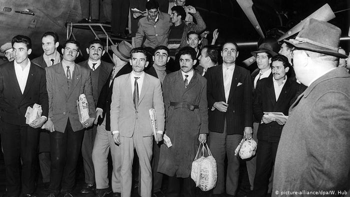
It was clear that these assumptions did not reflect reality – many migrants stayed in Germany. Some West German policies even encouraged settlement and family reunification, such as the “family allowance.” The state made the payment available for children of migrants outside of Germany, but at a lesser rate, which encouraged migrants to bring their children to Germany to secure the higher payment.5 This shows how official state policy can cause an outcome that is opposite to the intention. In this case, the guest-workers were not a pure labor source and cost the state money in the social costs it had hoped to save on. It also demonstrates how the label “temporary” did not in itself force these migrants to leave the country.
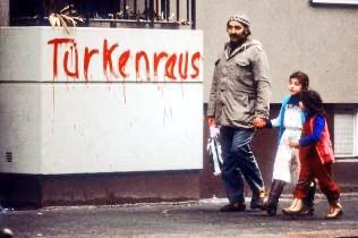
What the label “temporary” or “guest” did accomplish was convincing the German population that these migrants should leave. When they did not, German nationals reacted with “increasing hostility towards immigrant labor.”6 This culminated in the discontinuance of the “Gastarbeiter” recruitment scheme in Western Germany in 1973 (in combination with economic reasons). A Turkish migrant in Berlin remembered graffiti saying “Türken Raus,” meaning “Turks out!” He recalled, “The Germans wanted Gastarbeiter, and they got human beings.”7 When the state labelled these workers as temporary, it conveyed implicit attitudes about these migrants, perhaps that they were not deserving of permanent status.
While the situation of Chechens in Kazakhstan is not the same, we are able to observe throughout our readings on exiles in the USSR how labels and the attitudes that they create matter to migrant’s lives. In Pohl’s article on Chechen deportees in Kazakhstan, she discussed how the different groups of forced migrants in Kazakhstan adapted, or did not adapt, to their new surroundings.9 She emphasized a stark difference between Chechen migrants and other migrant groups such as Germans. Chechens, for the most part, did not assimilate to their new situations and maintained a “spirit of resistance.”10
These Chechens were deported to Kazakhstan because of suspicions about their loyalty to the Soviet regime – the state deemed that certain groups were not trustworthy and had to be removed to Central Asia. This attitude of suspicion may have had an effect on how Kazakh natives reacted to their arrival. While all exiled ethnic groups had the same stigma of suspicion, the native Kazakhs subjected Chechens especially to rumors and stereotypes, some spread by the NKVD themselves.11
Just as the label of “guest” affected the lived experience of guest-workers in Germany, these narratives that Chechens were traitors or cannibals may have had the same effect on their ability and desire to assimilate. While I don’t know for sure if this was the case, I am interested in how narratives and labels, while just words, can affect the way that migrants are accepted and how they assimilate to life in a new country.
This is relevant to the United States, as well. Government narratives about the dangers of Mexican immigrants, calling them “rapists” among other things, contribute to damaging, popular sentiments that can affect immigrants in employment, housing, and healthcare.12 Using the word “illegal” to describe immigrants, for example, is common in the US, but it can convey negative stereotypes and be dehumanizing. This blog dives into how this word is not neutral in any way, as well as the origins of the popular phrase, “No human being is illegal.”13 We can see from these examples that state, and individual, words matter to the lived experiences of migrants.
1 Hein De Haas et al., The Age of Migration: International Population Movements in the Modern World (New York: The Guildford Press, 2020), 27.
2 W.S.G. Thomas, “’Gastarbeiter’ in Western Germany.” Geographical Association, 1974, 59 (4): 348-350.
3 Paul Adams, “Family Policy and Labor Migration in East and West Germany,” Social Service Review 1989, 63 (2): 250.
4 Klaudia Prevezanos, “Turkish guest workers transformed German society.” DW.com. www.dw.com/en/turkish-guest-workers-transformed-german-society/a-15489210.
5 Paul Adams, “Family Policy and Labor Migration in East and West Germany.”
6 W.S.G. Thomas, “’Gastarbeiter’ in Western Germany.” Geographical Association, 1974, 348.
7 Robert Rigney, “The Turkish community in Germany: The Gastarbeiter issue.” Daily Sabah. September 04, 2019.
8 Gunes Tavmos, Twitter post. August 25, 2015. https://twitter.com/tavmos/status/718141523972526080
9 Michaela Pohl, “’It cannot be that our graves will be here’: The Survival of Chechen and Ingush Deportees in Kazakhstan 1944-1957,” Journal of Genocide Research, 2002 4(3);401-430.
10 Michaela Pohl, “’It cannot be that our graves will be here’: The Survival of Chechen and Ingush Deportees in Kazakhstan 1944-1957,” 411.
11 Michaela Pohl, “’It cannot be that our graves will be here’: The Survival of Chechen and Ingush Deportees in Kazakhstan 1944-1957.”
12 Amber Phillips, “’They’re rapists.’ President Trump’s campaign launch speech two years later, annotated.” The Washington Post. June 16, 2017.
13 Isabel Johnston, “Words matter: no human being is illegal.” Immigration and Human Rights Law Review. May 20, 2019.
And yet because our rights actually have their basis in citizenship in a particular country, we need terms to explain status. Who shares the full rights of citizen, and who doesn’t, and why? Are there ways to make these designations, and to make those laws about belonging (and unbelonging) that don’t bring all sorts of harmful repercussions?
Alexie, your post really pulls together a lot of sources as you examine the implications of labels for migrants in various contexts. One of the other blogposts for this class raised the question: when does one stop being a migrant? These labels, including the term “migrant” serve to highlight and maintain one aspect of an individual’s life–status as outsider.
I like the illustrations–you’ve found some good sources out there in the blogworld!
The idea of how certain countries frame migrants is an interesting one and makes me think about how the United States has used diction surrounding people of Asain decent. The familiar stereotype of the “smart Asian” was originally created through the United States being very selective about the people it allowed to settle in the United States, requiring them to be people that had Masters, PhDs, or fit into the category of skilled laborers. This then fed into the concept of “model minorities” that the United States tried to promote, by pointing to a singular case of carefully controlled migration, that racism against minorities or migrants had disappeared due to the high economic status these Asian migrants had in the U.S. due to their education elsewhere.