In 1991 Kazakhstan became an independent country for the first time in over two hundred years, and set out to create a homeland for Kazakhs all over the world. In order to achieve this feat, the new government would have to hold a census and ensure that Kazakhs were the majority. However, as history in the Kazakh territory showed, organizing an accurate census was going to be no walk in the park as the region consistently experienced population shifts and migrations to Russia proper.
For Kazakhstan’s new president, Nursultan Nazarbayev, ethnic homogeneity was necessary to legitimize his rule and show a break from their Russian/Soviet past.1 When I first read this article I didn’t completely understand how migration could be positively and negatively utilized in nation-building, but upon further research I learned how valuable it is.

In Hein De Haas’ The Age of Migration he discusses the impact of immigration on how a nation defines identity, belonging and integration.2 He goes on to provide examples of how the rapidly increasing number of non-White and non-Christian migrants to destination countries in Europe and North America has led to friction in discussions on acceptance, security concerns and how to protect sovereignty. In these countries, migrants will slowly be accepted if said migrants possess specialized skills or can be used for political gain for their origin.3
Unfortunately, such a situation has never been the case in Kazakhstan due to the high rates of emigration. Many Kazakhs emigrated to Russia or other Central Asian republics during the Soviet times for a number of reasons, and this trend exploded when the USSR collapsed leading to Russians and Kazakhs departing in search of better economic opportunities, however it has been going the other way for a while now. At this point I think its best we take a look at the history of censuses in Kazakhstan to better visualize what occurred.
The first official census of the Kazakh territory was done in 1897 by the Russian Empire but was ineffective because it counted individuals according to what language they spoke and resulted in miscounting and under counting.4 On top of this, ethnicities like Kazakh and Kyrgyz were considered the same, furthering the notion that they were a conquest more than an addition. The next three censuses took place in 1926, 1937 and 1939, and asked respondents to declare what nationality they identified with.
Although this was useful in numbering the Kazakhs, they showed a devastating trend of a decrease in the native population and an increase in Slavic immigration from Russia and Ukraine.5 Moreover, this shift was exacerbated by the forced relocation of prisoners to Kazakhstan through the gulag system and other migrations. As time progressed, Kazakhstan was able to flatten their decline and attracted Kazakhs abroad to resettle.
When the USSR collapsed, the new country continued to attract foreign Kazakhs, which would make them the majority for the first time since the 1930s. A major Russian emigration also played into this demographic shift. This reminded me of something that De Haas said about the need to conceptualize migration as a process that’s constantly evolving.6 The Slavic peoples who were relocated to Kazakhstan were sent to farm and ‘Russify’ it, but quickly returned to Russia because the economic and living conditions were better and the goal of the previous state had failed.
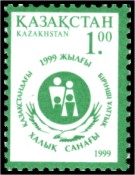
With their newfound majority, the Kazakh government set out to cement its nationality as the main one in the country. The 1999 census asked respondents to check off the nationality they identified with: Russian, Kazakh or identity found in a Dictionary of Nationalities. In order to ensure a clear Kazakh majority, the census included most tribal names and identities under the term “Kazakh” so the people would feel a connection to their new country. Additionally, Kazakhs from Mongolia or other Central Asian countries were immediately declared “Kazakh.” The results of this census served two purposes of legitimizing the presidency of Nursultan Nazarbayev and signifying the return of Kazakh hegemony in their own lands.7
Through researching the history of censuses in a given country, we can see how big a role processes like migration and emigration play in defining a nation’s politics and expressions of identity. In recent years, Kazakhstan has become a destination country for migrants in Central Asia, but still faces emigration to Russia for economic opportunities. Regardless, Kazakhstan should be proud that they survived the collectivization and attempted destruction through migration by the Soviet state and now are control of their own destiny.
1 Sinnott, P. (2003). Population Politics in Kazakhstan. Journal of International Affairs, 56(2), 103.
2 Haas, H. D., Castles, S., & Miller, M. J. (2020). The Age of Migration: International Population Movements in the Modern World. London: Guilford Publishing, 12.
3 Haas, H. D., Castles, S., & Miller, M. J. (2020). The Age of Migration: International Population Movements in the Modern World. London: Guilford Publishing, 28.
4 Sinnott, P. (2003). Population Politics in Kazakhstan. Journal of International Affairs, 56(2), 107.
5 Sinnott, P. (2003). Population Politics in Kazakhstan. Journal of International Affairs, 56(2), 109.
6 Haas, H. D., Castles, S., & Miller, M. J. (2020). The Age of Migration: International Population Movements in the Modern World. London: Guilford Publishing, 27.
7 Sinnott, P. (2003). Population Politics in Kazakhstan. Journal of International Affairs, 56(2), 115.
We will be reading quite a bit more about this interesting process of appealing to co-ethnics to immigrate. In Kazakhstan, this program calling on Kazakhs from Mongolia, China, and other Central Asian countries to “come home” is called the Oralman project.
What an interesting read! I wonder if these Kazakhs from Mongolia and other Central Asian countries consider themselves Kazakh like the Kazakhstan government does? How big is the generational separation from the time they emigrated from Kazakhstan to the time they returned?
Thanks for the read and question! The article I used doesn’t get a time frame for the generational separation for Kazakhs in Mongolia, but I looked it up online and learned that ethnic Kazakhs started moving to Mongolia in 1860. This is around the time that the Kazakh Khanate fell under control of the Russian Empire and saw repression start. These Kazakhs were invited back to their homeland a little over 130 years later in the early 1990s.