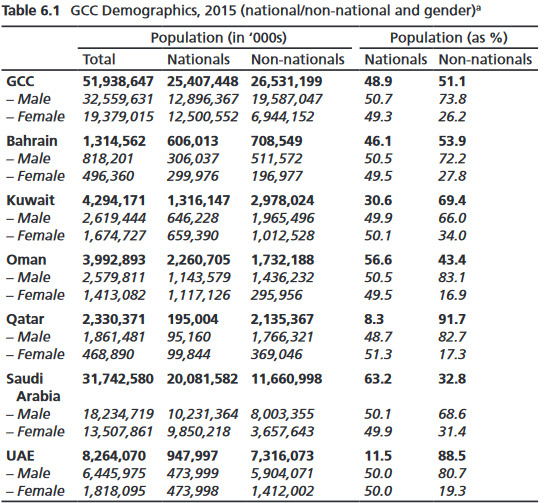
As I’ve discussed in my previous two blog posts, the 1973 oil shock resulted in a massive restructuring of global migration patterns and paved the way for the economic ascendancy of oil-exporting Gulf states. Since 1973, Gulf Cooperation Council countries have become a magnet for migration, initially from other Arab states, but in the decade following the oil shock the trend has increasingly been for Gulf states to seek out South Asian labor migrants.1 Of the six GCC countries, 4 have a higher population of foreign nationals than citizens. The United Arab Emirates has the greatest proportion of non-nationals of GCC countries, with 88.5% in 2015.2 The majority of foreign nationals in the United Arab Emirates are Indians, who make up a plurality of the UAE’s population.
Chowdhury 106
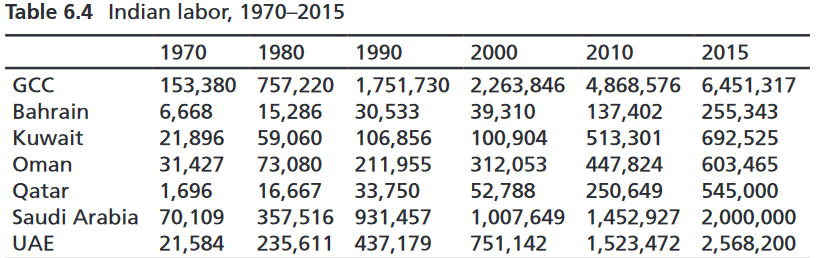
Between 1970, before the oil shock, there were 21,584 Indians working in the UAE. This number increased over 500% to 235,611 by 1980, and by 2015 the Indian population had grown by 11,798% to 2,568,200.3 The preponderance of Indian laborers living the United Arab Emirates has necessitated that the two countries develop their economic and political ties. In some instances, this has led to improved social standing and labor rights for Indians working abroad, but many injustices persist.
Chowdhury 107
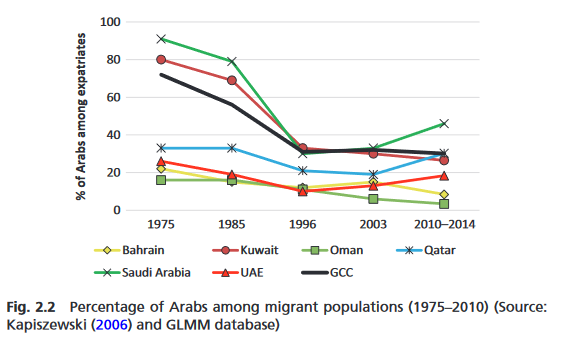
I’ve previously glossed over reasons for the shift from the early days of the oil shock, during which the majority of labor migrants in the Gulf were from Arab states, to the late 1970s, after which the proportion of Arab migrant workers fell dramatically throughout the GCC whereas the South Asian working population exploded. It is worth looking more closely into why this trend emerged, as it has relevance to the conditions of millions of South Asian migrants today.
There are some simple economic reasons for why the proportion of South Asian workers skyrocketed in the late 1970s. As oil-producing states raked in enormous sums of money from exports, they underwent a massive expansion of construction and infrastructure, which necessitated hiring many workers.4 The supply of laborers from South Asian countries was larger than those of neighboring Arab countries, and these South Asians had worse economic conditions in their home countries, which led them to accept lower wages than Arabs.
AlShehabi et al 21
Without an understanding of the political ideologies that were gaining popular support at the time, this may seem to be an adequate answer. By accepting applicants from the world’s largest talent pool, it follows that the employers in the Gulf would greatly benefit by selecting for those who would accept the lowest wages, longest hours, and poorest conditions. However, there are additional sociopolitical considerations to make.
During the 1970s, waves of political consciousness were running through the Arab world. At the time, nationalist, pan-Arabist, Marxist, and socialist ideologies threatened the status quo and standard operations of Gulf oil production.5 Additionally, Kazuhide Iketaki writes, “Arab workers have a tendency to establish strong relationships with their employers and colleagues and their influence is not negligible for the Gulf rulers who fear their political ideologies; from secularism to religious extremism.”6 Not only do Gulf states prefer to hire ideologically neutral workers, they have at times deported political dissidents and those who they fear may destabilize their system of business and government. For example, during the first Gulf War from 1990 to 1991, Kuwaiti and Saudi officials deported two million Arab foreign nationals who supported Saddam Hussein. Some Bangladeshis and Pakistanis were also deported, but Indians in particular remained undisturbed. Their political neutrality secured them their jobs, and led to increased demand for Indian laborers to fill in the gaps from those who were deported.7
As one can see, ideological and political as well as economic conditions have led to the trends of South Asian migrant laborers far outnumbering Arab migrant workers in the Gulf.
https://gulfnews.com/world/asia/india/india-and-uae-move-towards-new-goals-1.1566486204027
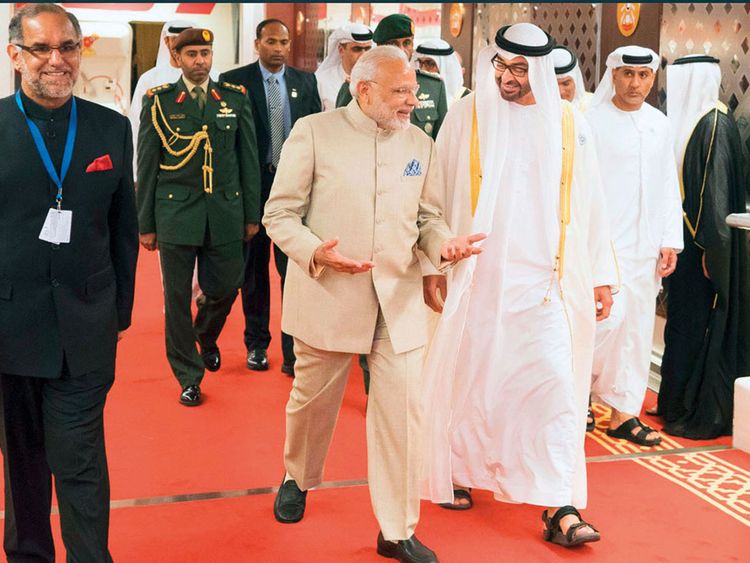
Since establishing diplomatic relations in 1972, the people and economies of India and the UAE have become increasingly interconnected.8 The UAE is India’s largest export market9, while India is the UAE’s single largest export market.10 Additionally, the UAE is India’s largest source of remittance money, with 13.8 billion dollars coming in 2018.11 All this together leads India to maintain great interest in ensuring positive relations with the Emirati government. Because of its large number of overseas labor migrants, India has established government institutions to manage the welfare of its citizens abroad. The Ministry of Overseas Indian Affairs was founded in 2004 to provide Indians living abroad with assistance with diaspora, financial, emigration, and management services. Issues within the scope of this ministry include overseas employment, voting, and welfare.12 These services are available to emigrants around the world, and offices exist in major emigrant centers.
Despite attempts at securing the welfare of its citizens abroad, many Indian migrant laborers face unacceptable living and working conditions, and are exploited in various ways in the UAE and other GCC countries. For example, following the announcement that Qatar would host the 2022 World Cup, the Qatari government ramped up construction on sports facilities, transportation infrastructure, hotels, and more. Investigative journalists revealed that within the four years following the announcement, 700 Indian migrant workers had died in the Qatari construction industry.13
Many of the abuses faced by Indian migrant workers in the Gulf stem are inherent design features of the kafala system, through which labor migrants are required to travel to Gulf countries under the sponsorship of an employer. Common grievances for workers under the kafala system include confiscation of passports, which ensures a worker cannot change jobs or leave the country, dirty and dangerous living conditions that are maintained by construction companies, unpaid waged, exorbitant administrative fees that are legally required to paid by employers but frequently are passed onto workers, and forced labor.14 While labor migrants accept a degree of risk and are disproportionately faced with exploitation, the kafala system institutionalizes these ills and makes them much more likely.
Today Indians make up the largest single national group in the United Arab Emirates, and make up a large proportion of the population of all GCC countries. Given that diplomatic relations have existed between these countries for decades, and given that foreign migrants make up the majority of workers in these countries, India should demand that tolerable standards be held up in the Gulf. Labor migrants have done the physical work of developing Gulf countries since the oil shock of 1973, and they should be treated with dignity and respect and return.
- De Haas, Hein, The Age of Migration International Population Movements in the Modern World (New York: The Guilford Press, 2020), 208.
- Rutledge, Emilie J., “Labor Markets in the Gulf and the South Asian Migration,” in South Asian Migration in the Gulf: Causes and Consequences ed. Mehdi Chowdhury and S. Irudaya Rajan (New York: Palgrave Macmillan, 2018), 106.
- Rutledge 107.
- De Haas 208.
- AlShehabi, Oman, “Histories of Migration to the Gulf,” in Transit States: Labour, Migration and Citizenship in the Gulf ed. Abdulhadi Khalaf, Omar AlShehabi, and Adam Hanieh (London: Pluto Press, 2015), 9.
- Iketaki, Kazuhide, “Geopolitics of the Middle East and South Asia: Changing Relationships through the Movement of Migrant Workers,” in South Asian Migration in the Gulf: Causes and Consequences ed. Mehdi Chowdhury and S. Irudaya Rajan (New York: Palgrave Macmillan, 2018), 195-196.
- Ibid
- “Political Relations,” The Embassy of India, Abu Dhabi, United Arab Emirates, accessed 14 December 2020, https://www.indembassyuae.gov.in/political-relation.php.
- “South Asia:: India,” World Factbook, Central Intelligence Agency, accessed 14 December 2020, https://www.cia.gov/library/publications/the-world-factbook/geos/in.html.
- “Middle East:: United Arab Emirates,” World Factbook, Central Intelligence Agency, accessed 14 December 2020, https://www.cia.gov/library/publications/the-world-factbook/geos/ae.html.
- “India-UAE Bilateral Relations,” Ministry of External Affairs, accessed 14 December 2020, https://www.mea.gov.in/Portal/ForeignRelation/uae_december_2018.pdf.
- “Overview,” Ministry of External Affairs, accessed 14 December 2020, https://www.mea.gov.in/overseas-indian-affairs.htm.
- Hanieh, Adam, “Migrant Rights in the Gulf: Charting the Way Forward,” in Transit States: Labour, Migration and Citizenship in the Gulf ed. Abdulhadi Khalaf, Omar AlShehabi, and Adam Hanieh (London: Pluto Press, 2015), 223-224.
- Storbeck, Doreen, “Indian Labour Migration to the Arab Gulf States: The Impact of a Growing Interdependence,” Internationales Asien Forum International Quarterly for Asian Studies 42, no. ½ (2011): 21-46,213,215, accessed 14 December 2020, https://search-proquest-com.proxyiub.uits.iu.edu/ibss/docview/906101363/3EC992D71E8B4163PQ/15?accountid=11620.
Hi Jackson, right off the bat, the statement “Of the six GCC countries, 4 have a higher population of foreign nationals than citizens,” shocked me. This is a fascinating post. I appreciate your use of demographic charts and images. I also found that every time a question formed in my head about what I was reading, the next paragraph would answer said question. Why do you think India continues to tolerate the treatment of its migrant workers under the kafala system? What about India’s relationship with the UAE and the country’s overall stance on labor migration allow for this mistreatment to continue?