While my last blog post focused primarily on migrant women’s experience with reproductive health facilities in the United States and Russia, I wanted to focus my last post on reproductive healthcare, specifically abortion, in Central Asia. Unfortunately, some countries in Central Asia had a huge gap in information regarding abortion, but I was still able to find a decent amount of literature on the subject, even though some sources had to be taken from the early 2000s. This blog will generally cover abortion policy and culture in Turkey, Georgia, Kazakhstan, and a little in Kyrgystan and Uzbekistan.
Abortion in Turkey

The first country I wanted to focus on was Turkey. Turkey has had a very interesting reproductive health policy, as it is one of the few Muslim-majority nations that has legalized abortion since 1983 (Cavallo). Because of this, many Saudi Arabian and Iranian women go to Turkey for this procedure. However, recently under the rule of Recep Tayyip Erdoğan, the Turkish abortion policy has become significantly more conservative. According to Erdoğan, abortion is a crime, all women should have at least three children, and women who reject motherhood are “incomplete” (BBC). Because of Erdoğan’s constant slander towards Pro-Choice women and policies, he has attempted to revert current laws to make abortion more inaccessible. For example, in 2012, the AK ruling Party even tried to decrease the abortion period from 10 weeks to 6 weeks, but feminist groups fought back and won (Al Jazeera). Even though abortion is still legal in Turkey, many hospitals refuse to administer the procedure regardless of the law. People and administrations such as Erdoğan’s have practically ignored De jure law and created de facto laws in place to prohibit or disincentivise women who want to get an abortion.

One woman, Sevilay, a 38-year-old mother of two, tells her story of receiving an abortion in Turkey. First, Sevilay had to receive the permission of her husband, as all women do in Turkey. She said the hardest part was asking permission from her husband, as she feared she would upset him and make her feel guilty about her decision. She said, “I became very upset when I learned about my pregnancy. I wondered whether I could do it or not. I was already having a hard time with two kids. There was nobody that could help me” (Nawa).
Unfortunately for Sevilay, the challenges did not stop there. She detailed her experience of being constantly judged and turned away by public clinics, adding that she could not go to a private one due to financial reasons. In the end, Sevilay was able to get her procedure when she was 9 weeks pregnant (one week before the 10-week limitation) through the help of Mor Cati, a women’s organization and private shelter foundation for victims of domestic violence. Mor Cati aided her with finding a public hospital where she could get an abortion for free. However, Sevilay still felt judged by her hospital staff, saying how she was inhumanely threatened by them and as they made her feel guilty for her decision (Nawa).
Other women had similar experiences in Turkey. One 22-year-old woman, stated in a letter to a women’s organization that “if my family learns about the pregnancy, they won’t let me live. I know you help a lot of people, but you don’t know where I live, and you don’t know my family.” the woman said in the letter, adding, “Please get back to me as soon as possible. I cannot trust anyone except you. This is a conservative city. Even if I go to the hospital … they will let my family know about it. Please help.” Another woman added that she doesn’t have the money to get an abortion and another woman ran away from a violent husband yet still needs his permission to get an abortion. As we can see, all of these women, while able to get their procedures in the end, had to endure emotional and harsh treatment from the hospital staff or face domestically violent situations just to receive this supposedly legal procedure (Nawa). This de facto ban on abortion under the president’s rule has forced women in dire financial and abusive relationships to risk everything to obtain a procedure that is legally supposed to be provided for them.
Abortion in Georgia
In an article on worldwide abortion from 2007, it details the reproductive healthcare infrastructure in Central Asia. In Armenia, Azerbaijan, Georgia, and Russia, more abortions than births occured each year (as of 2007). Abortion rates collected from a survey of 103 Georgian women had some of the highest rates recently reported for any country with complete or incomplete data. Women in Georgia have an average of three abortions due to a small desired family size, combined with a continued reliance on traditional rather than modern methods of family planning and contraception. Also, heavy reliance on the Soviet Union healthcare system helped explain that after the collapse, the use of modern contraceptives was low in countries of the former Soviet Union such as Georgia (Segh).
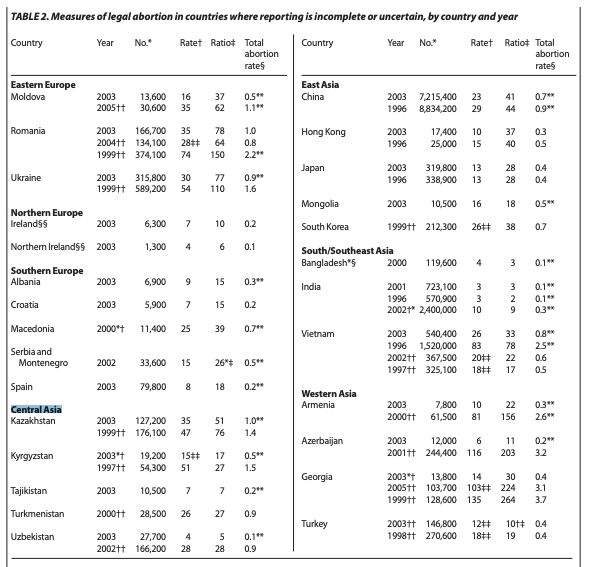
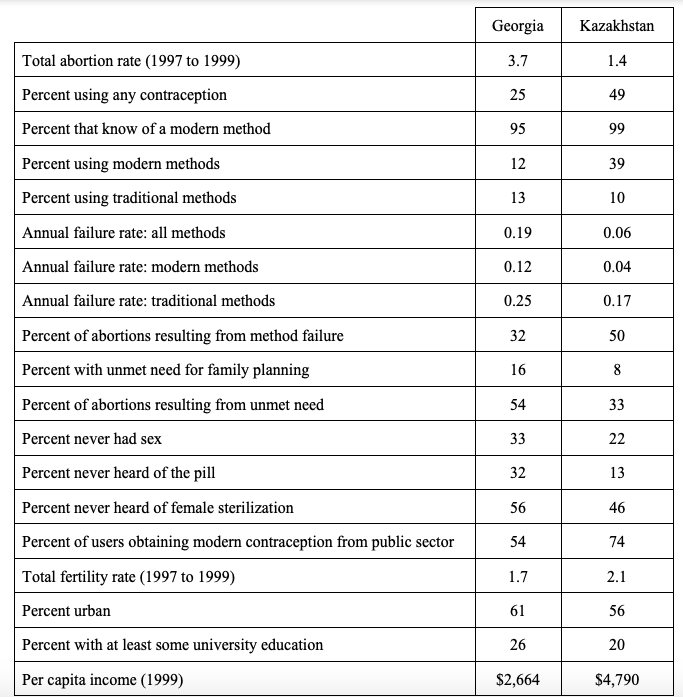
In an article by Charles F. Westoff, he details an academic account of abortion in Georgia and Kazakhstan. He notes that Georgia has a high rate of legal abortion and low use of modern contraception, and attributes this to insufficient family planning, sex education, and access to oral contraceptives. In addition, he notes that 60% of Georgian women claimed that their last pregnancy was mistimed or unwanted, and only 46% of women between the ages of 14 and 44 knew where to find oral contraception. By comparison, Georgian abortion rates were three times higher than those in Kazakhstan (Westoff). Interestingly, even though Georgian family planning services are inadequate, over 80% of Georgian women believe that abortion is a women’s choice (Westoff). His recommendations to fix these issues is for the Georgian government to take responsibility by investing more in family planning services, distributing contraceptives, and improving rural infrastructure so remote villages can have equal access to reproductive health services such as investing in rural ambulances and mobile healthcare teams that can reach remote areas.
Abortion in Kazakhstan
Interestingly, while comparing Georgian and Kazakhstan’s health infrastructure for abortion services, Westoff acknowledges that there has been an increase in women obtaining abortions in the private sector, which is not as readily recorded. “There is no doubt that the abortion rate in Kazakhstan declined significantly in the 1990s, by around 50 percent. The best guess that we can make for the years since 1998 is that the abortion rate has plateaued at a level that is on the low side among countries in this region and indicates a rate of about one abortion per lifetime. Almost the entire decline in abortion between 1995 and 1999 occurred among ethnic Russians in Kazakhstan. Their total abortion rate fell from 2.74 for the 1993 to 1995 period to 1.75 in the 1997 to 1999 period. The overall decline among Kazakh women was from 1.11 to 1.06.” (Westoff).
Westoff also adds that about half of all abortions in Kazakhstan were the result of contraceptive failure, and the other half were the result of pregnancies conceived without contraception. If all current contraceptive use were with modern methods, the abortion rate could be virtually cut in half. So, Westoff’s recommendations for Kazakhstan was similar to Georgia’s in that there needs to be more investment in family planning services and modern contraceptive distribution. However, more people in Kazakhstan used modern contraception than in Georgia, which is why the abortion rate in Georgia was significantly higher.
However, fortunately, Kazakhstan has made great strides in this regard, and as of 2000, a national program to reduce the abortion rate was introduced and approved by the Kazakh government. This reproductive health program includes the training of medical personnel, providing the population with contraceptive information, and establishing teenage pregnancy hotlines in major cities. In addition, findings from the 1999 Kazakhstan Demographic and Health Survey (KDHS) also suggest a decline in abortion (Academy of Prevented Medicine). The document noted a 22% decrease in abortion since 1995 due to a greater reliance on modern contraception methods such as the IUD and birth control. This represents an increase in the use of modern methods among currently married women from 46 percent in 1995 to 53 percent in 1999. Eighty-eight percent of all married women report having used a contraceptive method, up
from 84 percent in the 1995 KDHS. Modern contraception method is up from 77% in 1995 to 82% (Academy of Prevented Medicine).
Interestingly, my third blog covers the idea of “abortion culture” in Russia, and that Central Asian women tend to use long-term contraceptives more effectively while Russian women are more likely to obtain an abortion. The above data further back up my research from blog 3 that claims women in Central Asia use of long-term contraceptives such as the IUD. In the intensive article on Kazakhstan’s abortion demographics, they note that ethnic Russian women (49% of women) from Kazakhstan are twice as likely to get an abortion than Kazakh women (27% of women) (POPULATION REFERENCE BUREAU) The observations that Central Asian women seem to utilize long-term contraceptives more and obtain abortions less than ethnic Russians was reaffirmed by this article.
In 1999, 54% of married women in Kazakhstan reported using a modern method of contraception. During the 1990s, there was a 50% increase in the use of modern contraception methods along with a decline in abortions at the same rate. In conclusion, family planning services became more available Kazakhstan than abortion services during this period. By the late 1990s, a significant increase of healthcare providers was trained in reproductive health services and even more private pharmacies throughout Kazakhstan began to sell numerous brands of pills and condoms as well as IUDs and injectables. This began to address the gap between urban and rural Kazakhstan, where previously rural women had relatively low access to contraceptives and abortion services (Academy of Prevented Medicine).

Abortion after 1991 in Former Soviet States
In examples such as Georgia, it has been made clear that abortion services and healthcare has deteriorated after the collapse of the Soviet Union. During the Soviet Union, access to and knowledge of family planning and contraception were overlooked. Rather, women attempting to control their fertility used abortion as a substitute for modern contraception, leading to this Soviet Union “Abortion Culture.” This is why Russia still has significantly higher rates of abortion, as contraceptives are seen as arbitrary if abortion services are available. In fact, by the 1980s, one out of every four abortions occurred in the Soviet Union (POPULATION REFERENCE BUREAU).
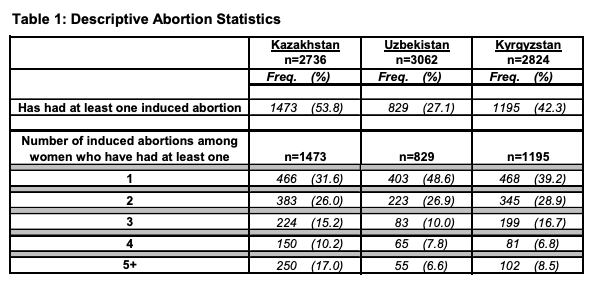
A study titled, A Fading Abortion Culture in Three Central Asian Republics, analyzes abortion politics in Kazakhstan, Kyrgyzstan, and Uzbekistan after the creation of their independent nations in 1991. According to the article, in Uzbekistan, sex education, such as contraception knowledge, is high among women (89% of women). And compared to Kazakhstan and Kyrgystan, Uzbekistan has a lower number of women with repeat abortions (Trevitt). This could be attributed to the fact that Uzbekistan has a higher socioeconomic status than that of its Central Asian neighbors, and Uzbek women tend to have a higher level of education, usually that of secondary school or higher. However, only about half of married women are using contraception. Among these women, 46% use the IUD, followed by traditional methods (4 %), the pill (2%), and the condom (2%). In addition, 49% of women in Kyrgyzstan report using some sort of modern contraceptive (POPULATION REFERENCE BUREAU).
We can see by the above information that abortion access in Central Asia varies widely. For example, looking solely from a legal perspective, Turkey has almost the exact same abortion policy as that of Uzbekistan or Georgia. However, given the significantly stronger Islamic ties the Turkish government has compared to other Central Asian nations, this has lead to repeated discrimination against women’s reproductive health rights. Women had to face emotional trauma during their already emotional experience of getting an abortion, and have to ask permission from a husband or (usually male) family member for permission for the procedure. These double-standards can put women’s safety at risk, as well as slowly decrease the quality of reproductive healthcare in Turkey. In comparison, places such as Uzbekistan, Georgia, Kazakhstan, and Kyrgyzstan have improved abortion services. However, there is still a need for better investment in family planning, and women in rural and religious areas often face a disadvantage when trying to access these services. Overall, governments in Central Asia, while making progress compares to that of the 1990s, can still do more to ensure the reproductive rights of women.
Bibliography:
Academy of Prevented Medicine. “Kazakhstan: Demographic and Health Survey 1999.” 2000.
Al Jazeera. “Turkey Drops Anti-Abortion Legislation.” Middle East News | Al Jazeera, Al Jazeera, 22 June 2012, www.aljazeera.com/news/2012/6/22/turkey-drops-anti-abortion-legislation.
BBC. “Turkey’s Erdogan Says Women Who Reject Motherhood ‘Incomplete’.” BBC News, BBC, 5 June 2016, www.bbc.com/news/world-europe-36456878.
Cavallo, Shena. “Access to Abortion in Turkey: No Laughing Matter.” International Women’s Health Coalition, 17 Feb. 2015, iwhc.org/2015/02/access-abortion-turkey-no-laughing-matter/.
Nawa, Fariba. “Abortion Increasingly Hard to Access in Turkey.” The World from PRX, 5 Oct. 2020, www.pri.org/stories/2020-10-05/abortion-increasingly-hard-access-turkey.
POPULATION REFERENCE BUREAU. “A Fading Abortion Culture in Three Central Asian Republics.” Population Reference Bureau, 2001, www.prb.org/afadingabortioncultureinthreecentralasianrepublics/.
Sedgh, Gilda, et al. “Legal Abortion Worldwide: Incidence and Recent Trends.” Perspectives on Sexual and Reproductive Health, vol. 39, no. 4, 2007, pp. 216–225., doi:10.1363/3921607.
Trevitt, Jamie, and Nan Astone. “Describing Repeat Abortions in Eurasia: A Comparison of Women in Kazakhstan, Uzbekistan, and Kyrgyzstan.” Princeton Journal, 2009.
Westoff, Charles F. “Abortion and Contraception in Georgia and Kazakhstan.” Open Society Foundations, 2004, www.opensocietyfoundations.org/publications/abortion-and-contraception-georgia-and-kazakhstan.
As someone who studies Turkish, your research reminded that Erdoğan’s opinions toward women are not on my list of reasons. While I find reject a strong word, at 41 and childless, I not consider myself ‘incomplete’ or any less of a woman. Further, no women should have to fear seeking medical treatment or fear the backlash from others from her decisions about her body. With that said, I was surprised to read about the casual attitude (at least in Georgia) abortion carries as it is apparently very common. It seems we can credit this to the lack of information about contraceptives. It appears that many former Soviet republics blame (now) Russia for many hardships, lack of things, opportunities and knowledge rather than taking responsibility for themselves after so many years of independence. Your essay mentions a recommendation for education, but does the government or do schools plan to educate people about family planning and sexual activity in general?