In South Sudan, since a tentative peace deal was signed with the help of the international community that seems to be holding, many people seem to be evaluating what to do next.
As of October 2020, UNHCR has made an official statement regarding South Sudanese refugees returning home in the current climate. “In recent years, South Sudan has made some progress in bringing peace and improving safety/security in some parts of the country. South Sudan is yet to resolve all the main problems that forced South Sudanese to flee from their homes to another part of South Sudan or to other countries. For the return of South Sudanese refugees to be long-lasting and in peace, safety and with dignity, all the main problems due to which they had fled their homes, must be resolved permanently.”
“Therefore, until all the main causes are resolved permanently, UNHCR is unable to support or assist South Sudanese refugees to return home.”
But do people even want to return home? In this blog post, I’m going to be investigating what refugees from South Sudan currently living in Uganda and Sudan, internally displaced people (IDPs), and the international community think about people returning home.

After a 6-year civil war that started in December of 2013 incredible amounts of violence have occurred to people all across South Sudan. For many, the only option was to run to neighboring countries or to Protection of Civilian (POC) cites for protection in fear of being forcibly conscripted into rebel groups, being raped, or killed. To make matters worse, this civil war started only 8 years after the war that is thought to have killed 1.5 million people and resulted in South Sudan seceding from Sudan that started in 1983 and ended in 2005.
There are more than 4.3 million displaced people from South Sudan, most people are refugees in neighboring countries such as Uganda, Sudan, and Ethiopia. Uganda and Sudan host almost 800,000 refugees each, and 1,665,815 IDPs that have been formally identified by UNHCR are still currently in South Sudan in POC camps.
A link to my previous blog post that explained more in-depth the nature of this conflict can be found here.
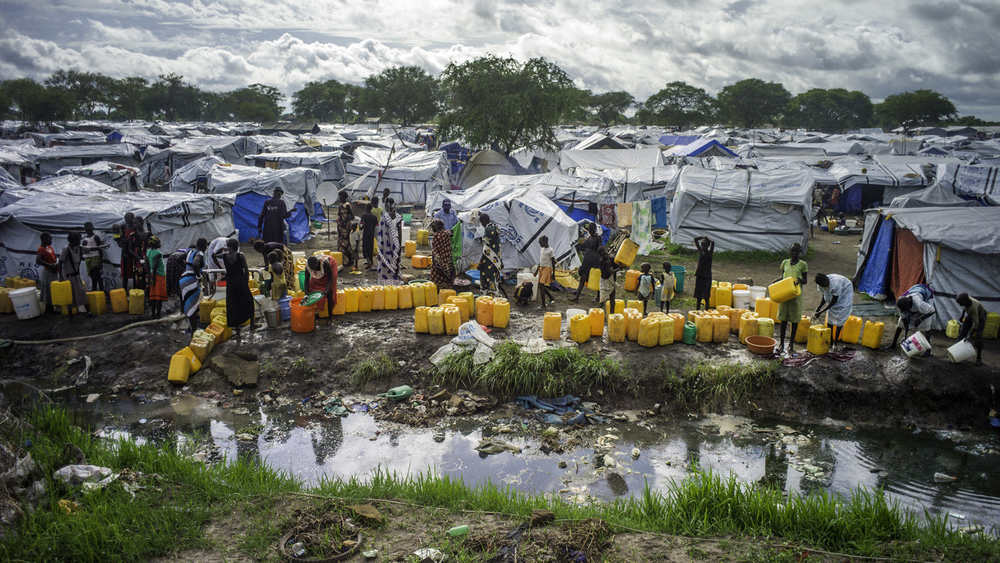
In the POC camp called Malakal, an intention-perception survey was conducted in 2019 to see if people living in Malakal had any intention of returning to their homes and the timeline that they planned to do so. Out of all the people they talked to 44% of households intend to leave the POC site. With 1/3 of them saying they were planning to leave in the next three months.
In focus group discussions, both men and women expressed that they would leave the POC site and return to their old residences if their safety and security could be assured permanently. Almost all participants preferred to remain until “peace prevails”.
“If we witness it, the peace, then we can go outside. If not, better to be here,” says Teresa, a mother of three who is originally from Mayendit who is now living in the Bentiu camp. “But what I want to add is that all the women from South Sudan, all the people of South Sudan, hope for peace. ”
However, on September 4th, 2020 South Sudan’s peacekeeping mission (UNMISS) has issued a statement saying it was withdrawing peacekeepers from POC cites.

“The POC sites were set up to protect people in imminent physical danger and they did so for many different ethnicities, for many years,” said UNMISS head David Shearer. “But today, many stay just to access services.”
These sites that were protected by UN peacekeepers will now be turned into Internally Displaced People (IDP) camps that are under the control of South Sudan’s government. This is cause for concern due to the fact that the UN has accused both sides of committing war crimes as well as the government being the primary source of civilian suffering.
Shearer continued to say that UNMISS would continue to monitor the former POC sites and would be in a position to act if something went wrong but, “we believe that we have got more important issues to focus our forces on rather than controlling a group of people who we don’t believe is under threat”.
Many South Sudan citizens feel differently “… it can even leave a security vacuum … the POC is far from town, it’s an isolated area … protecting the civilians, is risky,” said Tet who is living in a POC camp in Juba.
Many people currently working in South Sudan agree. “[UMISS] are not doing this because they think the sites are now safe. They are doing this because they do not want the responsibility,” said a humanitarian worker (who remained anonymous for the purpose of the interview).
“Now, if people die on these sites, UNMISS can say that it is not their fault. The UN does not want to be blamed for failing to protect civilians in South Sudan, as they failed to protect civilians in Srebrenica,” they added, referencing the 1995 incident where 8,000 individuals were killed in a UN “safe area”.
Internally displaced people are one aspect of South Sudanese people waiting to return to their homes while still in their country of origin. In Malakal, 80% of respondents to the survey stated that if they owned a house or property, it was destroyed. This is a problem that will be common for many people, unfortunately, displaced inside South Sudan or currently residing in refugee camps in neighboring states.

In Sudan, MSF (more commonly known as Doctors Without Borders) has noted that many people want to return home and get back to their normal lives. These people, however, prefer to stay in Sudan until the situation “calms down”. Even with the current ongoing peace process, there has not been a significant decrease in refugees residing in Sudan.
In Uganda, Beatrice is a 19 year old who fled South Sudan with her husband and baby after her mother was raped and killed. She currently lives in Imvepi Refugee Settlement as one of 95,000 refugees.
“They brought us to this place in Uganda. Now that we are here, I feel relieved. We came to a country where you see there is no disturbance, you can sleep and we do not have to run in the middle of the night under the sounds of the bullets. There is peace here and our plan is to stay and try to make our life,” she says.

However, life in a refugee camp is not easy. Access to water is limited and food can be hard to get a hold of. Refugees often survive by leaning on neighbors and friends in the camp. “We have not eaten and any water that you get even down at the sewage you just drink to survive, even though it is dirty. After boiling you can drink it but if you don’t do it the dirt still remains,” Beatrice says.
When asked if she wanted to return to South Sudan when the conflict ended Beatrice said something that might surprise some people.
“South Sudan is my country, but I do not feel happy if they will take us back. I am not going back, because I lost all my family there. I have nothing to come back to, so I would like to stay in Uganda.”
Another refugee named Malis lives in Bidi Bidi, Uganda’s largest refugee camp. There he was reunited with his wife and his youngest daughter who were separated during the chaos of the conflict. “I have my wife back, the children are in school. I am able to farm and sell vegetables to support the children and help out my neighbors” he said. But Malis, despite the newfound life stability that he has in Uganda says all he wishes for is an end to the war in South Sudan so that he can go home.
“Home is home, every minute of every day one thinks ‘when will I go home?'”.
Malis is not alone in his opinion. Jackie Sitima is 24 years old who learned how to tailor while in Bidi Bidi, and due to funding given by Caritas, the nonprofit, she has opened a shop that sells homemade clothes.
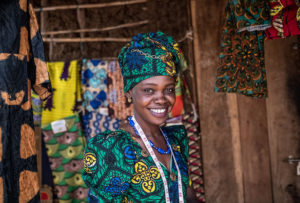
“When I do go back to South Sudan I will bring with me the skills I have learned to build a better life.”
I know that three stories do not represent the opinions of 1.6 million refugees both in Uganda and Sudan. Also, because of how most states set up their refugee programs, staying long term is usually not an option. So while Beatrice felt safe publicly admitting that she did not want to return home, many other people who might share her opinion might not feel comfortable coming forward. It is also extremely hard to gather information while this conflict is currently happening. These stories do, however, highlight several key issues that both host states worry about as well as refugees themselves.
Host states are faced with many problems with the arrival of refugees. It challenges these states to find extra resources, money, to provide even basic provisions to help thousands of people that aren’t citizens. The international community can help, but the responsibility ultimately falls to the host country.
Refugees face different problems than say migrants simply due to the fact that they did not choose to leave. Refugees left because their lives and the lives of their children were in danger and most want to go back to their country of origin after the conflict is over. But in cases like Syria and South Sudan, predicting when the conflict will be truly over and the country will be safe and stable enough for its citizens to come back is a difficult question. But what do these people do in the mean time?
Most countries deal with this dilemma by putting refugees in to camps. That way they are not taking as many resources away from the locals and international aid organizations can have easy access to refugees for easy aid distribution.

The amount of time refugees tend to be displaced is another problem host countries have to solve. The average stay in a refugee camp is now 17 years. To be in a different country for 17 years moves aid and care for these people far past the emergency phase. However, since refugee camps are supposed to be temporary, temporariness becomes permanent. This can put refugees into a permanent limbo situation where they are only able to live until the next day instead of creating a semi-permanent life. Because if refugees are allowed to put down roots will they not want to go home?
Like migration, refugees tend to challenge the very nature of states. The issues of things like citizenship, culture, national identity are all brought to the forefront of debates and issues. The fact that refugees are supposed to be a temporary problem for host countries that then stretches to almost 7 years in the case of the South Sudanese refugees can create further tensions.
The most challenging part can sometimes be remembering the pain and the suffering that individual refugees go through. These refugees from South Sudan have survived incredible violence and horrors. They did not want to leave their country, but they had to in order to survive. They did not leave as most migrants do in search of better job opportunities or living conditions. More than anything else, refugees usually want stability and safety.
Sources
Nicholson, Patrick. “South Sudan Refugees: Life in Uganda Refugee Camps.” Caritas, 5 Oct. 2018, www.caritas.org/2018/09/south-sudan-refugees/.
Devictor, Xavier. “2019 Update: How Long Do Refugees Stay in Exile? To Find out, Beware of Averages.” World Bank Blogs, 2019, blogs.worldbank.org/dev4peace/2019-update-how-long-do-refugees-stay-exile-find-out-beware-averages.
Hayden, Sally. “UN Peacekeepers Withdraw from South Sudan Civilian Protection Sites.” The Irish Times, The Irish Times, 29 Oct. 2020, www.irishtimes.com/news/world/africa/un-peacekeepers-withdraw-from-south-sudan-civilian-protection-sites-1.4393475.
Mold, Francesca. “UN Protection of Civilians Sites Begin Transitioning to Conventional Displacement Camps.” UNMISS, United Nations Mission in South Sudan , 4 Sept. 2020, unmiss.unmissions.org/un-protection-civilians-sites-begin-transitioning-conventional-displacement-camps.
Turner, Simon. “What Is a Refugee Camp? Explorations of the Limits and Effects of the Camp,” Journal of Refugee Studies, Volume 29, Issue 2, June 2016, Pages 139–148, https://doi-org.proxyiub.uits.iu.edu/10.1093/jrs/fev024
Writer , Staff. “South Sudan Profile – Overview.” BBC News, BBC, 27 Apr. 2016, www.bbc.com/news/world-africa-14019208.
Writer , Staff. “South Sudan Refugee Crisis: Aid, Statistics and News: USA for UNHCR.” South Sudan Refugee Crisis: Aid, Statistics and News | USA for UNHCR, 2020, www.unrefugees.org/emergencies/south-sudan/.
Writer , Staff. “The Life of South Sudanese Refugees in Uganda on Hold: Beatrice’s Story.” Oxfam International, 17 Aug. 2017, www.oxfam.org/en/life-south-sudanese-refugees-uganda-hold-beatrices-story.
Writer, Staff. I Am a South Sudanese Refugee Who Left the Country Due to Conflict and Returned Back to South Sudan. 2020, help.unhcr.org/southsudan/who-are-you/i-am-a-south-sudanese-refugee-who-left-the-country-due-to-conflict-and-returned-back-to-south-sudan/.
Writer, Staff. “Key Facts about Refugees and Asylum Seekers’ Rights.” Refugees, Asylum-Seekers and Migrants | Amnesty International, 2020, www.amnesty.org/en/what-we-do/refugees-asylum-seekers-and-migrants/.
Writer, Staff. “South Sudan.” South Sudan | Global Focus, 2020, reporting.unhcr.org/node/2553?y=2020.
Writer, Staff. “South Sudan: Thousands of People Trapped in Poor Conditions at Protection of Civilians Sites.” Doctors Without Borders – USA, 20 June 2019, www.doctorswithoutborders.org/what-we-do/news-stories/story/south-sudan-thousands-people-trapped-poor-conditions-protection.
Writer, Staff. “South Sudanese Refugees in Sudan, What You Need to Know: MSF.” Médecins Sans Frontières (MSF) International, 15 May 2020, www.msf.org/south-sudanese-refugees-sudan-what-you-need-know.