This Part 3 of my exploration into educational outcomes for migrants. You can find Part I and Part II here. In this post, I will be looking specifically at outcomes for migrants in Germany – how do migrants fare educationally in comparison with German natives? Education is seen as a way in which migrant families can “economically catch up over generations with the native population.”1 Lack of sufficient education over entire groups of migrants can lead to a more economically and socially segregated society.
My research into the same question in the Russian context yielded conflicting results. It seems that migrant children have particular trouble registering in schools due to certain requirements, like requiring a parent’s legal documentation. But some research finds that, in terms of educational outcomes like reading scores, there is no difference between migrant and native children. I have the sense that this is not true in Germany.
Germany is home to the highest number of migrants of Turkish origin in Europe. At present, there are upwards of 3 million people of Turkish origin living in the country.2 About every second foreign student in Germany holds a Turkish passport, and about 16% of all 15-year-old migrant students have at least one parent born in Turkey.3 Because of these realities, much of the data on this topic relates specifically to Turkish migrants living in Germany.
There exist significant differences in educational attainment between migrants and native children in Germany. Soehn, in her article “The educational attainment of Turkish migrants in Germany,” attributes these differences not to specific educational policies aimed at migrants and their children, but rather to the overall educational regulations.3 To understand the specific ways in which migrant children, specifically those of Turkish origin, underperform, it is necessary to understand the German education system.
The German Education System
Education is handled by each regional state, not by the federal state, so there are differences depending on a child’s geography. Kindergarten is universally free for all children and is important, especially for children of migrants, because it is the last place to learn the German language before entering primary school. In 2000, 47.1% of foreign three-year-olds attended kindergarten, while the number for all children was 56.3%.4 This difference may not seem so striking considering we’re discussing three-year-olds, but kindergarten attendance seems to predict future academic success in migrants more so than in native children: 51.4% of migrant children who attended kindergarten entered intermediate or higher secondary school tracks, while only 21.3% of non-attendees did the same.5 This holds true only for migrant children. Likely, this has to do with learning the German language.
Children next go on to primary school. At the end, each child will receive a recommendation for which secondary school track they will continue onto. There are three and they have a clear hierarchical order: Hauptschule, Realschule, and Gymnasium, where they receive the Abitur certificate. Only Gymnasium provides entrance to university, while the others provide entry to vocational schools. Each child’s track is decided for them very early on, and it is very difficult to reverse this decision further into their educational career. Depending on which regional state they are in, the recommendation most likely comes from the school and is based chiefly on their academic performance. Because of this early recommendation, educational careers for children are cemented at a very young age.6
In primary schools, where a child’s performance will determine on which secondary school track they will continue, children with a migration background are consistently outperformed by native children. In reading scores, 5% of native children were classified as “weak students,” while 13% of children with a migration background were classified as weak.7 This difference can possibly be attributed to other factors correlated with migration status, such as socioeconomic status or language comprehension. Perhaps the learning environment of specific schools could have something to do with it, as well. Most regional states require children to attend the school closest to them, leading to a concentration of ethnicities and backgrounds in certain schools.
Soehn also points out that a child’s language problems may be misinterpreted by teachers as a learning disability, in which case the child could be referred to schools for special needs and further affect (and in many ways, destroy) their chances to continue on in the Gymnasium track towards higher education. Turkish children’s risk of attending such a school is about twice as high as that of German children.8 These factors all make it so migrant children are less likely to be recommended for the Gymnasium track (higher secondary school). And their chances are, in fact, lower. While grades mostly decide which track a child will continue on, “compared to Germans with the same grades, Turkish and Italian children are still more likely to be recommended for the lowest Hauptschul track.”9 Around one in four migrant children are recommended to enter that lowest track, compared to 17% of native children.10
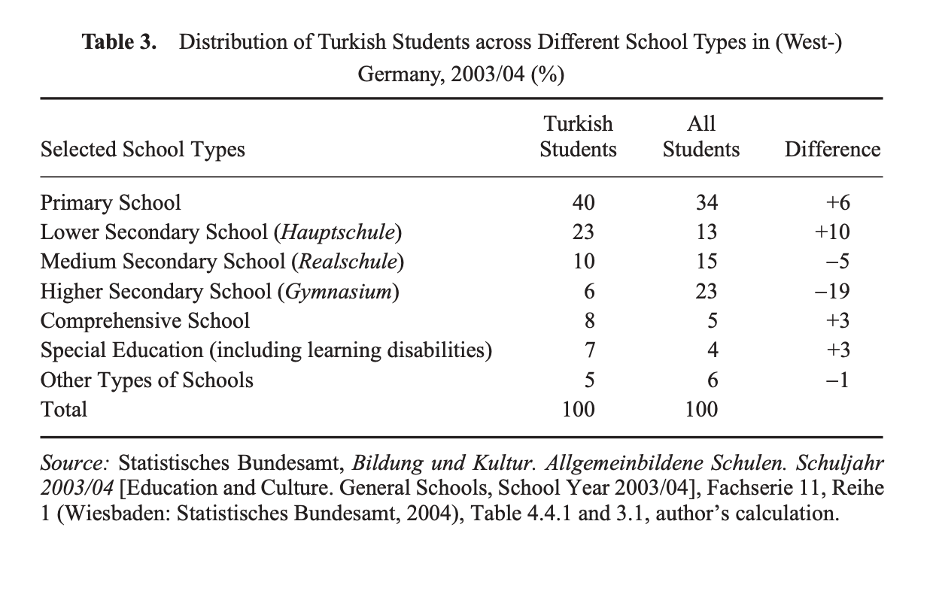
Secondary school performance similarly reveals discrepancies between migrants and natives. Not only do Turkish students perform worse than native German students, they perform lower than all immigrant groups.
Explanations
Soehn offers some possible explanations for the differences. Firstly, migration in general disrupts school careers and makes it so that parents have less social capital compared to native Germans. Secondly, language barriers may prevent migrant students from excelling. Lastly, migrant’s socioeconomic status is usually lower than that of natives. Soehn says that migrant children “have to bear the brunt of the German education systems’ tendency to reproduce social inequality more strongly than any other OECD country.” Ethnically segregated schools, a product of attendance laws making children attend the school closest to their home, may also be segregated by socioeconomic status. These schools likely have fewer resources. Further explaining the gaps in performance is the system that recommends students to secondary school tracks. Soehn explains it here:
“Schools tend to prefer more homogeneous school classes (with regard to academic performance and ‘normal’ student social behavior and language proficiency) as they are considered easier to instruct. As a consequence, if a class at a primary school is regarded as too crowded, migrant pupils with insufficient knowledge of German are seen as ‘problematic’…and thus stand a higher risk of being referred to a special school.”
Once in a special school, the likelihood of being recommended to the higher secondary school track is lower. All of these make it difficult for a child to catch up to other children. Krause believes there are two parts to the gap: some migrant-specific part and then a part that can be explained by the socioeconomic and family backgrounds of migrants.12 The fact that migrant parents have lower “human capital endowment and socioeconomic status” means that they may face systematic barriers to succeeding in school at the same level as native children.”13 These factors are very important to explaining the gap between migrant and native children. In Krause’s analysis, migrant children are found to be around 10 percentage points more likely to get a recommendation for the Hauptschul track (the lowest), and 20 percentage points less likely to be recommended for the Gymnasium track (the highest). But when Krause controls for family background and household characteristics in her analysis, the gap between migrants and natives becomes “virtually zero” for these outcomes.
Based on this analysis, the differences found in Soehn’s paper are possibly due entirely to differences in socioeconomic family background, like household income or parents’ years of education. Renee Luthra confirms, in her own analysis, that parental education “accounts for the largest amount of inequality observed between second generation children and native German children.”14 Luthra even finds that, after controlling for this factor, most migrant groups have even higher odds of completing the highest track, compared to native Germans. This finding is concentrated among those children who have very low educated parents, though. This group, children having low educated parents, is larger among migrants than among native Germans. Given this, Luthra’s conclusion is that “even the relatively advantaged second generation groups have a very long road to reaching convergence in educational outcomes with native Germans.”15
If socioeconomic status accounts for so much of the difference in educational outcomes, maybe we can attempt to get at potential migration-specific differences by comparing migrants in Germany to those left behind in the origin country. Sait Bayrakdar and Ayse Guveli attempt to do just that by comparing migrants of Turkish origin in Europe with non-migrants in Turkey.16 Comparing non-migrants in “high-sending” regions of Turkey to migrants and their descendants from those same regions, they find that migrants in Europe obtain higher levels of education than stayers in Turkey, on average. This analysis further confirms the idea that parental education, and even grandparental education, has positive effects on educational attainment for children. Migration seems to have positive effects on migrants and their descendants in terms of educational outcomes. While these outcomes are not Germany-specific, they give us an idea of how migration affects educational outcomes in Germany.
But there is also the fact that more affluent people are more likely to migrate. There are likely unobserved characteristics that make stayers and migrants inherently different, thus rendering this comparison insufficient. Overall, based on the research that I’ve found, I would say that there are significant differences in achievement between migrant and native children in Germany, but that they are due to socioeconomic status and family situation rather than to some migrant-specific effect. There are several reasons why students with a lower socioeconomic status might underperform. These include failure to learn proper emotional responses, chronic stress, cognitive lags, or malnutrition.17 Regardless of the concrete reasons behind it, this research suggests that to close these gaps, the German educational system in general needs to be reevaluated. How can disadvantaged children, not just migrants, be helped in this context? Scholarships, targeted educational programs?
Potential for Reform
The three-tiered system of sending children to secondary school may also have room for improvement, because the early decision-making that it requires does not give disadvantaged children much time to catch up to their peers before their educational future is set in stone. If a migrant child enters primary school with significant German language difficulties, they have only around 4 years to improve their performance before they are recommended for a track. Research finds that, even beyond the context of migrants, the three-track system reinforces inequalities because academic performance is highly associated with socioeconomic status.18 For example, among children with comparable school performance, “ a child whose parents finished upper secondary schooling faces a 15 percent higher chance of placement in the highest track.”19
Krause recommends that fixing this problem could take several different forms. Firstly, “de-tracking,” or postponing the selection of a child’s track until a later age, could help. Some German states, in fact, track two years later than usual, in the 6th grade. In these schools, students with a lower socioeconomic background have better 9th grade test scores than in 4th grade tracking schools.
My research has led me to believe that the answers to my initial questions are not simple. In fact, many scholars disagree or come to different conclusions based on different analytical methods. In the German case, I do think that the achievement gaps between migrant and native students, even if they are mostly due to socioeconomic differences, shed light on an important lesson: regardless of whether or not a particular policy is aimed at migrants, it is important to consider the ramifications on marginalized groups.
Sources:
1 Krause, A., Rinne, U., Schuller, S. “Kick it like Özil? Decomposing the native-migrant education gap,” SOEPpapers on Multidisciplinary Panel Data Research, No. 508, Deutsches Institut für Wirtschaftsforschung, 2012. https://www.econstor.eu/bitstream/10419/68171/1/733811914.pdf
2 Smith, S., Eckart, A. “Germans of Turkish descent struggle with identity, seek acceptance,” nbcnews.com, 14 August 2018. https://www.nbcnews.com/news/world/germans-turkish-descent-struggle-identity-seek-acceptance-n886961
3 Soehn, Janina. “The Educational Attainment of Turkish Migrants in Germany,” Turkish Studies, Vol. 7, No. 1, 101-124, March 2006.
4 Soehn, 105.
5 Soehn, 105.
6 Krause, Schuller.
7 Soehn, 106.
8 Soehn, 106.
9 Soehn, 108.
10 Krause, 5.
11 Soehn, 109.
12 Krause, Schuller.
13 Krause, 6.
14 Luthra, Renee. “Assimilation in a new context: Educational attainment of the immigrant second generation in Germany,” ISER Working Paper Series, No. 2010-21, Institute for Social and Economic Research, 2010. https://www.econstor.eu/bitstream/10419/65936/1/632259515.pdf
15 Luthra, 47.
16 Bayrakdar, S., Guveli, A. “The Educational Consequences of Migration for Women and Men. Migrant and Europe-born Turkish Origin People Compared to Non-migrants in Turkey,” Institute for Social and Economic Research, No. 2019-8, September 2019. https://www.iser.essex.ac.uk/research/publications/working-papers/iser/2019-08.pdf
17 Jensen, Eric. “Chapter 2: How Poverty Affects Behavior and Academic Performance,” ascd.org, 2009. http://www.ascd.org/publications/books/109074/chapters/How-Poverty-Affects-Behavior-and-Academic-Performance.aspx
18 Krause, A., Schuller, S. “Evidence and Persistence of Education Inequality in an Early-Tracking System: The German Case,” IZA Discussion Papers, No. 8545, Institute for the Study of Labor, 2014.
19 Krause, “Evidence and Persistence of Education Inequality in an Early-Tracking System: The German Case,” 3.
Kristen, C., Reimer, D., Kogan, I. “Higher Education Entry of Turkish Immigrant Youth in Germany,” International Journal of Comparative Sociology, 2008.
Hi Alexie, I have been super impressed with your last three blogs as you’ve done a wonderful job with your research. Your explanations are also very clear. I am curious though… since Turkish migrants form the largest migrant group in Germany and have such a strong diaspora, are there any ways in which the diaspora has stepped in to help strengthen Turkish children’s chances in the German school system? I know you mentioned that socioeconomic difference may account for the disparity in educational outcomes, but I’m wondering what has done at more of a grassroots, diasporic level to try and increase Turkish students’ chances.