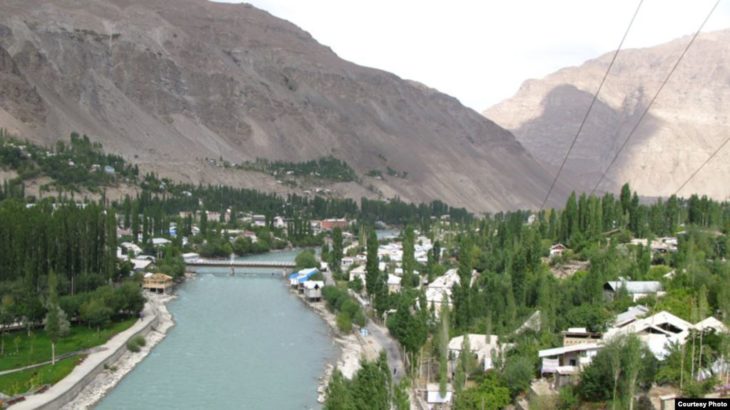
The case of Gorno-Badakhshan Autonomous Region (GBAR), the Pamir people.
The Tajik Civil War of 1992-1994 took the lives of 100 thousand Tajik people and left 55 000 orphans and 20 000 widows. After the collapse of the Soviet Union and the civil war the country faced “severe economic challenges and a seriously lowered standard of living.” Third of the country’s labor force has been migrating to Russia to find work with remittances constituting more than 50 percent of Tajiksitan’s GDP. (Turaeva 2007.)
In 1995, GBAR registered 325 families with only female as the head of the household and 924 orphans as many mothers lost their sons in the war. However, it should be noted that in 1991 at the onset of obtaining independence, the Republic of Tajikistan began constructing a model for providing equal rights to men and women on the basis of socio-economic norms and traditions particular to different regions across the country with the goal of improving women’s independence in decision making over their own lives. This particular phenomenon pushed the new Tajik government to join in numerous conventions that deal with gender, discrimination, human trafficking, protection of migrant workers especially women and children migrants. By 2008 the migration trend had hit GBAR just as much as it did the country as a whole with 12% of the total population of the region leaving the mountains for Russia. (Tuichieva 2011)
In 70 years, from 1931 to 2000, GBAR’s population increased from 30 000 to 210 000 – a rapid growth in a highly mountainous territory. During the Soviet Union, mass migration outside of the region was seen with just a few traveling for school, professional development and research. It is important to note that years before the collapse of the union, GBAR’s secondary schools included as part of their curriculum a strong emphasis on the Russian language and that can also be observed by the fact that all TV channels in the Pamir mountains were mostly in Russian so the initial destination of all labor migrants from GBAR was Russia. However, compare to the older generation discomfort in the language skills is now more prevalent in the youth of GBAR as well as other youth of Tajikistan because during the independence Tajik government reduced hours of Russian language teaching significantly. As De Haas explains the trends and patterns of global migration, in the past many labor migrations were male dominated, and women were often delt with under the category of family reunion, even if they did take up employment. Although the share of female migrants as share of total migration has remained stable at levels of around 46 percent for decades the feminization of migration primarily pertains to the increasing participation of women in labor migration. This is well observed in GBAR because in 2000 almost all migrants were men and starting in 2001 the number of women migrants began to rise. (Kalandarov 2005)
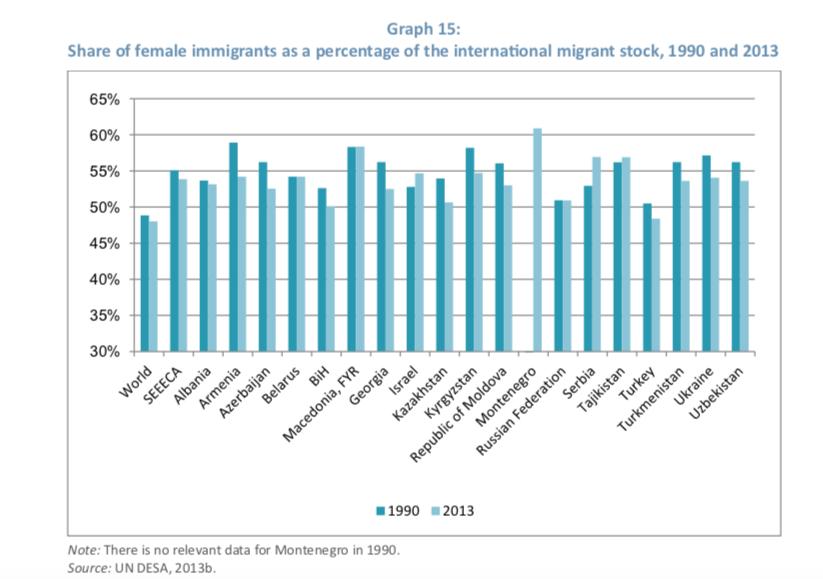
From the International Organization for Migration (IMO)’s facts and trends report, in 2013, 52.2 per cent of all international migrants residing in South Eastern, Eastern Europe and Central Asia were women. This is above the global average of 48 per cent. However, there is a significant variation among the countries in the region: in 2013, at 60.9 per cent, Montenegro had the highest share of women among its migrants, while Turkey, with just 48.4 per cent of women in its migrant stock, had the lowest and Tajikistan being above Turkey but more or less the same since 1990s. (see Graph 15).
De Haas says that “today women workers form the majority in movements as diverse as those of Cape Verdeans to Italy, Ecuadorians to Spain, Ethiopians to the Middle East, Thai to Japan, Myanmar to Thailand, Indonesians to Malaysia, and Filipinas to the Middle East and Europe. However, because of the high presence of female migrant workers in largely informal sectors such as personal care and cleaning, women are often still less visible part of workforce compared to men.”

With women coming to the forefront of migratory movement around the world, in this paper, I would to see how cumulative causation is manifested in the lives of women leaving Badakhshan and the impact of that migration on those left behind. We learned from De Haas that “information is not only instrumental in facilitating migration by increasing people’s migratory capabilities, but new ideas and exposure to new lifestyles conveyed by migrants may also change people’s cultural repertoires, preference, and aspirations.”
It is clear that any impact on the origin country is consistent with the economic status of the families left behind. ‘The number of households consisting of two or more marital units has increased in almost all regions of Tajikistan, leading to the decreasing role of the nuclear family. It is very common for families to merge comprising of two or more “conjugal units particularly striking in the countryside of Tajikistan, where almost all men of working age have left to find work. Families may be composed of the migrant’s elderly parents, his wife and children, and possibly one or more of his brothers, along with their wives and children. one can also find migrants’ families spanning three or four generations, the members of which are only women and children.” (Laruelle M. 2013) This seems to perfectly confirm De Haas’s theory: if migration becomes strongly associated with success, migrating can give rise to a culture of migration in which migration becomes the norm and staying home is associated with failure. Such migration-affected cultural change combined with social remittances can further strengthen migration aspirations.
Labor migration has a significant impact on the development of human capital in Tajikistan. Migrants with higher education send more money and more often than those with lover education levels even though no migrant ever works according to their profession. Migrants returning home tend to make their biggest contribution through small business, especially women who open shops in the market but less on the overall country’s development. Families with a returning migrant will benefit from new skills and slightly higher income leading to better diet and health for children. Overall migration benefits are far less than its negative impact on the families (Hohmann, S. 2014)
One such negative impact of social change and migration has been the normalization of polygyny and the idea of agency exercised on the part of the man and the woman who agree to it. (Thibault 2018) What I find interesting is that no article about these marriages mention that it has always been customary for a Tajik man to go into a formal contract nikkah (marriage) in order to live with a woman, these types of “temporary” marriages existed during Soviet Union as well, especially when men were students in Russian universities and usually the contract ended when a man finished school/work and decided to return home he then gets married to someone from their own culture/village. In my opinion, the difference today is having been married first back home and now forced to live in Russia for work, kind of in a reverse, in any case this type of marriage is culturally not only accepted but is actually encouraged and is usually premised on the basis of one acting in accordance to the ethic of their faith.
The parents and men in general continue to have authority over youth and women in Tajikistan; however, large male out-migration and matrimonial separations cause diversification of gender roles and the growth of matrifocal families, in which women who are heads of households have increased power (Zotova and Cohen, 2017). I will cover more from this article on the next post.
Most readings so far reinforce the notion of gender inequality and women’s subversion across all of Tajikistan and I imagine Badakhshan is not that different from the rest of the country. The education level and lack of profession or skills have made it very difficult for women to stand on their own and make decisions. Fathers, husbands and in-laws are the ruling force in the lives of Tajik women. Migration and social remittance have not made a drastic difference in the lives of the majority of households. I will be touching on this aspect a bit deeper. (Abashin 2015) Of course, there are exceptions where women across all of Tajikistan who have gone to work, study outside of the country and have chosen to stay and take on a role of a provider. There are several in my circle of friends and family who have chosen to stay single, establish themselves in the west and provide for the family in Tajikistan.
In the 2019 Human Development Report, UNDP introduced a new measure, the Gender Development Index (GDI), based on the sex-disaggregated Human Development Index (HDI), defined as a ratio of the female to the male HDI. The GDI measures gender inequalities in achievement in three basic dimensions of human development: health (measured by female and male life expectancy at birth), education (measured by female and male expected years of schooling for children and mean years for adults aged 25 years and older) and command over economic resources (measured by female and male estimated Gross National Income per capita). (National Human Development Report: Tajikistan.) I would like to look into this report closer as I research more about feminization of labor, migration and the shifting role and status of women in Tajikistan.
In my next post I will explore the notion of power functions in intra – and inter-familial domination and repression, and to see if the country’s gender dynamics help social remittances or negate the potential positive impact that new ideas and social norms can bring to societies. I will work with Colette Harris’s work to understand how Tajikistan works with gender as the traditional norms are making a strong come back into the households. I will also look a bit deeper at Abashin’s anthropological view of the Tajik people and the stories he includes in his work. I will also look at Hegland’s comparative analyses of gender dynamics in Tajikistan and Iran to see how a community can actually control the younger members.
To bring my research back to the Pamir people, I would like to read through Sarfaroz Niyozov’s “The Realities of Being a Woman-Teacher in the Mountains of Tajikistan” where he presents a female who is an active participant during a radical transition from Soviet to post-Soviet periods and see how some of the theories discussed by De Haas and the authors that focus on migration, gender and interconnectedness of being a female at a time of social changes in labor, household and economy. In another article, Niyozov talks about teachers choosing to go into trade and abandon their roles as the teachers and how that has impacted the school quality and the quality of education for a generation or two.
Adbulloev, et al highlight that international migration and education effect labor force participation decision and its gender gap. In this article, it is said that international emigration from Tajikistan with 93.5% of the participants are men reduces labor force participation by men domestically but increased female tertiary education increases female participation which contribute to reducing the gender gap.
Another interesting way to present labor migration and its impact on the society in Badakhshan is bring a comparative analysis between Tajikistan and Afghanistan and explore patterns around the role and status of women in both countries. Soviet Union socialized the idea of education as the key factor in the lives of women in Tajikistan and consistently situated the idea of Tajiks being better off in the Soviet system compare to those in Afghanistan. I will go over the article that does just that, puts together the two countries approach to youth and education. I will look for enrollment of girls and their success associated with that education. (Whitsel and Mehran, 2010)
References:
- Turaeva, M. (2007), ‘Monetary Indicators’ Measurement in Economy Dependent on Migrants Remittances (Case of Tajikistan)’, paper presented at the conference, ‘KCTOS: Knowledge, Creativity and Transformations of Societies’, Vienna, 6–9 December, http://www.inst.at/ kctos/speakers_t-z/turaeva.htm.
- Tuichieva, S. N., (2011) Istoria Razvitia Gendernikh Otnosheniy v kulture Pamira (Konec XIX-nachalo XXI vv.) Dissirtacia na soiskanie uchionoi stepeni kandidata istoricheskikh nauk. Dushanbe, Institute Istorii, Arkheologii, Etnographii, im. A. Donisha, Akademii Nauk Respubliki Tajikistan
- Kalandarov, T.S. (2005) Pamirskie migranti-ismailiti v Rossii. Isledovania po prikladnoi i neotlozhnoi etnologii.
- Migration Facts and Trends: South-Eastern Europe, Eastern Europe and Central Asia (2015) International Organization for Migration. Regional Office for South-Eastern Europe, Eastern Europe and Central Asia Dampfschiffstrasse 4, 6th floor, 1030 Vienna, Austria
- Laruelle M. (2013) Migration and Social Upheaval as the Face of Globalization in Central Asia, Vol 34, Leiden, Boston
- Hohmann, S, et al., (2014) Development in Central Asia and the Caucasus, Migration, Democratisation and Inequality in the Post-Soviet Era. I.B. Tauris, London, New York.
- Hegland, M. E. (2008) A Discourse of Complaint: Precursors to a Mass Women’s Movement in Tajikistan?, Anthropological Field Research about Aging and gender in Tajikistan, Koln, Bohlau.
- Thibault, H. (2018) Labour Migration, sex, and polygyny: negotiating patriarchy in Tajikistan. Ethnic and Racial Studies. Online Journal tandfonline.com
- Zotoba, N. et al., (2020) Left Behind? Russia’s Entry Bars and Gender Relations in Tajikistan, The Ohio State University, Columbus, Ohio, USA
- Featured Image: The town of Khorog serves as the capital of Gorno-Badakhshan. Asia Plus.
- Adbulloev, I. et al., (2008) Migration, Education and the Gender Gap in Labour Force Participation. Open Society Institute, Dushanbe, Tajikistan.
- Niyozov, S. (2004) The Realities of Being a Woman-Teacher in the Mountains of Tajikistan. Cahiers D’Asie Centrale. Open Edition Journals.
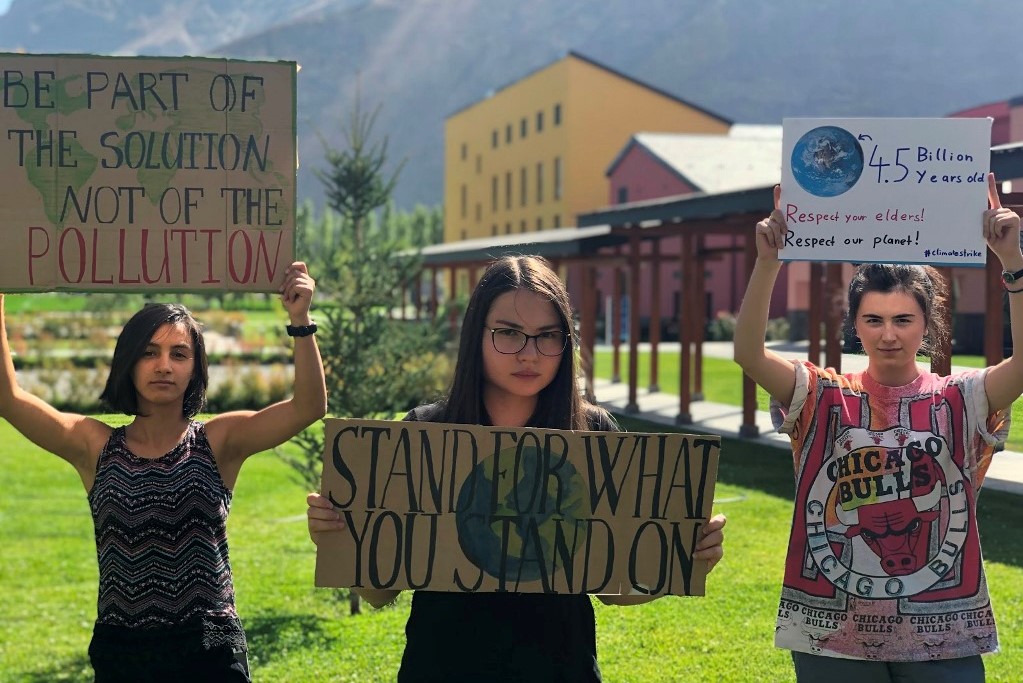
- Image in line: Asia Plus: Tajik Greta Thunberg. Eco-Activist Shares Her Ideas How to Help the Environment. University of Central Asia.
- Image in line: Birds Migrating. https://pixabay.com/service/license/
I read it, and I’ll provide some comments soon.
Hi Purnur-
I found the following line from your post interesting and a little ironic: “in 1991 at the onset of obtaining independence, the Republic of Tajikistan began constructing a model for providing equal rights to men and women on the basis of socio-economic norms and traditions particular to different regions.” My first thought, perhaps over simplified, was that norms and traditions do not coincide with equality. How do the expectations of domestic heavy roles for women give them the chance for equality? As I read on though, I realized they had to learn about how to do this, to provide gender equality and I applaud them for their efforts.
In the graph provided that shows the percentage of female migrants by country in 1990 and in 2013, I noticed Armenia had a decrease of about 5% which does not help in closing the gender gap; however, from my research, I learned that the job sectors typical of Armenian women are more available at home.
It is unfortunate that migrant workers are unable to obtain positions that match their trade or education. I look forward to (maybe your next post) that delves into the dimensions of human development and therefore how opportunities and expectations for women are changing.
Finally, my apologies if I overlooked something, but do you know the reason for the population growth and then decline in the mountainous region? Perhaps economic opportunity for the latter, though with lower Russian language skills I am not sure.
I really liked your blog post as I knew nothing of the civil war in Tajikistan in the 1990s. It is always interesting to see how a post-war-torn country’s female population adapts after a crisis such as this. One interesting thing you brought up were the concept of remittances and how many people when they return home, reinvest in women’s businesses. Many female migrants who come home end up opening shops with the money they made abroad. I found this concept unique and was wondering if you had any more information on how remittances open up opportunities for women in business?
I very much enjoyed reading your post and liked the comparison you added with migratory birds. One of the things that struck me was the mass population increase in the GBAR from 1931 to 2000. Why was there such a big population increase during this time and in this region? I have always found the shifting of gender and leadership roles after conflicts and ethnic cleansing to be quite interesting. I appreciated your analyzation of this in the first portion of your post. I also like how you tie in personal experiences with data– it makes your posts all the more interesting to read. You end your post by touching on the potential for better education amongst Tajik women and the graph you included shows a slight increase in the percentage of Tajik women who migrate. Do you believe the number of women who participate in the migration economy of Tajikistan will continue to increase?