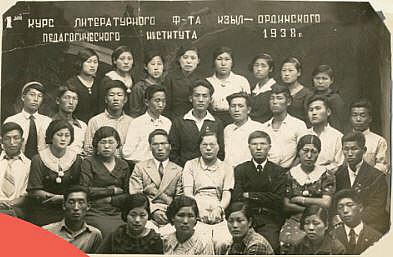
Whereas my previous blog post outlined the lives and livelihoods of ethnic Koreans in the Russian Far East prior to their exile in 1937, my next two posts will shift gears slightly, focusing more on the status of the Korean language among Koryo saram throughout the past century. This post will track the maintenance of the Korean language from the perspective of more formal social institutions such as newspapers, language policy, and Korean language pedagogy.
What is the language of the Koryo saram?
This question is undeniably tricky to answer. By virtue of their name, we might first associate a variety of Korean with the Koryo saram. This was, indeed, the case. Today, there are very few Korean-language speakers left, most having taken up Russian as their primary language. In this way, Russian is undeniably a language of the Koryo saram. This blog series will, however, be looking at the story of the Korean varieties spoken by the modern Koryo saram as well as their ancestors.
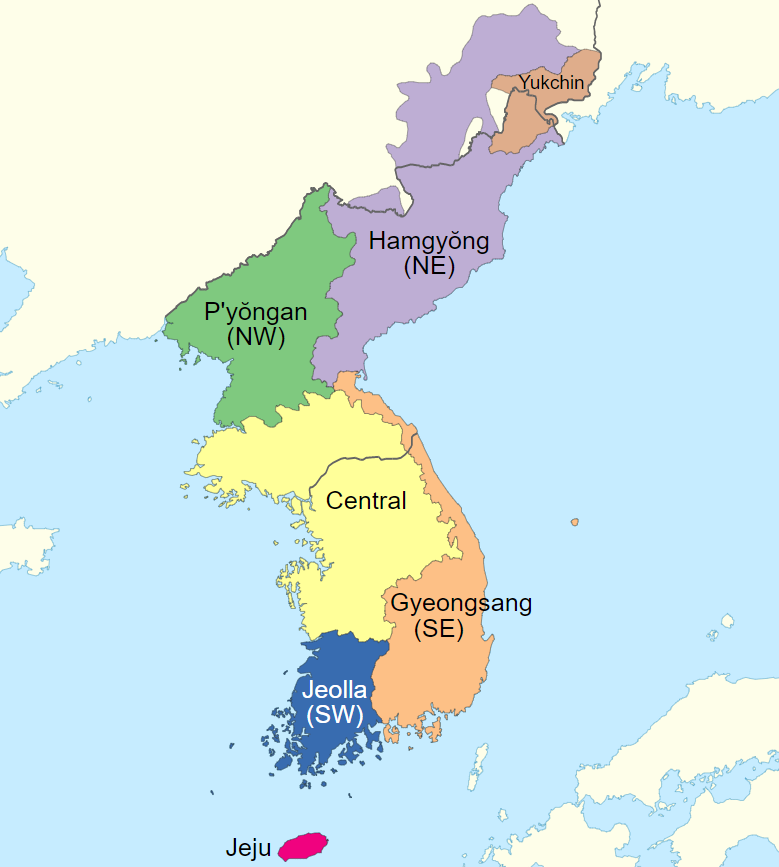
This map distinguishes seven varieties of Korean.[1] They can be called “dialects”, but this term is often too polarized to be of any use. While the peninsular varieties are largely mutually intelligible – if readily distinguishable from one another – the Jeju is sometimes considered a separate language, and Yukchin a subdialect of the Hamgyeong variety with many Middle Korean archaisms.
The migrants from the Korean Peninsula spoke varieties of Korean, chiefly the Hamgyeong and Yukchin varieties[FN to KING]. As processes of language contact affected both the speech of the Koryo saram and that of the Koreans on the peninsula, a quite distinctive variety emerged among the Koryo saram called Koryo mar. This is the language of the elderly Korean speakers of the Koryo saram community[FN]. It is mostly mutually intelligible with the modern Seoul standard variety. However, both varieties have many imported words (in Koryo mar, from Russian and Turkic languages; in the Seoul standard, mainly from English). Furthermore, the dialectal differences between the ancestors of both varieties still exist, further hindering communication.
Early Divergences – Newspapers from the 1920s
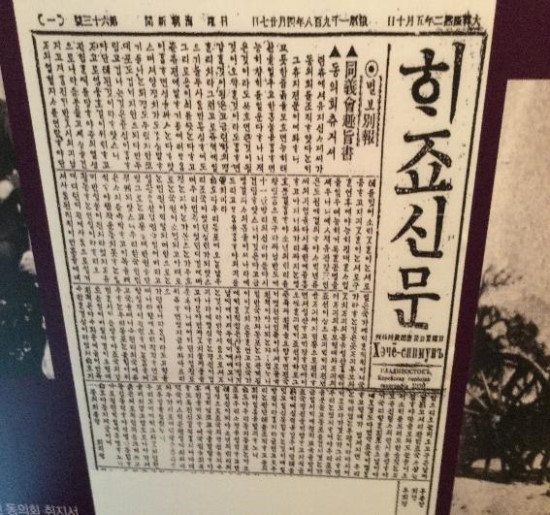
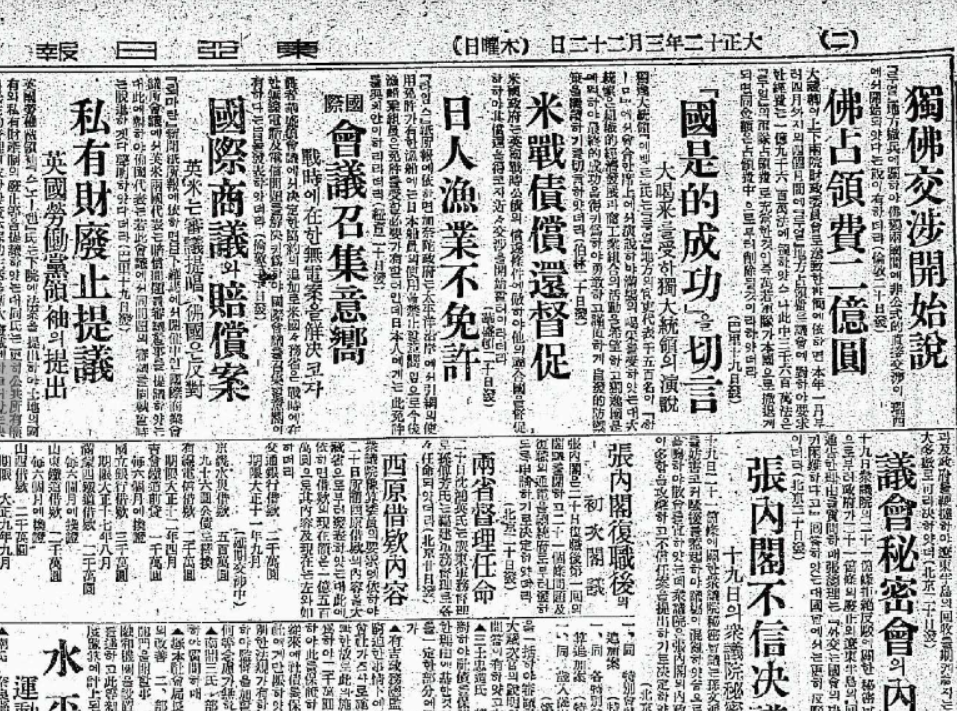
The language of the Koryo saram was different from the language of the majority of the Korean Peninsula from the beginning, as the majority of the Peninsula spoke the Central dialect. Being a part – willingly or not – of the “Russian” sphere of the world and the Japanese sphere set further divergences into motion. These are readily visible when comparing newspaper clippings. Below are two newspapers. The first is a Koryo saram publication; the second is a Korean Peninsula one. Both were published in 1923.
Status of the Korean language among Koryo saram: An overview
Prior to their forced migration, the Koryo saram were known to have very high levels of Korean language retention, even among the 2nd, 3rd, and 4th generation migrants. This is indicative of strong intergenerational transmission of the language, a key factor in assessing the vitality and/or endangerment of a language. Much of this has to do with very tolerant policies of the early Soviet Union. From 1923, Koreans in the Far East were educated in Korean. In 1930, Korean orthography was more-or-less unified within the Soviet Union, a development very much still in progress back on the peninsula. Newspapers, schools, and even theatre productions were available in Korean (and will be discussed further in the coming sections), providing the Korean language a very solid foundation in large social institutions.
Interestingly, many of these same institutions remained in some form even after the 1937 forced migration. However, it was after the migration that language shift to Russian began to feature more prominently within the Koryo saram community. According to 1979 census data, only 55.4% of the 340,000 Koreans in Central Asia claimed Korean as their mother tongue, but 92.1% of this total number could speak Russian fluently. This implies a large degree of bilingualism, a situation which further implies heavy Russian influence on the Korean varieties spoken in the USSR (Kho, 1987:101).
Exile
In September of 1937, nearly the entire population of ethnic Koreans living in the Far East and Maritime regions of the Soviet Union were forcibly displaced to Central Asia. In total, over 170,000 individuals were put on trains and shipped out to the Kazakhstan and Uzbekistan SSRs, where they were later dispersed throughout different areas in the Soviet Union.
Accompanying this exile was a widespread purge of Koryo saram communist party officials. Accused of being spies, these individuals were executed, dealing a massive blow to leadership and organization within the Koryo saram community.
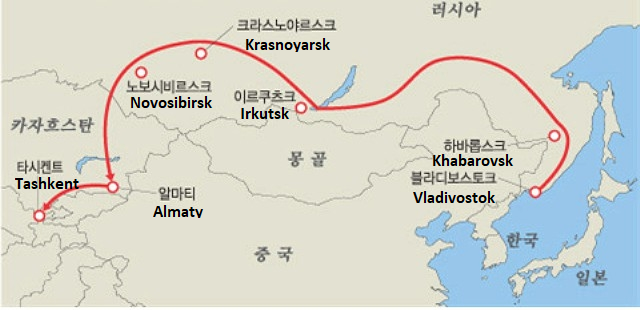
Adapted from: https://www.pressian.com/pages/articles/168113#0DKU 프레시안(http://www.pressian.com), 고려인이주150주년기념사업추진위원회 [The Koryoin Migration – 150-Year Anniversary Project Promotion Committee]
The journey of over 4,000 miles across took approximately one month to complete. Conditions on the train were dire, and the trains themselves eventually became known as “Ghost Trains”, in reference to the many who died on the journey.
The displaced Koreans were removed from their cities, homes, and farms in the Far East and quite literally “dumped” out into the unfamiliar lands of Central Asia. The Soviets provided limited provisions for the Koryo saram, leaving their resettlement largely in the hands of local Kazakhstani and Uzbekistani SNKs (Council of People’s Commissars).
With the deportations beginning in September and continuing over the next three months, most Koryo saram arrived in Central Asia in late autumn and early winter. This seasonal fact was calamitous to the already devastated people. With little wood to construct houses, many Koreans in Ushtobe were forced to dig holes in the ground to escape the bitter winter winds.
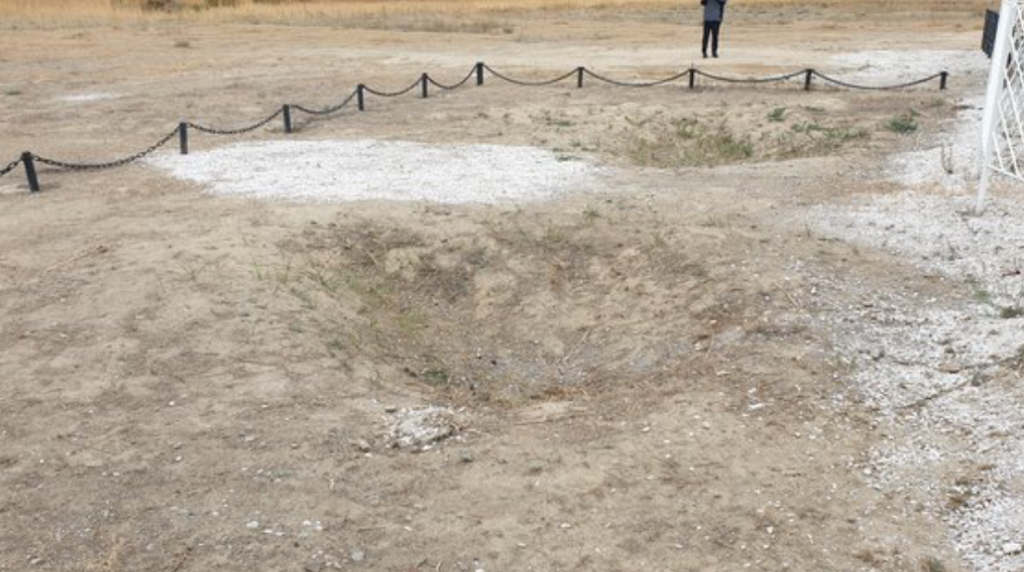
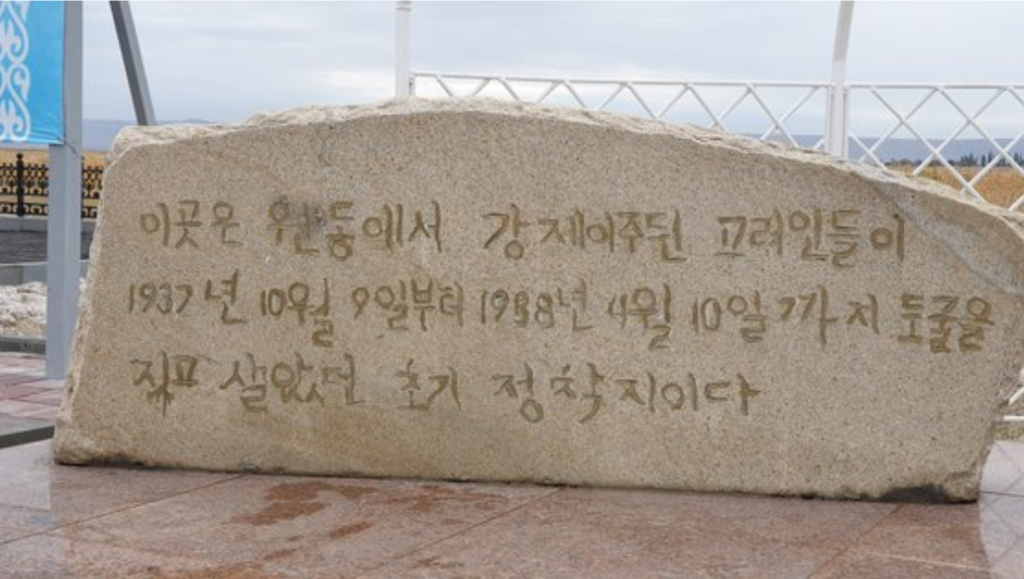
The exile and forced displacement did much more than move people from one place to another. It threatened to kill the very roots of ethnic Korean identity in the Soviet Union. The land the Koryo saram had tilled, their houses, their schools, their printing presses, and their communities were razed, leaving an intense struggle for mere survival for the first few years in Central Asia.
Data regarding language use during these early years in Central Asia is rather scarce. However, after a few more years, more and more consistent publications emerge in the Korean language. In fact, some of the very same social institutions that had facilitated the language in the Far East came to be reconstructed in Central Asia. Why, then, did the Koryo saram shift to Russian more rapidly after their forced movement. The sections below will explore some of these language-facilitating institutions, all the while working toward identifying causes of language shift.
Newspapers
Newspapers have a long history among the Koryo saram. The first such publication was the Shinhan Minbo (1904), published by the Military People’s Association. The Haejo Shinmun was first published in Vladivostok in 1907, the Daedong Shinbo in 1909, and the Daeyangbo in May 1911.
Lenin Kichi – “Lenin’s Banner”
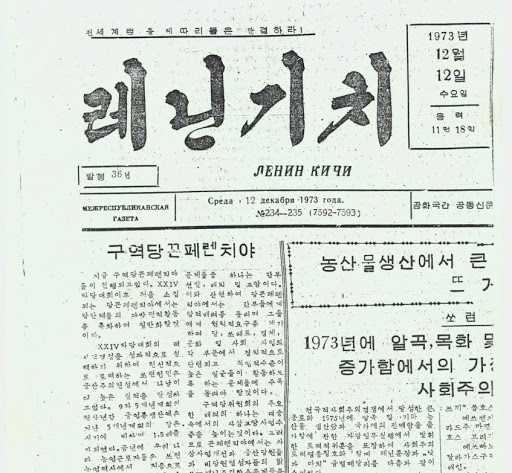
The Lenin Kichi was an almost-daily (6 days/week) Korean-language newspaper published in the Kazakhstan SSR from 1938 to 1990. Chung (2006) notes that, though it was published in Korean and distributed throughout Koryo saram kolkhozes, few people – if any – could still read it. Kho (1987: 112) notes that the language in the Lenin Kichi largely adheres to North Korean orthographic norms (a statement that my limited dataset does not yet confirm), and that this “literary Korean” in the newspaper was very different from the language as it was actually spoken at the time. In this way, we begin to see cracks in the veneer of “inclusive” Soviet language policies. Nominally, Korean-language media was available and, to some extent, encouraged. This language was, however, completely out of touch with its intended audience.
Koryo Ilbo – “The Koryo Daily News”
The fall of the Soviet Union saw the reorganization of many social structures within these suddenly “post-Soviet” states. Naturally, one of the first items to be done away with was the newspaper title Lenin Kichi. Its successor is the Koryo Ilbo, and it is still published in Kazakhstan. It is just one of several newspapers and magazines published with a Koryo saram target audience.
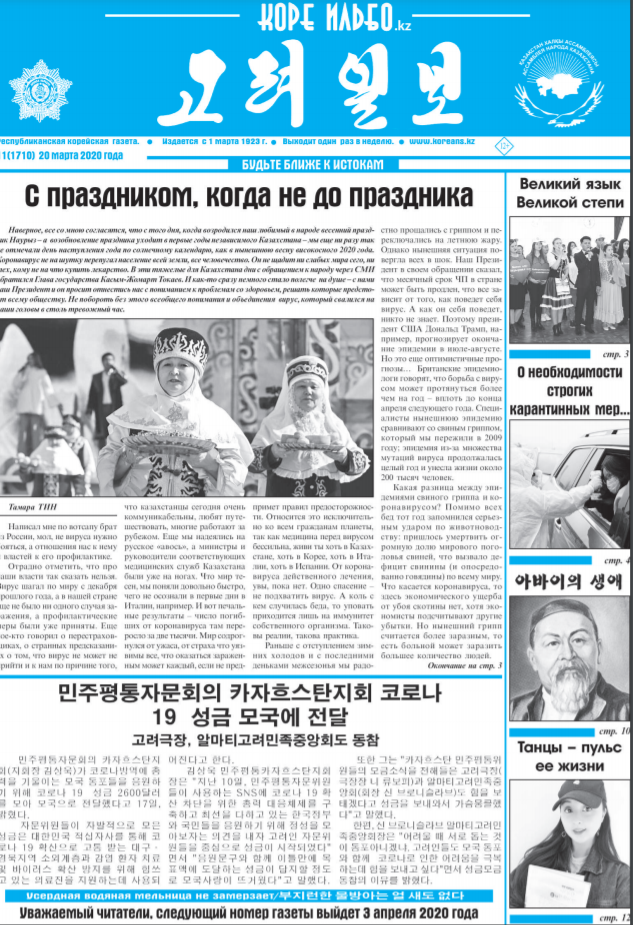
This newspaper is bilingual in Russian and Korean, but seems to be more oriented toward Russian speakers, something that is perhaps indicated by the first article of each edition appearing in Russian.
The picture below features a piece from the recurring “Russian-Korean Dictionary” section of the Koryo Ilbo.
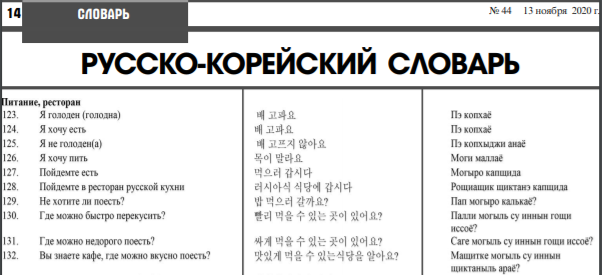
arirang.ru, Koryo Ilbo newspaper archive
It is called “Russian-Korean Dictionary”, but functions more like a phrasebook. In each issue, these general phrases are clustered around a theme meant to aid the readers in real-world Korean-speaking situations such as ordering food (this issue), crossing a border (issue #45), and getting around town (various issues).
The phrases above are given in three columns. First is the Russian text, next is the Korean translation in the han’geul script, then finally the Cyrillic transliteration of the Korean han’geul. This structure leads us to the obvious – but still very important – idea that this section is intended more for Russian speakers learning Korean than Korean speakers learning Russian. Interestingly, the third column with the transcription was first added in issue #41 (October 23, 2020). We can make all kinds of inferences as to why this transliteration has been added to more recent issues. Perhaps readership has expanded to include non-Koryo saram. Perhaps the Koryo saram this newspaper targets are largely unfamiliar with the han’geul script, thus necessitating a transliteration. In any case, the authors of this section found providing a transliteration to be necessary, so we can assume at least a sizeable group within the readership does not know han’geul.
National Theatre
The Far Eastern Regional Korean Theatre was founded in 1932 in Vladivostok, and exists to this day in Almaty, Kazakhstan. The theatre has the unusual history of being deported along with its actors. One part of the theatre ended up in Kazaskhstan (at first, Kyzyl Orda, later Almaty), the other in Tashkent.
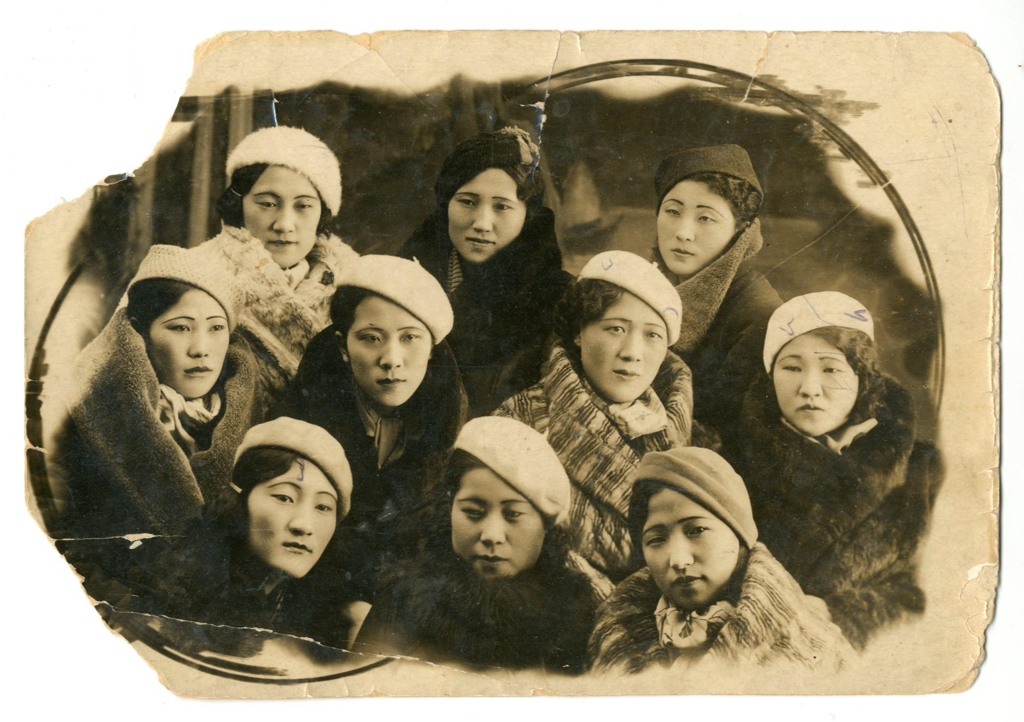
Though beginning as three different theatre groups in Vladivostok, when forcibly moved to the Kazakhstan SSR, these groups formed one unified national Korean theatre. It was one of seven national theatres active in Almaty.
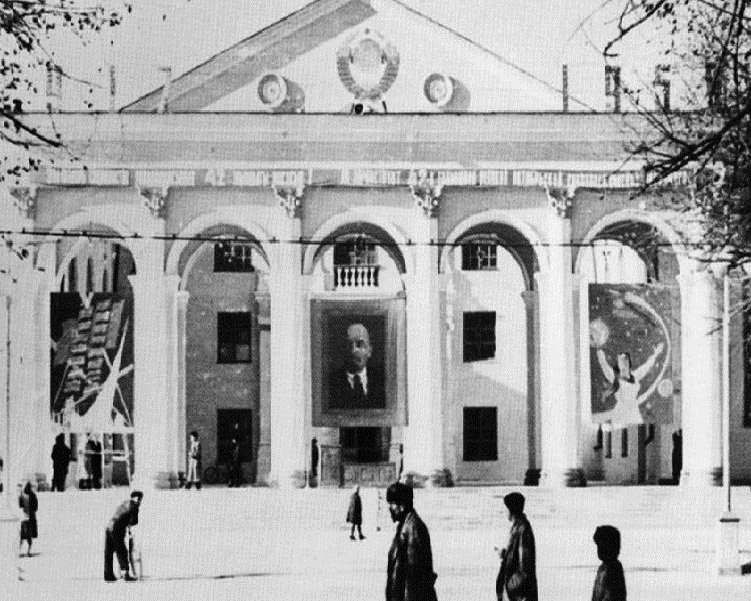
The activities of the theatre featured prominently in the Lenin Kichi. On the 50th anniversary of the founding of the theatre, the newspaper even ran a whole-page article entitled “The 50th Anniversary of the Proud Soviet Korean Art (On the Occasion of the 50th Anniversary of the Establishment of the Kazakh Republic National Korean Music and Comedy Theatre)” (Kho, 1987: 141).
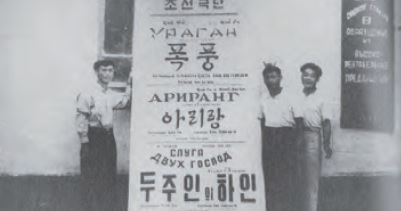
Though underscored as a pillar of the Koryo saram community (see Kho, 156), the theatre began shifting to more Russian-language productions. This shift was expedited by the lack of Koryo saram actors able to speak Korean and the smaller crowds that Korean-language productions would bring. Furthermore, there were fewer teachers of traditional Korean song and dance available.
Schooling
Whereas Korean language instruction suffered greatly during the Japanese occupation period, in the Far East, the Korean language enjoyed a fair degree of use as a medium of instruction. With Korean schools being offered officially from 1923 and the unification of the Soviet Korean script in the 1930s, the use of Korean appeared to be expanding in its domains of use among the Koryo saram, reaching all levels of education.
Unfortunately, I have been unable to gather much data regarding the use of Korean in schools in the period immediately following the forced displacement of the Koryo saram. Additionally, the period just after their movement is comprised of the years of World War II, a time in which little attention would likely have been devoted to developing Korean language learning materials for students.
Kho (1987) has managed to track down a few readers used in Uzbekistan for elementary-aged students, as well as evidence of the Korean language being actively taught in the SSR. Still, it appears as though by the 1980s, Korean had fallen completely out of use in schools. There does not seem to be any law expressly prohibiting the use of Korean as a language of instruction. The answer to why Korean was no longer used in schools likely has something to do with its utility among would-be speakers. Russian would have been a far more “economic” choice of language knowledge. At this point, this blog post can only speculate about why the Korean language was no longer deemed useful to the Koryo saram. In any case, in addition to not being seen as “useful”, it is also very likely that the Korean language lacked the prestige (a measure of social capital) that other languages would have offered. This question will be explored more thoroughly in my next blog post.
The Korean Language at Summer Camp
Over the past three decades, with the normalizing of relations between South Korea and former Soviet Republics, South Korean language teachers have been welcomed into Central Asia. Jeongmin An (2020) surveys these observations of South Korean teachers as they taught the Korean language at a 2019 summer camp which lasted for ten days and nine nights. The students were some 80 Koryo saram youth from Uzbekistan, Kyrgyzstan, Ukraine, and Tajikistan.
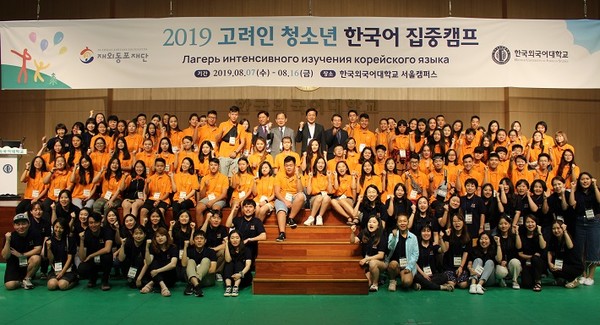
Teachers noted that while many of the students knew very little Korean (some not knowing more than “My name is…”), many students who did know some of the language seemed to know words from K-pop.
One teacher expressed his frustration over the use of “cutesie” speech among his students, and he attributed its appearance in his class to its widespread usage among K-pop stars. The default polite ending for a Korean verb is the suffix “-yo”. We hear this in things like the greeting annyeonghaseyo “hello” or saranghaeyo “I love you”. A more recent development in Korean is a way to make speech sound “cuter” by adding an -ng to the -yo ending, giving something like annyeonghaseyong. In English, this might be like saying “hewwo” instead of “hello”. Apparently, students love to add this to their speech. While deeply amusing to me, I can understand the ire of a prescriptivist teacher trying his best to teach “proper” Korean.
The Future of Koryo Mar
Language death is a painful topic, no matter how many times it happens or how “natural” it may be in contact situations. A professor in college always advised me to think of languages that are no longer spoken not as “dead”, but as dormant. In this way, we can imagine these varieties being revived and/or reclaimed one day. This is exactly what happened with Hebrew, and what is ongoing throughout the Americas with indigenous languages like Ojibwe, Navajo, and Lakota, among so many others.
Regardless of the effort and well-wishes put into these reclamation efforts, the success of the program is constrained by a host of societal factors including relative prestige of the language being reclaimed, resources to devote to the efforts (teachers, books, curriculum), and motivation to learn the language. One of the most important factors is the applicability of a variety in a learner’s life. If young Koryo saram are learning Korean at all, in order to immediately utilize it, they need to learn a variety that is widely used elsewhere. For this reason, I believe it to be highly unlikely that Koryo mar will see a resurgence in use and transmission.
Instead, though Koryo mar may well become further and further restricted in its usage, there may be room yet for a reconnection with a Korean language modeled on a South Korean variety.
Whereas this blog post examined formal institutions that facilitate language, my next blog post will focus on language transmission on an interpersonal and intergenerational level. It will look at how language indexes parts of identity, and how elements of both language and culture can thrive long after a language falls out of vernacular use.
Bibliography
An, Jeongmin. “A Study on Korean Language Education for Koryeoin Youths in CIS -Focusing on FGI of Korean Language Teacher”. [CIS지역 고려인 청소년 한국어 교육에 대한 소고 -한국어 교사 FGI를 중심으로-].” Studies in Foreign Language Education 34, no. 1 (2020): 263–90.
Buchkin, Andrew. “KOREANS UNDER COMMUNISM,” 2020, 18. Chung, Y. David. Koryo Saram – The Unreliable People. Documentary, 2006. http://www.koryosaram.net/about_film.html.
Lee, Ki-moon, and S. Robert Ramsey. A History of the Korean Language. New York: Cambridge University Press, 2011.
Kho, Songmoo. Koreans in Soviet Central Asia. Studia Orientalia,0039-3282 ;61, 262 p. Helsinki: Finnish Oriental Society, 1987. //catalog.hathitrust.org/Record/003157270.
King, J.R.P. “An Introduction to Soviet Korean.” Language Research. 23, no. 3 (1987).
Kim, German, and Ross King. “The Northern Region of Korea as Portrayed in Russian Sources, 1860s– 1913.” In Northern Region of Korea : History, Identity, and Culture, edited by Kim Sun Joo. University of Washington Press, 2010.
King, Ross. “Blagoslovennoe: Korean Village on the Amur, 1871-1937.” The Review of Korean Studies 4, no. 2 (n.d.).
Pohl, J.O. Ethnic Cleansing in the USSR, 1937-1949. Contributions to the Study of World History. Greenwood Press, 1999.
Saveliev, Igor. “Mobility Decision-Making and New Diasporic Spaces: Conceptualizing Korean Diasporas in the Post-Soviet Space.” Pacific Affairs 83, no. 3 (2010): 481–504.
Zatsepine, Victor. Beyond the Amur: Frontier Encounters Between China and Russia, 1850-1930. Canada: UBC Press, 2017.
Useful Sites
Encyclopedia of Korean Culture (Korean)
Arirang.ru (Russian) Has archives of Koryo saram publications
The comparison of 1923 newspapers is fascinating. I wonder whether pre-Japan Korean papers generally featured fewer Chinese characters? Good discussions of changing use of Korean. Part of the issue in Central Asia was that Koreans did not live in compact, large communities. They were dispersed. They often opened their own small branch of a large kolkhoz, and the kids would have attended schools with children of the majority on the kolkhoz, so providing a Korean teacher would have been quite unusual. The second issue would be the lack of teacher training for instruction in Korean. There were “small language” divisions at several of the pedagogical institutes in Uzbekistan and Kazakhstan for certain languages (Tajik, Uyghur, even Dungan in Kyrgyzstan), but was there a Korean section at one of them? When did scholarship on Koryo Saram begin in the Academies of Science (i.e., where German Kim and Valeriy Kim became scholars)?
Such an interesting blog post! I loved your image choices–relevant, helpful for understanding, and interesting. The blog overall was very clear and readable, though there were some areas where I might have appreciated a little further explanation (If I don’t know what Japanese reign years are it’s hard to look for them for comparison, though of course this is also easily googleable).
I appreciated your mention of K-Pop because I had been wondering about it as I read the earlier parts of the blog. In my experience in Georgia (and in the United States) I’ve noticed a definite increase in interest in Korean language study strictly because of K-Pop. You mention that this and other reasons of utility might encourage Koryo Saram to learn a more mainstream version of Korean. I wonder if K-Pop-influenced Korean learning would also encourage younger Koryo Saram to be more interested in their history and then from there Koryo Mar?
Do you know if the Lenin Kichi was more widely read at the beginning of publication and then readership dropped, or if it was always more symbolic than useful?
Hey Corrina, thanks for the informative and captivating blog post. I found your post easy to follow and learned a lot about the decline of Korean among the Koryo saman living in Central Asia. In your explanation of the Koryo Ilbo you mention that there is a recurring “Russian-Korean Dictionary” section that provides phrases in Russian, their translation into Korean and then transliteration back into Cyrillic characters, which I found very interesting. Does the theme of this section have anything to do with the other articles, or is it simply a random theme that changes every edition?
Another thing you mention that caught my attention was the Korean Language Summer Camp that invites teachers from South Korea to teach Korean to Koryo saman youth in Central Asia. Since the youth doesn’t speak Korean very well, if at all, they are heavily influenced by linguistical trends found in K-pop, which frustrates the teachers who desire to teach them ‘pure’ Korean. Did you find any evidence or testimonials that discussed how successful, or unsuccessful, this summer program is in revitalizing interest in Korean? Has there been in an increase in Korean proficiency among this community since the program started?
Regardless, I thoroughly enjoyed your post.