This is the continuation of an examination of the effects of recent sanctions against Iran on Iranian migration. In this half I explore more specific circumstances caused by the sanctions that have affected the people of Iran and their decision to leave the country.
Petrol & Protests
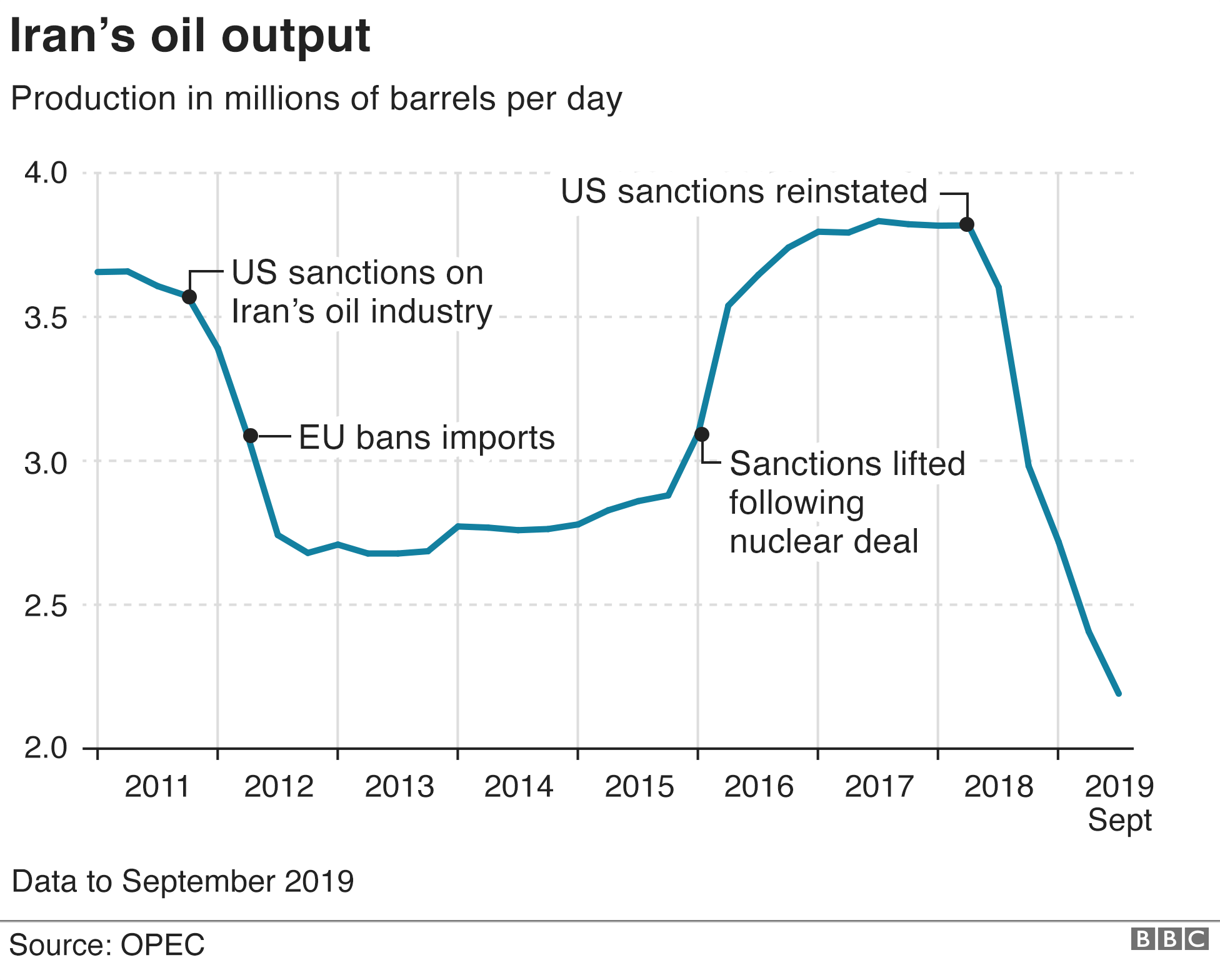
In November of 2019, thousands of protesters took to the streets in more than 100 Iranian cities.4 Citizens were angered by the overall economic situation and the announcement that gas prices were to rise up to 200%.4 President Rouhani claimed that the revenue generated by the increased gas prices would be used to help those most impacted by the economic downturn.7 During this time, the Iranian unemployment rate was at 12.5% and the state’s oil exports had declined by 80% since 2018 — a direct result of president Trump’s decision to remove the United States from the Iran nuclear deal.4 Iran had experienced similar protests in 2017 and 2018 in response to economic decline.7 The major difference between these protests and the most recent in 2019, was that of the response of the Iranian government.
Shortly after the 2019 protests broke out, Supreme Leader Ayatollah Ali Khamenei gave the order to Iranian officials to put down the protests by any means necessary. The result was incredibly bloody. While the number of casualties is disputed, data gathered from institutions such as hospitals and morgues estimate the number of protesters killed by Iranian forces to be 1,500.4 Why is this significant? What does it have to do with migration?
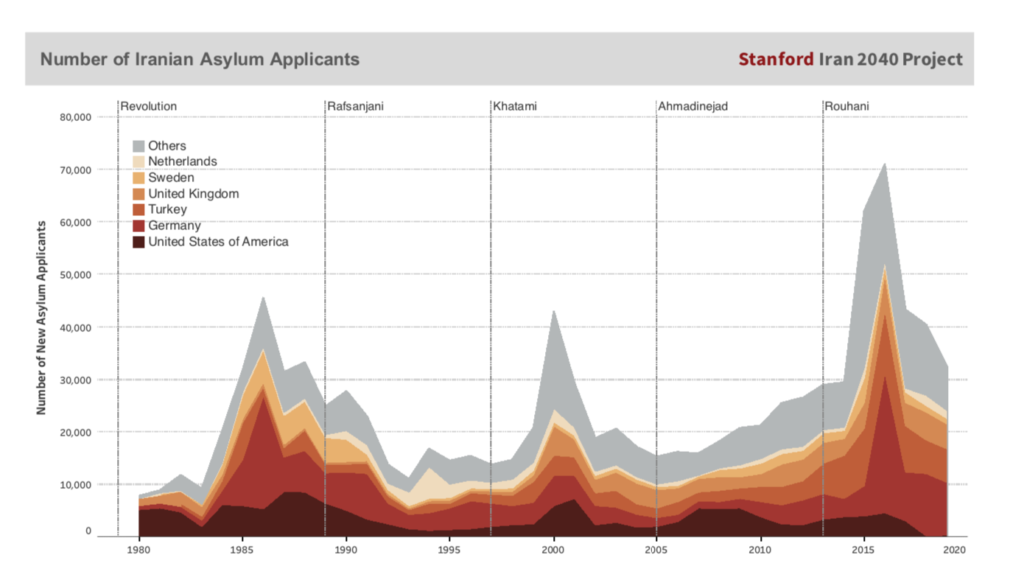
Iranian migration trends show a pattern of spikes in emigration after large government crackdowns, specifically in relation to protests.1 Violence against citizens creates further mistrust of the government and incentivizes individuals to leave Iran for the benefit of their safety. There is a significant tendency for rates of asylum-seeking to increase after large instances of violence towards citizens by the Iranian state. For example, the student protests of 1999 which also culminated in the deaths of citizens, led to the second significant wave of asylum seekers since the 1979 revolution.1 The 2017 to 2018 protests also caused greater flows of migrants leaving Iran, and the 2019 protests are no exception.1 In this way, the current sanctions are not only precipitating events on their own, but they also have created smaller precipitating events that lead to more emigration.
If they are not staying in Iran, where are these individuals going? During and shortly after the suppression of protesters, many Iranians fled to Turkey.3 Those who are able to go to Turkey find that they are more able to openly discuss what is happening in Iran. In Istanbul, a gentleman named Mahyar commented on the extent of the situation, saying ” Everyone — it’s not just the middle class. Even the rich are without hope now because no investments are coming in. They only answer people with bullets, torture, prison and lies.”3
Rials and Turkish Real Estate
Iranian migrants are not just going to Turkey in order to escape human rights abuses and overall oppression by the Iranian state, but for more favorable economic conditions too. Since the beginning of the latest Iranian recession, Iranians have sought fiscal refuge in Turkey. This is consistent with the overall trend of increasing migration to Turkey from Iran. Since 2013, the number of Iranians living in Turkey has skyrocketed by nearly ten times the original rate.6 In 2013, the Turkish Statistical Institute (TurkStat) reported a total of 3,831 Iranians living in Turkey, while in 2018 the number had gone up to 32,111.6
The recent sanctions have understandably created mistrust in the Iranian economy amongst the public. As a result, investments in the Iranian economy have rapidly decreased and citizens are looking towards liquid stores of value and foreign currencies.1 This has a cyclical effect on the economy, making it even weaker and furthering a loss of faith from the public. How does this tie into migration to Turkey? For those with means, Turkish real estate offers an affordable and safer investment opportunity. Iranians are not only able to funnel their savings into a more stable market, but they can also receive Turkish citizenship in exchange for their purchase.8

Since the 2018 Turkish currency crisis, the Turkish government has made the pathway to citizenship through property investment easier for foreigners. Instead of the prior investment of $1 million, foreign nationals now only need to pay $250,000.8 If an Iranian citizen buys Turkish property at this level or higher for either his/her home or business and agrees to not sell the property for at least three years, he/she may apply for Turkish citizenship.8 This policy is meant to increase investment in the Turkish economy, and many Iranians have been taking advantage of it lately. The number of Turkish properties purchased by Iranians nearly doubled in early 2018.8 Additionally, from September of 2018 to October of 2019, over 981 individuals became Turkish citizens; more than 250 of which were from Iran.8 Iranians are therefore incentivized to migrate to and settle in Turkey.
Bibliography
1Azadi, Pooya, Matin Mirramezani, and Mohsen B. Mesgaran. “Stanford Iran 2040 Project, An Academic Platform for Research on Iran’s Long-Term Sustainable Development.” Stanford University, April 2020. https://iranian-studies.stanford.edu/sites/g/files/sbiybj6191/f/publications/migration_and_brain_drain_from_iran_final.pdf.
2Iran’s Oil Output. BBC News. OPEC, 2019. https://www.bbc.com/news/world-middle-east-48119109.
3Kenyon, Peter. “Iranians Fleeing To Turkey.” NPR. National Public Radio, December 14, 2019. https://www.npr.org/2019/12/14/788056542/iranians-fleeing-to-turkey.
4Reuters staff. “Special Report: Iran’s Leader Ordered Crackdown on Unrest – ‘Do Whatever It Takes to End It’.” Reuters. Thomson Reuters, December 23, 2019. https://www.reuters.com/article/us-iran-protests-specialreport/special-report-irans-leader-ordered-crackdown-on-unrest-do-whatever-it-takes-to-end-it-idUSKBN1YR0QR.
5Spicer, Jonathan. Cheaper Homes, Promise of Passports Draw Iranians. Reuters. Refinitiv Datastream, 2019. https://fingfx.thomsonreuters.com/gfx/mkt/12/6784/6715/Pasted%20Image.jpg.
6“Turkish Migration Source by Country 2018.” Turkish Statistical Institute, December 31, 2018.
7Williams, Mark. “Breaking News, World, US, DC News and Analysis.” The Washington Post. Bloomberg, December 2, 2019. https://www.washingtonpost.com/business/energy/irans-protests-are-about-more-than-rising-fuel-prices/2019/11/20/dab82c10-0b89-11ea-8054-289aef6e38a3_story.html.
8Wither, Emily, and Ezgi Erkoyun. “Iranian Home Buyers Dodge Sanctions, Make Turkey Their Plan B.” Reuters. Thomson Reuters, October 1, 2019. https://www.reuters.com/article/us-turkey-iranians/iranian-home-buyers-dodge-sanctions-make-turkey-their-plan-b-idUSKBN1WG3ON.
The graph with spikes of asylum seekers has one moment that interests me: the lack of any such trend in 2009. The very largest anti-government demonstrations took place in 2009, the so-called “Green Revolution”. This followed an election where Ahmedinejad won with a mere plurality of votes. The protests lasted for quite some time, were put down in a bloody way, and failed to change things. I wonder why that episode was not followed with an asylum-seeking spike?
I had exactly the same thought. I did some quick research (Spiegel and Human Rights Watch) and found that there was a steady increase in the number of Iranian asylum applicants from the years 2009-2011. I only wonder why the increase doesn’t appear more dramatically on the graph. I have a couple theories as to why this is. The first is discouragement of asylum seeking. From what I read, Germany (the main destination country at the time) was quite particular as to whose applications they would approve. The Spiegel article I read said they were only approving applications filed by those with occupations like journalists and photographers. I could see this as a factor that would discourage Iranians from seeking asylum in Germany. Additionally, the first destination of many post- Green Revolution was Turkey. There, they claimed refugee status. Later on these refugees applied for asylum in other (European) countries. If the distinction is made between asylum and refugee status, this could potentially in-part explain the more steady increase in asylum numbers rather than spike post-2009.
As to underlying economic issues, check out Iran fuel subsidies. The price rises that triggered protests were in response to the government saying it would cut fuel subsidies–which are very large in Iran. Of course fuel subsidies help those with cars and not those without, those with large houses more than those with small houses, so many economists see them as regressive.
Thank you for the suggestion; I will be sure to look into that.
I think you’ve done a really good job of illustrating the economic impacts of US sanctions on Iranian oil revenues, and synthesizing that with data on the Turkish housing market to show where migrants might go and why.
Do you think there is anything that Iran could do unilaterally that would improve living conditions to retain more of its population? Iran has recently signed treaties with Russia and China for long-term economic development, and it will be interesting to see if this has any impact of migration. If anything, making alliances with countries such as Russia and China reduces the United States’ bargaining power.
Hi Jackson, thank you for your question and apologizes for the very late reply. The notification of your question ended up in my spam box. I agree with your assessment that cooperation with Russia and China does reduce the United State’s bargaining power, but not to the degree one might think . Agreements for long-term economic development are doing nothing to help Iran dig itself out of this hole. With the way the current regime operates, it is more than willing to hold out as long as possible. In my opinion, the Iranian government has made it clear that the ball is no longer in their court. The only way I see the country getting out of this recession relatively soon is if the United States lets up on sanctions. I also don’t think these alliances would shift migration. With the path the state is on now, I could see migration increasing when the coronavirus pandemic subsides, but Iranians will continue to migrate to the countries that they always have (Germany, Sweden, the U.S., etc).