In my last post I discussed the perilous lives of the Kolberi– Iranian Kurds who traverse the Iran-Iraq border for a living. Specifically, I delved into the effects of economic sanctions on the Kolberi system. This post will examine how these sanctions have recently impacted and continue to impact the Iranian economy and consequently Iranian migration. What are the sanctions imposed on Iran and what effect do they have on the Iranian economy as a whole?
Implications of Sanctions at the Macro Level
The United States government has a long history of imposing sanctions on the Islamic Republic of Iran, beginning with a round of sanctions during the 1979 hostage crisis at the U.S. embassy in Tehran. Recently, a series of sanctions have been instated under the Trump presidency. There have been various types of sanctions imposed by the U.S. in 2018 and 2019 for a variety of reasons including, but not limited to, Iran’s nuclear and ballistic missile buildup. The most recent sanctions that target large Iranian banks were introduced by president Trump on October 8th of this year.4 The aim of this move is to disconnect Iran from the international financial system (IFS) .4 As a result of these compounding sanctions, the Iranian economy has dove into a deep recession.
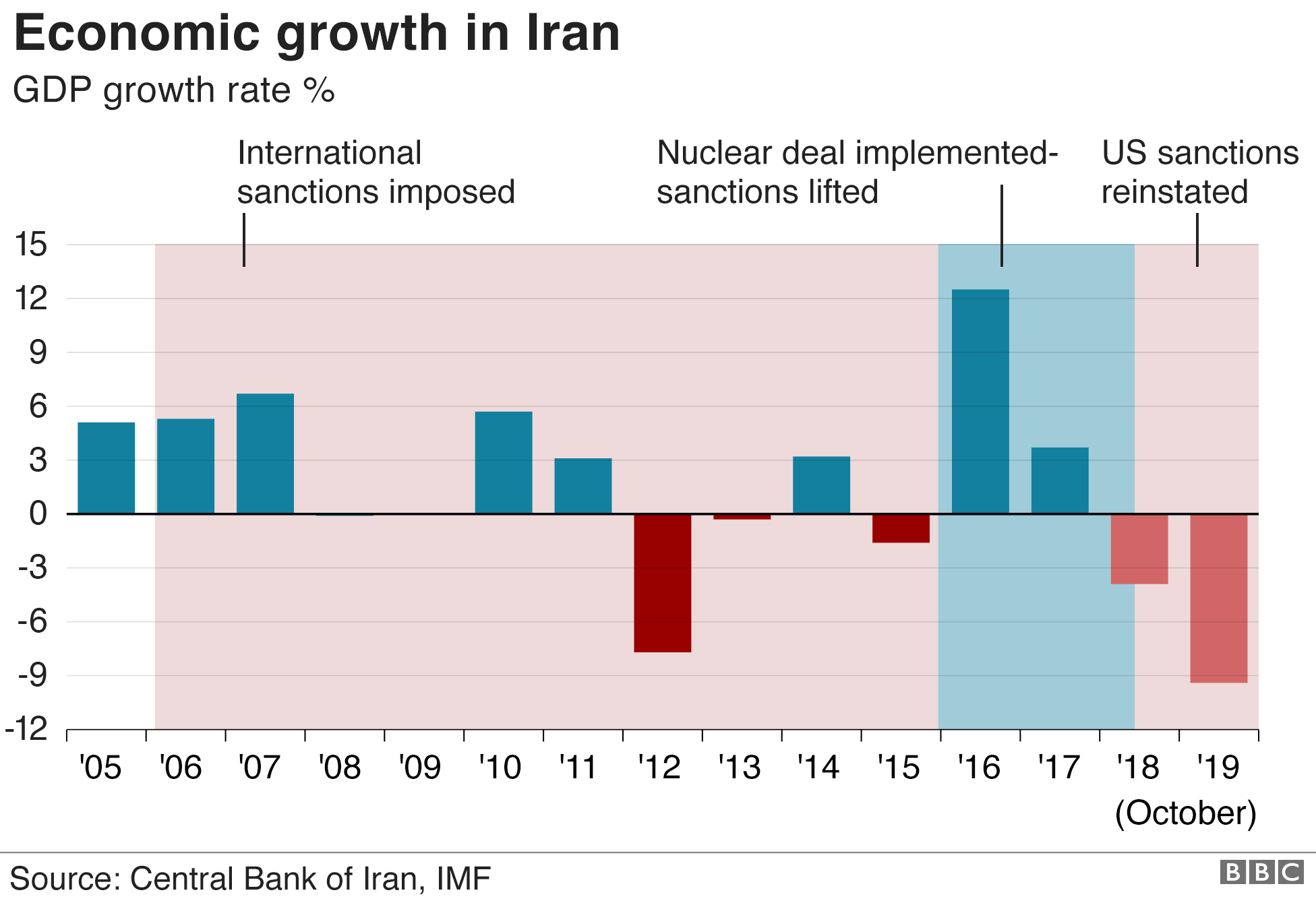
In May of 2018 after Trump withdrew the United States from the Joint Comprehensive Plan of Action (JCPOA), he began reimposing all sanctions that were lifted by the stipulations of the agreement.6 A decline in the Iranian economy consequently ensued. That year, it was predicted by the International Monetary Fund that the Iranian economy would experience a contraction of 1.5% followed by a contraction of 3.6% in 2019.6 By September of 2018 the inflation rate reached a new high of 31.4%.6
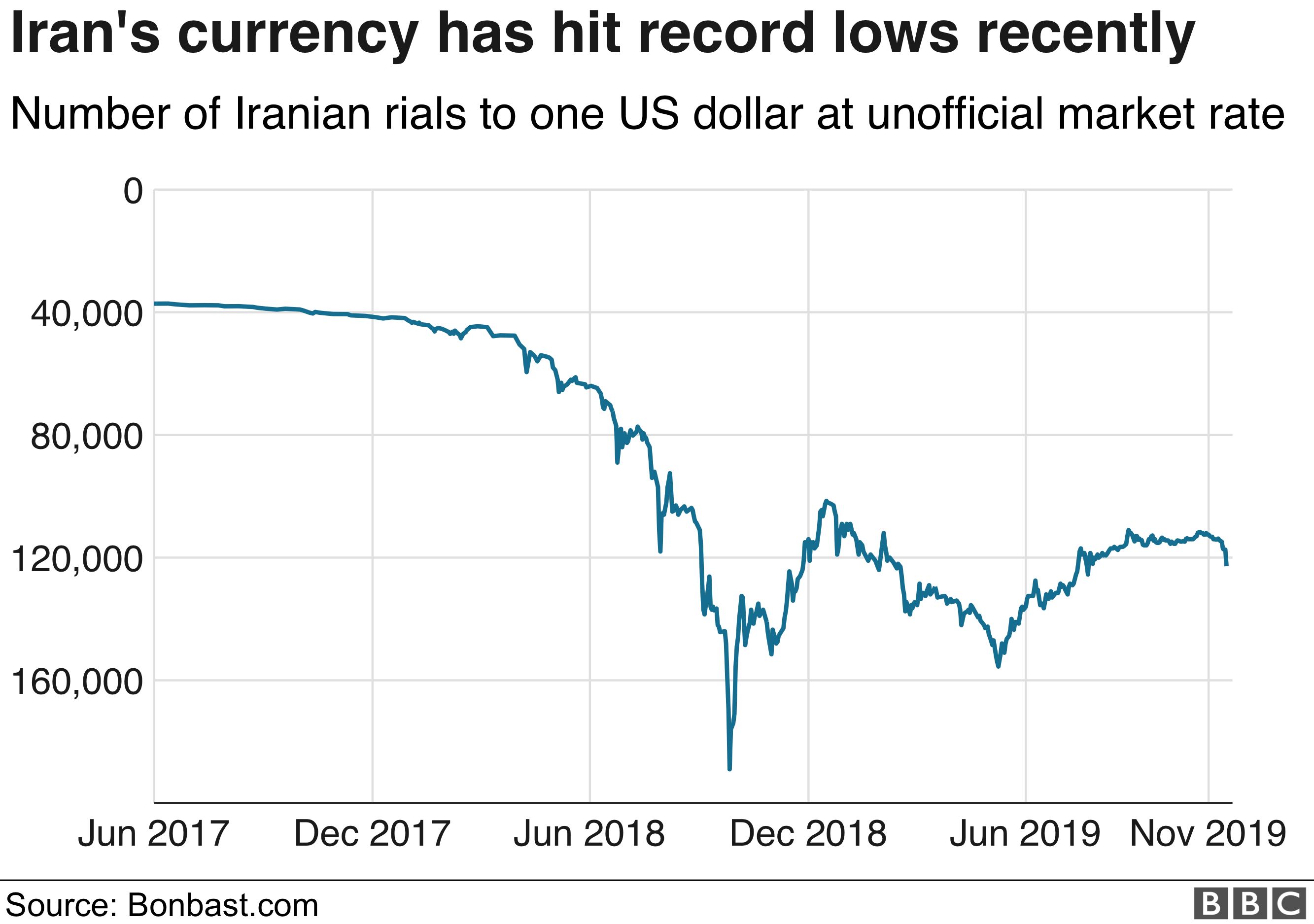
By 2020, it was confirmed that the Iranian economy had experienced a contraction of 4.6% in the 2018-2019 fiscal year alone.2 In January of this year the Institute of International Finance (IIF) projected that the Iranian economy would fall by $73 billion by the next month with a total contraction of 7.2% this fiscal year.2 The IIF maintains that Iranian reserves will decrease by $20 billion and the unemployment rate will surpass 20% by early 2023 if the existing sanctions are not lifted. 2
Trends in Iranian Emigration
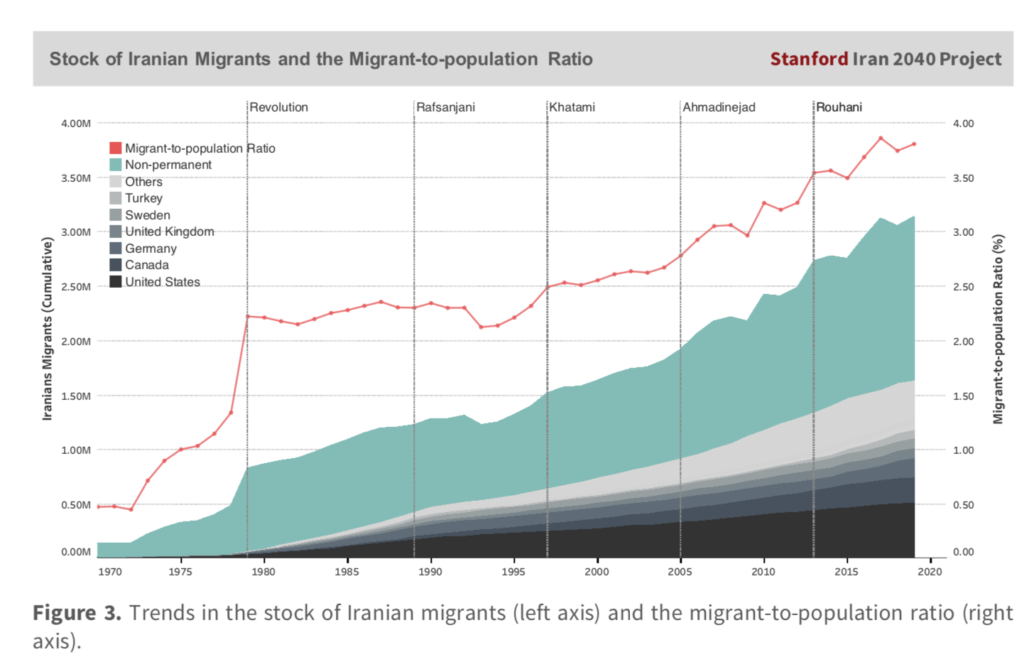
Migration from Iran to key receiving countries has steadily increased over the past few decades. The number of Iranian migrants recorded in 1970 was 130,000, while the estimated number of Iranian migrants today has reached 3.1 million.1 Additionally, the migrant-to-population ratio of Iran jumped from 0.5% in 1970 to 3.8% in 2019.1 Every year, approximately 63,000 individuals migrate from Iran.1 The main receiving countries are listed in descending order of percentage of Iranian migrants : The United States, Canada, Germany, the United Kingdom, Sweden, and Turkey.1
A long-term driver of Iranian migration, or predisposing cause, is the fact that Iran has lower quality education compared to other developed nations.1 Today about 130,000 Iranian students are enrolled in foreign universities, with a total of 700,000 people born in Iran who have attended foreign universities to date.1 More than 100,000 Iranian researchers have done work in foreign universities; a number equivalent to “one-third of Iran’s human capital in research”.1 In theory, an increase in higher education of Iranians should lead to an improvement in economic output of Iran. Instead, migrating for education has had the opposite effect and has led to a massive case of brain drain in the country. Of the Iranian students who study outside the country, only 10% typically return to Iran after graduating.1 In addition to slow-acting, long-term causes of migration like comparative quality of education, there are also events that can be pinpointed as factors that drive up migration rates.
A significant spike in migration was documented in 1979 in correlation with the Iranian Revolution. An estimated total of 830,000 Iranians migrated during this time.1 Occurrences such as the Iranian Revolution are considered precipitating events , or specific events that have the potential to cause significant migration “such as natural disasters, war, financial crises, and government crackdowns”.1 As drivers of migration, the recent sanctions against Iran are precipitating events that have directly induced an increase in Iranian migration rates.
In order to make this post a bit of a lighter read, I have divided it in two parts. The intention of this initial part is to give helpful background information on the state of the Iranian economy under U.S. sanctions that will aid in the understanding of how sanctions directly effect levels of Iranian migration. Knowledge of broader Iranian migration trends is also useful when examining how particular events can lead to migration. Please view Part II of this post to read about how the sanctions against Iran have triggered specific instances of migration.
Bibliography
1Azadi, Pooya, Matin Mirramezani, and Mohsen B. Mesgaran. “Stanford Iran 2040 Project, An Academic Platform for Research on Iran’s Long-Term Sustainable Development.” Stanford University, April 2020. https://iranian-studies.stanford.edu/sites/g/files/sbiybj6191/f/publications/migration_and_brain_drain_from_iran_final.pdf.
2Barbuscia, Davide. “Iran Recession to Deepen, Reserves to Fall to $73 Billion by March: IIF.” Reuters. Thomson Reuters, January 15, 2020. https://www.reuters.com/article/us-iran-economy-iif/iran-recession-to-deepen-reserves-to-fall-to-73-billion-by-march-iif-idUSKBN1ZE139.
3Economic Growth in Iran. BBC News. International Monetary Fund, 2019. https://ichef.bbci.co.uk/news/800/cpsprodpb/BD7A/production/_\110060584_iran_economic_growth_nov_2019_976_2x-nc.png.
4“Iran Sanctions: US Moves to Isolate ‘Major’ Banks.” BBC News. British Broadcasting Corporation, October 9, 2020. https://www.bbc.com/news/world-middle-east-54476894.
5Number of Iranian Rials to One US Dollar at Unofficial Market Rate. BBC News. Bonbast, 2019. https://ichef.bbci.co.uk/news/800/cpsprodpb/A222/production/_110060514_iran_currency-nc.png.
6Segal, Stephanie, and Dylan Gerstel. “The Economic Impact of Iran Sanctions.” The Economic Impact of Iran Sanctions | Center for Strategic and International Studies. Center for Strategic & International Studies, November 20, 2020. https://www.csis.org/analysis/economic-impact-iran-sanctions.
really interesting data on Iran’s migration trends.