The Workforce The struggle for gender equality is a familiar foe of Armenian women. Since the fall of the soviet Union in 1991 when the female unemployment rate was a mere 2.19%, women in Armenia have struggled to maintain their place in the workforce (World Bank, 1991).
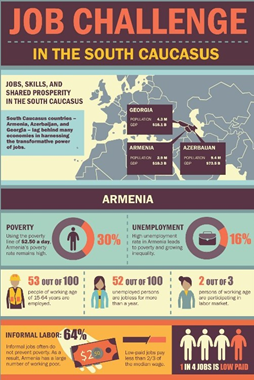
Let’s talk more numbers. Armenia first became a member of the Council of Europe, whose mission is to “protect democracy and human rights and to promote European unity by fostering cooperation on legal, cultural, and social issues,” in 2001 (Gabel, 2019). At this time, female unemployment in Armenia was 13.82% and has since increased to 17.45%. Armenia has the highest rate of unemployment among women of the post-Soviet republics; it is a staggering 10.69% higher than neighboring Azerbaijan. However, a silver lining rests in a small increase in employed women from 45.54% in 2001 to 47.07% last year; women now make up 46.13% of working Armenians, nearly five percentage points higher than the average among 182 nations (The World Bank, 2020).
Global Economy Link https://www.theglobaleconomy.com/rankings/Female_unemployment/Asia/
This surprising rise demonstrates the lack of progress made after aligning oneself with an organization that promotes democracy, of which a cornerstone is human rights. Despite the Armenian constitution officially granting equality to women in 1991, these words only seem a formality as the place of most women remains in the home (iArmenia, 2017).
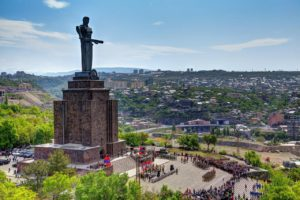
As a result of the patriarchal structure of Armenian society, women are left with little choice among opportunities in the work force. Unlike the freedom of movement many of us are accustomed to, the domestic responsibilities of Armenian women constrain this privilege. These family, intergenerational obligations produce “simultaneous elements of dependence, interdependence, and independence” (Whitehead, Hashim, and Iverson 2007). These three classifications of responsibility and reliance are seen within the role of each person in a typical Armenian household. Moreover, the standard model of migration decisions involved the entire family; this process reflects the New Economic Labor Migration theory which is based on the same principle (De Haas, 54).
https://www.iarmenia.org
Perhaps household responsibility could succumb to economic growth if advice from a 2018 report from the Council of Europe is followed; there, Human Rights Commissioner Dunja Mijatovic stressed the importance of “equal opportunities for leadership at all levels of public life, equal pay and equal access to the labor market.”
With an aging population, it is necessary for Armenia to promote education and opportunity for young women to fill crucial soon-to-be vacant roles in the workforce. Former World Bank Global Lead for Stability Peace and Security Laura Bailey argues the importance of science, technology, engineering and math (STEM) careers for woman; these fields are in high demand, decrease the gender wage gap and provide a flexible schedule, appealing to those with domestic responsibilities as well (Bailey, 2107). I agree with her considering the female to male ratio in post-secondary schools in 2018 was 1.33:1 (The World Bank, 2017). Currently, the gender wage gap in Armenia is great. The majority of women are forced to support their families through low paying jobs in part due to high levels of male migration. With this burden placed on women, it appears the state favors to look the other way. Gender equality is not a popular subject on television or in textbooks and women are unrepresented in government roles thus leaving many with no positive example to follow. Additional concerns over domestic violence and a declining birth rate leave little hope and even less support for the well-being and growth of Armenian women in their own society (Jilozian and Matosian, 2016).
Despite this need, not all women desire opportunities outside of their home. The women discussed in Fatma Lloyd’s article Intersectional power dynamics and extended households: Elderly and widowed women’s international migration from Armenia did not seek professional growth for themselves. Instead, they wanted to uphold tradition of fulfilling their domestic role ahead of any desire to migrate and thus join the work force. Further, these women are limited in their ability to exercise their agency since this privilege is based on gender and household position. Such a hierarchy suppresses their opportunities despite generation-based responsibility within the roles they do fill.
There are always exceptions to the norm and the women who shared their community with Lloyd represent just that; however, the surrounding circumstances were often less than desirable. For example, when male family members fail to fulfill their financial obligations, instead creating a whole new life for themselves abroad. This, to me, was surprising and shameful. In these cases, women became forced migrants, now required to support their families and all the while maintained their self-respect.
While the strength and wish to uphold family tradition are honorable, the obligatory hierarchy of responsibility is somewhat foreign to me since many women, my mother included, were able to work and raise a child simultaneously. The extended household structure, common to the Armenian women discussed in Lloyd’s article, increases their domestic workload and thus family obligations and traditions would not permit time for work outside of the home. Perhaps moving forward a better balance between family and work may be reached.
Bibliography
Bailey, Laura. “Women Count: Turning Demographic Challenge into Opportunity in Armenia.” World Bank Blogs, 2017, blogs.worldbank.org/europeandcentralasia/women-count-turning-demographic-challenge-opportunity-armenia.
Council of Europe. “Report on Armenia Recommends Measures to Improve Women’s Rights, Protection of Disadvantaged or Vulnerable Groups, and Establishing Accountability for Past Human Rights Violations.” Commissioner for Human Rights, Council of Europe, 8 Feb. 2019, www.coe.int/en/web/commissioner/-/report-on-armenia-recommends-measures-to-improve-women-s-rights-protection-of-disadvantaged-or-vulnerable-groups-and-establishing-accountability-for-p.
Haas, Hein de, et al. The Age of Migration: International Population Movements in the Modern World. The Guilford Press, 2020.
Gabel, Matthew. “Council of Europe.” Encyclopædia Britannica, Encyclopædia Britannica, Inc., 22 Feb. 2019, www.britannica.com/topic/Council-of-Europe.
Hovsepian, Nora. “The Role And Empowerment of the Armenian Woman.” Asbarez.com, 8 Mar. 2017, asbarez.com/161040/the-role-and-empowerment-of-the-armenian-woman/.
iArmenia. Armenian Women: IArmenia: Armenian History, Holidays, Sights, Events. 3 Sept. 2017, www.iarmenia.org/armenian-women/.
Lloyd, Fatma Armagan Teke. “Intersectional Power Dynamics and Extended Households: Elderly and Widowed Women’s International Migration from Armenia.” Gender, Place & Culture, vol. 26, no. 3, 2018, pp. 362–383., doi:10.1080/0966369x.2018.1518315.
Matosian, Mary, and Ani Jilozian. “Armenian Women Today: Realities and Challenges.” The Armenian Weekly, 8 Mar. 2016, armenianweekly.com/2016/03/08/armenian-women-today-2016/.
Mkrtchian, Anush. “Armenia Has Highest Female Unemployment Rate Among Post-Soviet Countries.” Ազատություն ռ/կ. 9 Mar. 2018, https://www.azatutyun.am/a/29089151.html.
The World Bank. “Female Unemployment in Asia.” TheGlobalEconomy.com, 2001, www.theglobaleconomy.com/rankings/Female_unemployment/Asia/.
Womeninarmenia. “Gender Roles.” Women in Armenia, 8 June 2018, womeninarmenia.wordpress.com/2016/03/30/gender-roles/.
Hi Kristie!
I agree – I suppose I am grateful that I am unfamiliar with the more rigid hierarchy that has many women in Armenia seeking to uphold their domestic role rather than pursue professional work. Well, the hierarchy is “rigid” from my perspective, anyway.
I am curious about the type of informal work women engage in. Of course, nice statistics on this are likely impossible to come by. Still, do we have any idea what this looks like? Also, I am curious about what a regional divide might people they describe are from?
Hi Corrina-
I have not looked at specific regions within Armenia and how each differs in terms of a woman’s role and opporuntities outside of the home. And I think rigid is fair since compared with the envioronment and opportunities we are used to, it likely is; however, I will have to delve further into specfics before I can accurately answer. I plan to build on my blog post through case studies of particular women which learning about their journey may give some more insite.