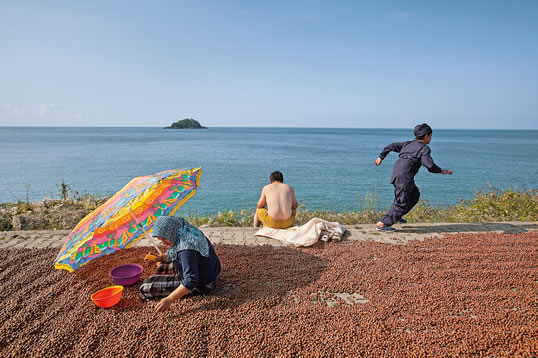
One area of migration that I kept coming back to in our discussions of migration theory was the bidirectional labor migration I encountered while living near the Georgian-Turkish border. So many of the theories of migration (like the push-pull model, neoclassical migration theory, human capital theory, etc.) seemed to easily explain migration between high-developed, wealthy countries and their less-developed, less-wealthy counterparts, but seemed to avoid too much discussion of migration between less-wealthy countries, where the differences in wages and skill levels is not so drastic. For example, in the case of Turkey and Western European countries, we read a lot about Turkish migrants going to perform industrial labor, but we never hear about European migrants going to Turkey to perform “menial” labor, typically only higher status jobs in fields like teaching, journalism, research, and even then not in huge numbers. In contrast, migration between Georgia and Turkey spans the class spectrum–Turks go to Georgia to work in restaurants, construction, tourism, and other fields, Georgians likewise go to Turkey to work in hospitality, agriculture, and probably other sectors.

Of course, Turkey is a wealthier country than Georgia by almost every measure, but Turkey’s high levels of income inequality mean that Turkey has millions more people than even exist in Georgia living in poverty, which leaves one to wonder why there is a market for Georgian menial labor in the country, while the difference between the Georgian minimum wage (officially $7/month) and the Turkish ($391.5/month) makes one wonder why anyone would leave Turkey to work in Georgia.
One reason that people might prefer to hire Georgians rather than Turks in Turkey is as a more exploitable labor source, not unlike the position of Central American migrant workers in the US. While the legal minimum wage in Turkey is high for the region, workers like the Georgians and even more exploitable Syrian refugees are sometimes not paid what they were promised or work grueling, dangerous hours to make that wage, doing work that Turkish laborers are either unwilling to do or that local supervisors prefer not to hire because Turkish workers are more able to make complaints about their labor conditions. Interestingly, Kurdish workers also migrate seasonally from other regions of Turkey to do this work.
In contrast, it seems like Turkish workers in Georgia, particularly those working on large-scale construction projects like hydroelectric dams, roads, and railways, are there with Turkish companies, and therefore receive similar wages as they would in Turkey, which has caused problems for companies that hire both Turkish and Georgian workers but pay them differently. In this case though, one wonders why the Turkish companies would bother paying Turkish workers nearly ten times as much (in some cases), when they could hire cheaper Georgian labor. Is it the training? Ease of doing business with people who already speak your language well? A nationalistic desire to spread wealth to their countrymen? A legal requirement? More investigation is needed.
As far as theories of migration, the new economics of labor migration theory seems relevant. In the village I lived in in Georgia, many of my students’ households often had one or both parents living in Turkey, seasonally or essentially permanently, while the grandparents worked the land and had other jobs, such as as teachers, drivers, or shopkeepers. While the family members in Turkey might not have been sending home very large amounts of money, there were few opportunities for formal labor in the rural region I lived in, and working in Turkey gave the people who moved abroad valuable language skills that could later be put to use in the growing Georgian tourist industry and being located in Turkey might protect their families from economic shocks in Georgia, such as the impact of the 2008 war with Russia, a conflict that, as the recent re-start of the Nagorno-Karabakh War shows, could come unfrozen at any time (though it’s less likely that Georgia would intentionally start a war with Russia of course).
I don’t feel like theories like the migration transition theories or the aspirations-capabilities model apply as much here. While Georgians working abroad often aspire towards “the good life,” as we all tend to do, in my experience they rarely relate that to Turkey, instead aiming at American or Western European lifestyles. In a sense, the visa-free border regime and historical ties make this migration seem less like an international move with the aspirations and challenges that come with it, and more like a regional, temporary visit to an area that has at various points been part of Georgia and had Georgian inhabitants. People cross back and forth to shop (cheaper Turkish-made goods), to visit doctors (more expensive but better trained), to visit relatives, and as tourists. In this case, the internal dynamics of Kurdish or Syrian workers moving within Turkey for agricultural work seem like a more relevant comparison than migrants moving from Turkey to Germany or a situation like that.
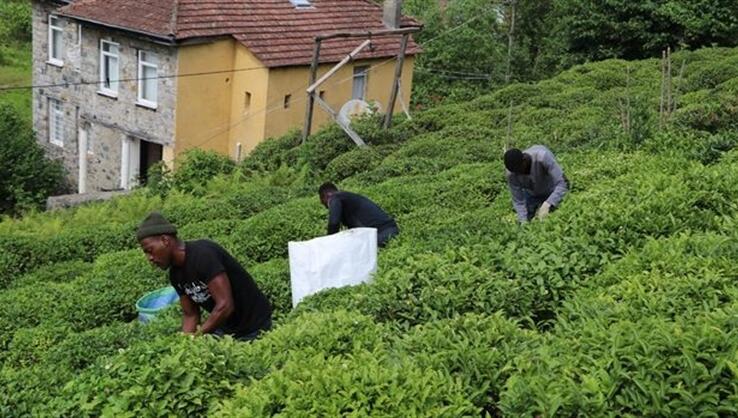
An interesting aside, while looking for information for this blog post, I found an article noting that the pandemic had prevented 40,000 foreign workers from entering Turkey for the tea harvest, including many Georgians, due to the pandemic. In their place came former residents of the tea-growing region, Rize, who live in Istanbul now, along with migrants from Senegal, Afghanistan, and Uzbekistan who were already in the country. The article is short on details and one wonders what jobs these people had previously and why they had chosen to come pick tea this year, but the pandemic has created an interesting natural experiment with what happens when migration flows are cut off. Has the pay gone up because the tea farmers need to recruit different workers? Or has the economic impact of the pandemic, including many lost jobs in hospitality and tourism created a group of out-of-work residents ready to fill the gap?
Sources:
https://archive.aramcoworld.com/issue/201405/the.hazelnuts.of.trabzon.htm
https://databank.worldbank.org/source/poverty-and-equity#
https://eurasianet.org/georgian-fight-for-minimum-wage-faces-uphill-battle
https://www.aa.com.tr/en/economy/turkey-to-raise-minimum-wage-15-in-2020/1684813#:~:text=Turkey%20is%20raising%20its%20minimum,)%2C%20Zehra%20Zumrut%20Selcuk%20said.
https://www.nytimes.com/2019/04/29/business/syrian-refugees-turkey-hazelnut-farms.html
https://www.voanews.com/economy-business/bitter-harvest-kurdish-hazelnut-pickers-turkeys-black-sea-region
https://www.hurriyetdailynews.com/senegalese-workers-replace-georgians-in-tea-gardens-due-to-pandemic-restrictions-155559
https://eurasianet.org/without-georgian-migrants-turkish-tea-farmers-buckle
http://www.eng.kavkaz-uzel.eu/articles/22846/
I found your post to be quite interesting and I enjoyed reading it. I like how you discussed a migration relationship using your own experiences. You brought up interesting points about the kinds of labor Georgians do in Turkey versus the kinds of labor Turks do in Georgia. Your facts and statistics led me to the same questions you posed, and I would be interested to find out the answers.
I’m also interested in the question you pose about Turkish companies operating in Georgia. It seems to me that companies will not do something unless they’ve decided it’s profitable in some way, so any explanation other than “legal reasons” (or maybe if the costs of training are particularly high for certain construction projects) seems unlikely to me, though I’m not familiar with how Turkish companies are run. If you run across any answers to this question, I’d like to hear about it!
The low barriers make this seem more like regional migration than international migration. It would be interesting to compare the experience of Georgians with that of Armenians. Georgia and Turkey have these low barriers. Armenia is just as proximate, but the barriers are far higher, and moving across the border cannot be such a casual thing. You have really keen observations about differences in general in economies, asking why labor migration goes both ways between Georgia and Turkey.