If you walk down 108th Street in Queens, NY, you’ll see some familiar sites of an Uzbek diaspora community: tandoor restaurants, traditional clothing stores, and newspaper stands carrying a publication called the Bukharan Times. More curious things you may find are signs with Hebrew alongside Uzbek Cyrillic, synagogues, and Jewish community centers. One does not usually think of Uzbekistan as a cultural or historical hub for the Jewish people. However, in what is colloquially known as “Bukharan Broadway,” you would be forgiven for thinking Bukhara has a massive Jewish community. The modern numbers in Bukhara and Uzbekistan as a whole, unfortunately, do not reflect this.
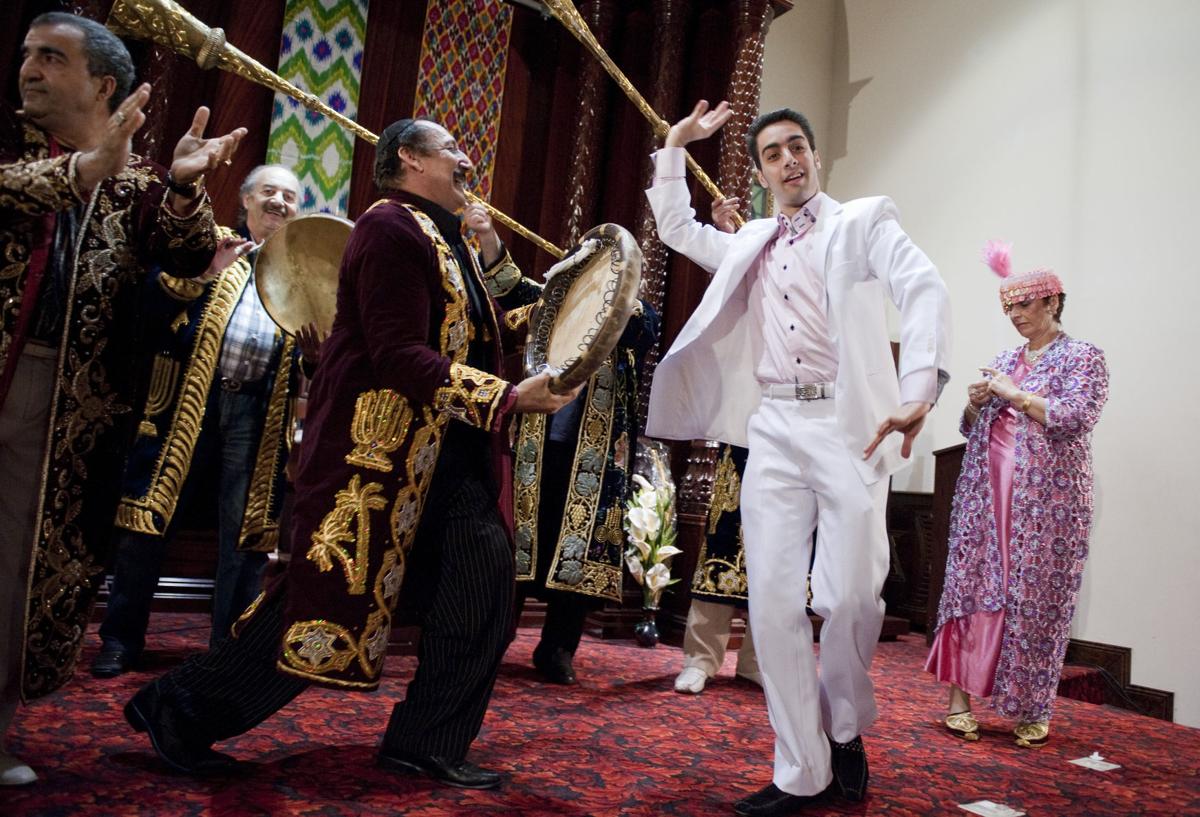
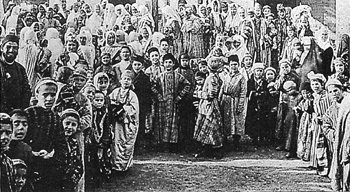
In Central Asia, Bukharan Jews numbered over 45,000 people as late as 1989. Their ancestry can be traced back to the conquering of Babylon by the Persian king Cyrus the Great. Many in the community contend that their heritage dates back even further to the Assyrian exile where their people descended from the ten lost tribes of Israel. Regardless of the origin story, the Bukharan Jews make up one of the oldest still-surviving ethnoreligious communities on Earth.

Now, in 2020, estimates put their numbers in Bukhara at around 100. Jewish cemeteries in the ancient city sit abandoned. Synagogues and homes have been converted to guest houses and restaurants for tourists. Yet, one would be mistaken to say that their culture is nearly extinct. In Queens, NY alone, the largest hub in the world, Bukharan Jews number over 50,000 strong.
So what caused this massive migration? Why is it that thousands of Bukharan Jews thrive in Israel, America, and Europe while their homeland’s community struggles to survive? Why don’t the few remaining members in Bukhara leave to find a thriving, welcoming community elsewhere?
The great Bukharan Jewish exodus began relatively recently. In the final years of the Soviet Union, easing restrictions on Jewish emigration led to the first Bukharan Jews traveling to the United States, Israel, and Australia. After the collapse of the Soviet Union in 1991, this emigration movement grew rapidly. Some moved for economic reasons, hoping for a better chance at economic stability in nations outside of the struggling region. Others moved out of concern for the rise of Islamic nationalism in the newly formed Republic of Uzbekistan, fearing religious persecution. Despite this persecution never coming to fruition, Bukharan Jews exited their homeland en masse joining growing diaspora communities in countries around the world.
Its entirely possible that the driving force for the remaining community members after the first migrations in the 1970s came as a consequence of NELM and network theories: with greater social capital abroad, it would be more lucrative to move and send money and support back to their homeland. As the exodus surged, however, the reasons for migrating must have shifted. With few remaining people in Bukhara, the impetus for migrating might have become human capital. It was not their skills as laborers that were truly valued, but their knowledge of the historic language, culture, and religion that was necessary to strengthen a new, fledgling diaspora community clinging together in the landscape of a foreign state. Their human cultural capital became devalued in their homeland as opposed to their new cultural hubs. As any student of economics understands, however, scarcity brings higher value.
There have been consistent, persistent efforts by the Uzbek government to facilitate the return of Bukharan Jews to the country. After the death of dictator Islam Karimov, new laws were passed that granted Israelis visa-free entry, and emigrants were encouraged by Uzbek activists to return. Former Uzbek ambassador the US, Sodiq Safoev stated that “[Bukharan Jews] have always been an organic part of Uzbek society, and people here need them… It will be very sad if they are all melted down in the big melting pot of New York.” It is clear that the community has great cultural value in Uzbekistan.
When the elder rabbi of the Bukharan community in Uzbekistan passed away a few years ago, it came as a massive blow to the community. The few young adults who remained in the city began to study their religion and culture vigorously. Some shifted their career trajectories altogether, choosing to become cantors or rabbis in Uzbekistan rather than join their family members abroad.

Yet, many Jewish residents of Bukhara, especially young adults, are ready to leave their historic homes. They desire to join the vibrant “Queensistan” community in New York where there are Jewish schools, shops, places of worship, Bukharan Jewish history museums, Bukharan newspapers, and even a dedicated radio station. In Bukhara, almost all Jewish residents have a familial or social connection to Israel or the United States. In an interview with the New York Times, a resident with a daughter in Queens but still caring for her father-in-law in Bukhara, stated “We are all ready to leave. Only the old folk are hanging on.” Another resident states that his father, the remaining rabbi in Bukhara, will never leave despite the rest of his family living in New York. So what keeps them, and others like them, in place?
For some, its simply stubborn elders and family members. For many others, however, its the desire (or burden) to maintain the history of their ancient culture; the recognition of their intangible value to the Jewish culture of their native Bukhara.
According to a Jewish historian and Cantor in Bukhara, Abraham Ishakov, over $50,000 comes into the community annually from organizations like the Bukhara Fund to ensure that gravesites are maintained regularly. Though the cemeteries are virtually abandoned, the graves themselves are spotless and regularly upgraded with new, modern tombstones. Family members of the interred from Israel and the United States continue to visit, desperate to find the resting places of their loved ones.

A cemetery director, Emmanuel Elnatov, told National Geographic that even though he desperately desires to reunite with his wife, children, and parents who live in the US and Israel, he is bound to Bukhara by his work and faith. If he leaves, an entire community both in Uzbekistan and abroad, will be devastated. The choice, he says, was “was made for me by God.”
Despite having all of the characteristics of future migrants, with social connections and networks, better economic opportunities, and a more vibrant and populous community abroad, Bukharan Jews in Uzbekistan remain. The cultural capital they possess, though far more plentiful in the United States and Israel, is too valuable in their homeland to let go. A Jewish school in the city remains popular and well attended, even though only a few Bukharan Jewish students can be found there. It seems, for now, that their ancient community will continue to persist in the lands of their ancestors. Only time knows for how long that will remain true.
Works consulted/referenced:
Badias, P., Maps, N., Dbtravel, P., Erken, P., Stapleton, P., & Setboun, P. (2015, August 04). Bukhara Jews Thrive in New York but Are Almost Gone in Bukhara. Retrieved October 04, 2020, from https://www.nationalgeographic.com/news/2015/08/150804-jews-diaspora-bukhara-uzbekistan-asia-world/
Benaim, R., Hanau, S., Kampeas, R., Sales, B., Harris, B., & Dolsten, J. (2017, September 26). Bukharian Jews face new, uniquely American challenges. Retrieved October 04, 2020, from https://www.jta.org/2017/04/05/united-states/bukharian-jews-now-americans-face-new-set-of-challenges
Bukharan Jews. (n.d.). Retrieved October 04, 2020, from https://www.oxfordbibliographies.com/view/document/obo-9780199840731/obo-9780199840731-0146.xml
Bukharian Times: Bjc-bukhara. (n.d.). Retrieved October 04, 2020, from https://www.bjc-bukhara.com/bukharin-times
Higgins, A. (2018, April 07). In Bukhara, 10,000 Jewish Graves but Just 150 Jews. Retrieved October 04, 2020, from https://www.nytimes.com/2018/04/07/world/asia/uzbekistan-bukhara-jews.html
Time, C., & Mastrini, J. (2019, June 04). Uzbekistan’s Remaining Bukharan Jews Hold Tight To Traditions. Retrieved October 04, 2020, from https://www.rferl.org/a/29981175.html
This is a really interesting choice for blogging about migration. How does a trickle become a flood, and what happens when most of the people from a small and isolated religious group decide to move to another country?
For Jewish emigration from the USSR to the US, the 1990 Lautenberg Amendment to the Jackson-Vanick amendment was a critical factor: it allowed all Jews from the USSR (and then successor countries) to come to the US as refugees under the assumption of religious persecution. In the early 1990s, Bukharan Jews who were contemplating migrating felt some pressure, worrying that this door would close. In 1993 I happened to interview a very famous Bukharan Jewish woman who was a renowned dancer; her family wanted her to move to the US. She was torn about it–she wanted to join her family, but it was hard to give up her home and the society that valued her art.
You found quite a few good sources. In paragraphs where it is clear that you are quoting someone, or drawing something very specific from a particular news story, it would be better to have a precise way of citing, whether with parentheses or footnotes.
If you are interested in digging into the history of this group, which may not be as ancient in Bukhara as the journalists assume, I’d start with recent books by Alanna Cooper, Bukharan Jews and the Dynamics of Global Judaism; and by Zeev Levin, Collectivization and Social Engineering: Soviet administration and the Jews of Uzbekistan.