“Ne mutlu Türküm diyene” – “How happy one is to say I am a Turk!” This expression, famously spoken by Mustafa Kemal Atatürk on the tenth anniversary of the Turkish Republic, demonstrates a simple and seemingly benign Turkish nationalism.1 However, Turkey’s history of compulsory international population exchange provides insight to the early republic’s determination of just who is a Turk.
Çağlar Keyder’s The Consequences of the Exchange of Populations for Turkey provides a compelling argument for the degree to which population exchange in 1923 between Greece and Turkey helped to define Turkey as a unified nation.
Keyder first describes Turkey’s Ottoman history, during which there was no attempt to create an ethnically or nationally homogeneous empire. Keyder writes, “the state did not seek to homogenise the population in the name of a single ethnic, confessional or linguistic affiliation. The subjects were free to construct and define their identities, usually within the bounds of their religious communities.”2 This describes the centuries-long millet system, under which subjects of the Ottoman Empire lived in religious communities. In this time, Christians, Muslims, and Jews lived harmoniously under the Muslim Sultan.
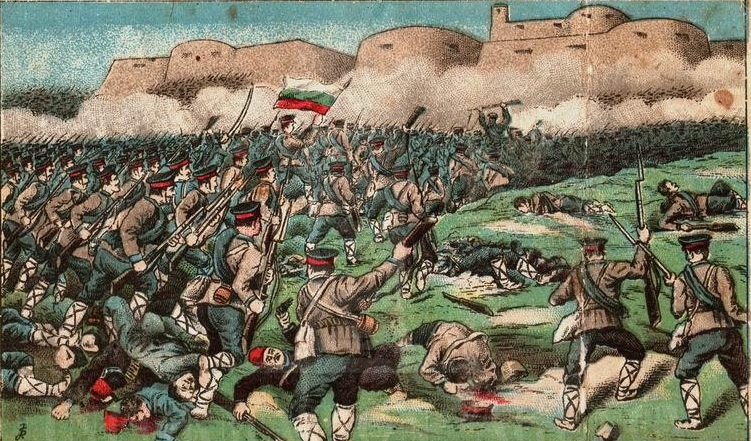
However, the religiously and ethnically varied empire would not survive. By the early twentieth century, the Ottoman Empire was losing power in the region, and the Balkan Wars of 1912-1913, in which the empire lost large tracts of territory, led to unrest and instability.3 Millions of Christians and Muslims faced displacement as Muslim refugees fled the Balkans for Anatolia, the Balkan nations seceded from the empire, and yet the Sick Man of Europe’s troubles were only beginning.
(https://bulgarianhistory.org/wp-content/uploads/2016/05/balkanska-voina2.jpg)
Things would only worsen for the Ottomans with the end of the First World War. Following their defeat in the war, the Treaty of Sevres carved out the Ottoman Empire, yielding great territorial gains for Greece, including much of Anatolia’s Aegean coastline.
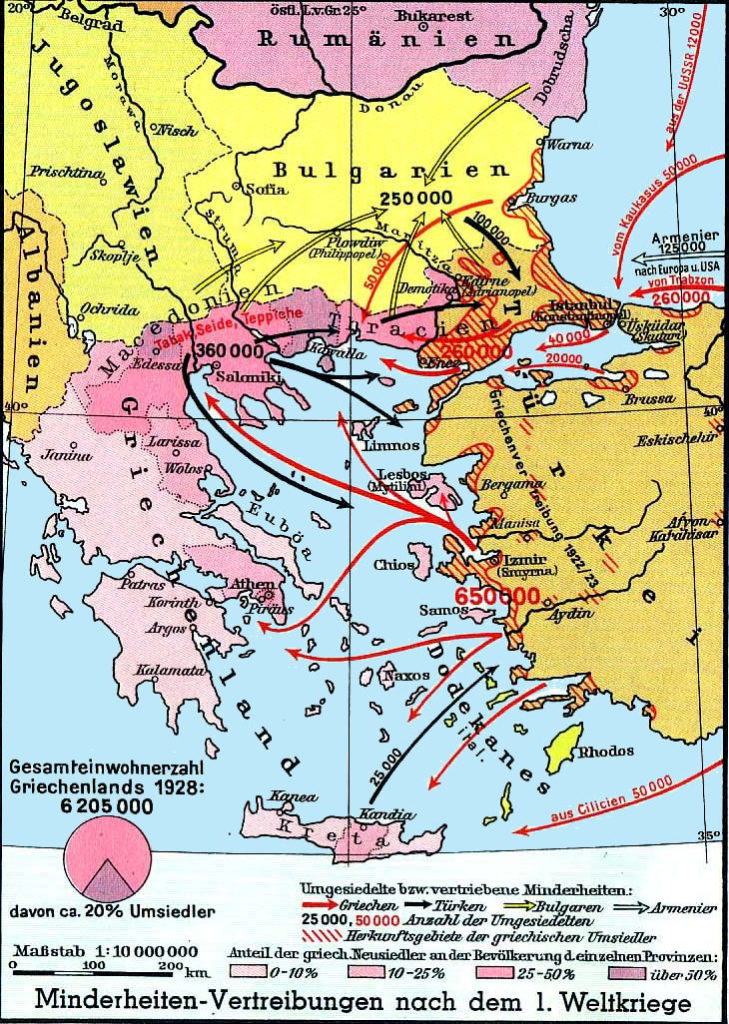
This ignited violent conflict between Greece and Turkey, resulting in massive civilian casualties. Turkey would emerge victorious, and the need for redrawing of international borders and for regional stability led to the League of Nations-sponsored Treaty of Lausanne, which established the Turkish Republic and set the stage for compulsory population exchange between Turkey’s Greek Orthodox population and Greece’s Muslim population.4
(https://www.globalsecurity.org/jhtml/jframe.html#https://www.globalsecurity.org/military/world/war/images/map-megali-katastrofi-01.jpg|||Megali%20Katastrofi%20/%20Great%20Catastrophe)
The population exchange refused the human rights and freedom of movement of members of religious minorities within the newly formed borders of Turkey and Greece. In defining nationality on religious grounds, the Treaty of Lausanne forced communities to “repatriate” to their “true homelands,” even though many of those forced to move were associated with their new country on the sole basis of religious affiliation, disregarding language or birthplace.
The Treaty of Lausanne effectively determined the definition of what it meant to be a Turk on the basis of religious affiliation, which is a distinction I find to be interesting considering the Republic’s then very recent history of multireligious peace. As Keyder writes, “The Turkish nation… was itself formed through this process of ethnic unmixing.”5 A great deal of Turkish historiography on the nation’s ethnic history communicates the idea that Turks are the rightful heirs of Anatolia on the basis of an uninterrupted period of occupation since the eleventh century, and that the deportation of Armenians and Greeks in the early twentieth century in a sense purified the nation.6 The Treaty of Lausanne essentially defined Turkey as secular state with a Muslim population.
The Treaty of Lausanne and the subsequent population exchange between Greece and Turkey were events that were spurred by and further developed the idea of Turkish nationalism and helped define Turkish identity. With the treaty came the newly minted Turkish Republic along with a new definition of what it means to be a Turk.
- Galvin, Shannon. “A Look at Turkish Nationalism: The Man, the Myth, and the Legend.” Georgetown University Berkley Center for Religion, Peace & World Affairs. 4 November 2013, https://berkleycenter.georgetown.edu/posts/a-look-at-turkish-nationalism-the-man-the-myth-and-the-legend.
- Keyder, Çağlar. “The Consequences of the Exchange of Populations for Turkey.” In Crossing the Aegean: an Appraisal of the 1923 Compulsory Population Exchange between Greece and Turkey, edited by Renee Hirschon, 40. New York: Berghahn Books, 2008.
- Hirschon, Renee. ‘Unmixing Peoples’ in the Aegean Region.” In Crossing the Aegean: an Appraisal of the 1923 Compulsory Population Exchange between Greece and Turkey, edited by Renee Hirschon, 3-4. New York: Berghahn Books, 2008.
- Hirschon, 6
- Keyder, 43
- Keyder, 49
Nice work with maps and images here, Jackson. The illustration of the population exchange adds a lot. Back in 1970, the philosopher Ernst Renan, wrote “Forgetting, I would even say historical error, is an essential factor in the creation
of a nation and it is for this reason that the progress of historical studies often poses a
threat to nationality.” http://ucparis.fr/files/9313/6549/9943/What_is_a_Nation.pdf Renan’s comments on the ways that eliding a complicated past serves the purposes of nation construction then inspired some of Benedict Anderson’s thought in Imagined Communities–the title of which Bedlek borrows. You illustrate the creation of a Turkish identity that involves a lot of forgetting about a more complex past.
Thanks for this comment. I agree that misremembering and misrepresentation of the past often leads to a national mythology from which nationalist ideologies draw their ideas and imagery.