In 2019, Pamiris of Tajikistan, the Tajik people of the Pamir mountains, current labor migrants in Moscow cleaned the grave of Shirinsho Shotemur at Donskoy Cemetery on the eve of Eid ul-Fitr (religious holiday celebrated by Muslims worldwide that marks the end of Ramadan, the Islamic holy month of fasting.)
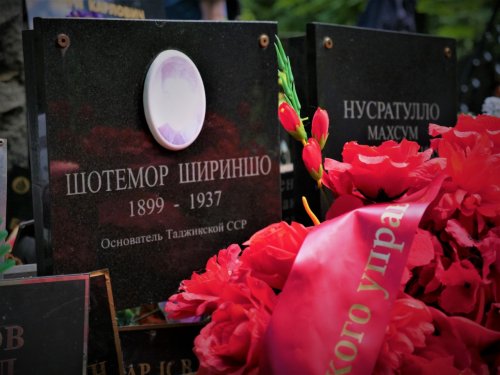
Shirinsho Shotemur, a prominent Tajik politician who made a major contribution to the early history of Soviet Tajikistan and was instrumental in the establishment of the Tajik Soviet Socialist Republic. Shotemur was born on December 1, 1899 in Shugnan District, Tajikistan, to a poor farmer family. From 1914 to 1918 he worked at a factory in Tashkent, capital of today’s Uzbekistan. In 1921 he began pursuing a political career and was sent back to the Pamirs as a member of the political-military team. From 1923 to 1924 he worked as an instructor of the national minorities department of Tajikistan’s Communist Party Central Committee. At the same time he headed the Tajik communist section. During his lifetime Shirinsho Shotemur held many leading positions in the Tajik government and in the communist party. In 1937 Shotemur was charged with participation in an anti-Soviet nationalistic organization and arrested in Moscow. Later the same year the Military board of the Supreme Court of the USSR sentenced Shotemur to death. He was executed on October 27, 1937. In 1956 Shotemur was posthumously rehabilitated by Military board of the Supreme Court of the USSR.
Moscow, once the USSR’s “internationalist city” is home to millions of migrants who also once belonged to the state mandated narrative of “friendship of peoples” a slogan that effected peoples’ identities decades after the collapse of the Soviet Union. In his book “Voices from the Soviet Edge” Sahadeo covers reflections and history of this emotionally driven slogan that shaped Central Asians and other non-Russian people’s relationships and perceptions of one another. Since 1930s when for the first time this slogan was introduced by Stalin, numerous facilities, places and sites have been named after this concept of “friendship of peoples” or “Druzhba Narodov” that forced/enabled people to think of each other belonging to one “friendly” Soviet nation.
The book includes stories and narratives that give a big picture of how people actually felt about this notion of friendship throughout their lives in the union and after the collapse. You can see that each individual has their own feelings and emotions attached to those words, for some it was real, for others a bittersweet realization of transformation and acceptance of a new reality. For example, Abdul Khalimov recalls his faith in friendship: “…Even though I knew that the Bolsheviks killed my grandfather…and I lived in poverty, and they wouldn’t let me study a foreign language at university because of where I came from and because I was not Russian. Despite all of this, if a Soviet athlete or team won an event, we all took pride in that.” Sahadeo writes: “The state enjoyed the power to set conventions and interactions, but Soviet citizens seized the friendship and perpetuated it decades after the USSR’s end.”
Additionally, Sahadeo states, with Moscow being the model for every other city in the union, every soviet citizen learned to love and cherish Moscow more than their own cities of birth, so with that much emotional manipulation does that mean current migrants in Moscow feel like they may have made it “home?” Is the concept of “druzhba narodov” today serving as a positive trigger for the migrants to live through the harsh conditions of Moscow? Are the Pamiris cleaning the grave of a soviet era politician in a way celebrating their soviet heritage? For years druzhba narodov was used as a point of celebration of difference through arts and music, does that mean Eid ul-Fitr replaces that central Soviet tenet for many Muslim migrants in Russia?
I have noticed from the stories narrated in the book and other instances that for those to whom Soviet system and structure “triggers an emotion of prestige and inclusion,” outsider understanding of the history of the regime or lack thereof triggers a sense of being gaslighted, as though they have to defend their reason for longing for that lost bond and friendship, in those cases reflections are a bit more abrupt such as a reaction when there was a suggestion of differences between the people of USSR, from a Kazakh scientist, Aliya Nurtaeva: “Minorities never existed in the Soviet Union. Everyone was the same with similar ambitions. This is a bad question.” There is also this notion of interpolation that happens around the feelings of dominance and being discriminated against by the Russian. Most of the time non-Russian citizens of the Tatar-Mongol origin will reflect on how mistreated they have been by the majority Russians emphasizing the superiority complex exercised by the Russians pointing at being the founders of the language, alphabet and literature, according to a young Kyrgyz civil engineering student in Sankt Peterburg (Leningrad).
Druzhba Narodov is a big part of my identity and it manifests in the most profound of ways throughout the years. For example, when I first moved to the United States of America in 2004, I formed a circle of close friends from Uzbekistan, Kyrgyzstan, Turkmenistan and Kazakhstan. They were my community of close friends/family that I sensed the most connection to, we all spoke Russian the lingua franca of Soviet Union.
References:
Sahadeo, Voices from the Soviet Edge Ch 2, 35-62. Ebook, IU lib
Could you include a source on Shotemur?
Thanks for raising the question of outsider views versus insider experiences. You had a complex sentence in there about gaslighting, and the need that scholars who study the Soviet Union feel to explain why anyone would say anything good about it or have positive emotions and memories. But wasn’t it the most oppressive place on earth? Totalitarianism? Stalin’s mass murders? We learn different things when we turn to everyday life and oral history–what Sahadeo is doing.
The version of Soviet history that Americans learn is often reduced to the gruesome parts, leaving us with questions about how anyone survived, let alone thrived. For decades, the people who left the USSR and came to the US were people whose own lives were illustrations of Soviet repression.
For the audience of westerners, then, the scholar who studies anything other than repression and death in the USSR always has to point out that there was more to life than that. Sahadeo, taking his interviewees seriously as they talk about their appreciation for the friendship of peoples, still seems to be skeptical: for real? you are not just saying that because you are supposed to? It’s really hard to get over one’s own fixed notions and open one’s mind to the concept that the truth as I think I know it is not the only possible truth.
I remember when I first went to Uzbekistan and said I was from Chicago. Chicago was familiar enough to people I met that they looked at me with great pity: how was I dealing with all of those gangs and the constant shooting and violence (and this was in 1991, not today)? When I was a party in Tashkent and some fool actually pulled a gun (!!!) and I ducked under the table, my friends’ response was “well of course you knew what to do! You are from Chicago!” But I never saw or experienced any violence in Chicago. I knew it was happening, but it wasn’t my lived truth. Like the migrants in Moscow, my stories of Chicago would be about friendship and adventure and culture and multiculturalism, and so on.
When reading about the state mandated narrative, “Friendship of Peoples” I interpreted the phrase to have two faces; one promoting unity and the other still exercising state control over (at the time) soon to be established independent Soviet States. As I understand, the “Friendship of Peoples” regulated identities perhaps due to fear the state had of newly forming republics creating their own identity separate from Russian identity and control. This left me wondering if the idea of one Soviet nation had two faces as well; a pro-Soviet state versus a pro-Russian state and if so, could they equally co-exist.
After the heavy Russian hand was lifted, thus allowing independent nation states to thrive on their own, the idea of one Soviet nation, through means similar culture and backgrounds, comes into focus without sacrificing one’s personal (national) identity. Purnur, I was also pleased to read the positive impact this narrative has had on your personal identity and believe many of our peers may share a similar story of blurring differences and building upon likenesses to forge meaningful friendships.
This is a comment on just a small subpoint of this overall text (which was really well written!) but I think it’s interesting how national pride or pride of a city can be manipulated by the state through sporting events. It’s something that brings a lot of different people together, the love of football (American and not American) or international sporting events like the Olympics. But only now through this article, I now look at these ‘national identity building’ events with state interference and how somehow people that are denied many other rights still participate in that pride.