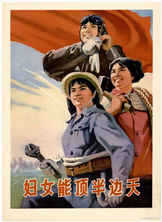
The discussion in the lecture on using female labors as the soviet solution to labor shortage reminded me of some popular Chinese propaganda from the Great Leap Era, where a giant poster reads “women can hold up half of the sky”. It is known to a saying from Mao Zedong. This public poster has left me a deep impression because it was in our Chinese history textbook. I have always found this slogan interesting because I perceived it as a way of exploitation of women instead of an effort in reaching true equality. I wondered if it was the same for the Soviet Union, and I also was interested in knowing why the Soviet Union did not want to broaden their reach and allow migrant workers into the USSR to solve the labor shortage problem.
A research summary by Edmund Nash pointed out that the USSR Constitution painted a picture of equality for USSR women, but the Constitution was essentially used as a tool to make women work in heavy labors and less about equal rights . Nash also stated there were very few, but an increasing number of, women executives.[1] From the lecture, we know that there was a deficit in male adult labor in the Soviet Union. While it was one of the important factors that mobilized women into workforce, other factors such as the economic development goals also played a critical role. According to Mary Buckley, “the economic goal of rapid industrialization, kicked into motion by Stalin’s First Five Year Plan of 1928, has been highly instrumental in mobilizing women into social production – more so than the deficit of males”.[2] Therefore, I want to draw the conclusion that the use of female labor was never from the intention of promoting gender equality.
Knowing that the USSR was enormous in size and was in control of many of today’s independent countries, I am curious about why the USSR did not simply promote more mobility within its giant administrative region. From the lecture, we know that before 1970, the Prospiska system limited mobility for many people, due to lack of employer-sponsored housing. People could not travel because of this system and there were simply not enough houses for everyone.
Hence, women who were already living in where labor shortage was happening became a viable option for the government to mobilize. Although Peter Sinnott’s article “Population Politics in Kazakhstan” did not directly mention the role of women in the soviet labor force, it provided much insight into what the USSR was like due to the tensions among different ethnicities and cultures. For the part where Sinnott discussed the demographics of Kazakhstan before 1970, we can see that the USSR government struggled to manage the largely diverse ethnic population. Sinnott also mentioned a barrier for many Kazakhs to get into workforce was because of language barriers. “Some Kazakh demographers claim that this sustained period of Russian immigration contributed to the dominance of the Russian language in the workplace, and as a necessary requirement for qualified workers”.[3] Although Sinnott used this claim to support why it was difficult for Kazakhs to develop their culture before the 1970s, I wonder if this was another reason for the USSR government to use women, assuming they were Russian-speaking, to join the workforce.
Having grown up in a country where pro-female propaganda is usually not truly promoting gender equality, the use of female labor in the Soviet Union greatly interested me. From what we have read, this strategy seems to have been political due to the economic development goals that were carried out, the difficulties to govern a diverse republic for the USSR, along with their inflexible Prospiska system.
References
[1] Nash, Edmund. 1955. Women Workers in the Soviet Union. Monthly Labor Review. Pp. 1008-1010.
[2] Buckley, May. 1981. Women in the Soviet Union. Feminist Review. Pp. 79-106.
[3] Sinnott, p. 110.
I don’t think these propositions are mutually exclusive: that economies need women workers, and that working contributes to women’s equality. The Soviet Union promoted women working for pay before they began rapid industrialization, as a core element in their ideology. A woman who does not depend on a man as a provider, they thought (and I think) is able to make her own decisions. But I’d agree that getting more workers seems to have been a higher Soviet priority than making women and men equal.
Good question: in Central Asia’s multicultural cities, Russian women were much more likely to be employed than were Central Asian women, and the propiska system prevented rural Central Asians, men or women, moving to cities to take up work. Employers would turn to whoever was already in the city rather than try to bring rural Central Asians (Kazakhs or Uzbeks) to urban jobs. You note how thoroughly these factors were intertwined, with the result that the USSR was not so successful at bringing about either ethnic or gender equality.