As I described in my previous blog post, the 1973 oil shock stemmed from an embargo placed on the United States by Arab oil producing nations in response to the United States financially supporting Israel during the Yom Kippur War.1 The oil shock spurred major trends for public finance and development within Gulf states and transformed patterns of international migration in Arab states and South Asia with oil exporting Gulf states at its center. Although the demographic data on Gulf states have massive migrant populations, such as the United Arab Emirates with 87.9% of the total population, immigrants are completely excluded from systems of social and political power, and citizenship in Gulf states is highly exclusionary.2 Like international immigrants everywhere, immigrant populations expose themselves to risks and potential exploitation. Immigrants in Gulf Cooperation Council countries have unique experiences and risks with regards to the kafala system and stringent citizenship laws. This blog post will focus on the demographics of the United Arab Emirates, and trends regarding Indian immigration, citizenship, and diaspora formation in the UAE.
The United Arab Emirates has some of the strictest citizenship laws in the world, and becoming a citizen by any means other than birth is nearly impossible. In fact, being born in the UAE isn’t enough by itself. Citizenship is not granted by birth, and to be born with citizenship one’s father must be a citizen. Dual citizenship is not recognized and the residency requirement for naturalization is 30 years.3 Because citizenship is not granted by birth, the children of migrants born in the UAE are categorized as migrants despite only ever having lived in the UAE. Because newborns may be counted as migrants, the number of migrants on official forms may not accurately illustrate the actual flow of movement from South Asia to the UAE.4
Because citizenship is so limited, only about 12% of the UAE’s population benefits from the generous welfare and social services offered by the government. No migrants are included in this number.
Kafala system
The kafala system is a custom in GCC countries wherein local citizens or institutions sponsor a migrant worker and are held responsible for their housing, employment conditions, and acquisition and maintenance of employment visas for workers.5 As we have seen throughout the course, migrant workers open themselves up to a huge degree of risk for exploitation, especially when the worker moves to a country that speaks a different language. By institutionalizing a relationship of migrants depending on their sponsor for their legal right to live and work in country, the kafala system amplifies the likelihood that migrant laborers in Gulf states experience exploitation and abuse.
South Asians/Indians
One may reasonably ask why there are so many South Asians working in the Arab Gulf states when there are many underemployed job candidates in neighboring Arab states. Succinctly, “Asian workers are favored because they do not harbor political ideologies, make few demands, tolerate lower wages, are easier to lay off and segregate, and tend to migrate without their families.”6
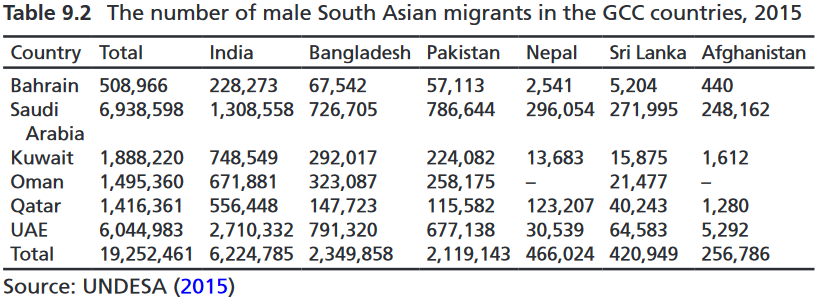
With the oil shock in 1973, government revenues derived from an extremely profitable oil market spiked, leading GCC member states to dramatically increase funding for construction and development projects. Migrant employment in the GCC was initially made up of mostly Arab migrants, but hiring Arabs was eventually seen as a political risk, and South Asian migrants increased their share of the migrant population.7
By promoting South Asian migration through the kafala system, oil-producing Gulf states can hire from an enormous pool of multinational laborers. The berth of labor in the market allows Gulf states such as the UAE to buy labor for cheap. Like we’ve seen in many instances throughout this course, migrant laborers have a higher tolerance for difficulty, dirt, and danger than the local population. Indian migrants in the UAE follow this rule.
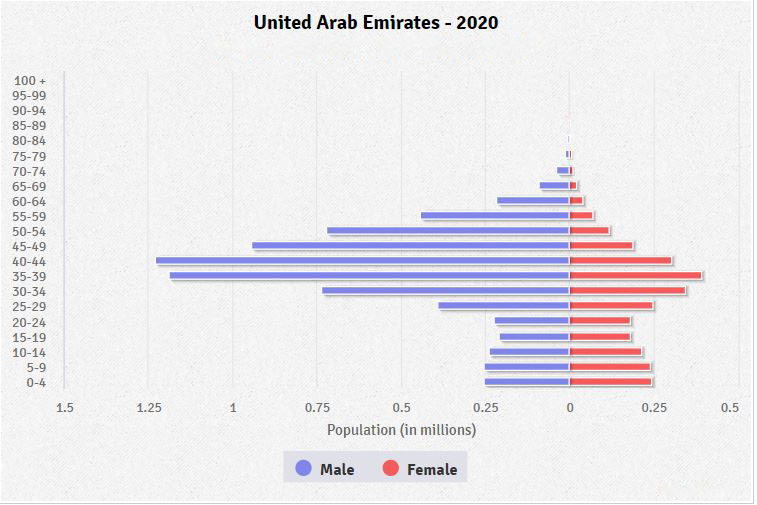
Thus, the construction industry has become a major area of Indian employment. Construction is a male-dominated industry, and the tendency of Indian migrants to migrate without their family leads to a striking discrepancy between male and female residents.
https://www.cia.gov/library/publications/the-world-factbook/geos/ae.html
Diaspora formation The Indian diaspora in Dubai has existed for over a century, stemming from established patterns of trade and from the former moneymaking venture of choice: pearl diving. Indians living in Dubai have a diaspora unlike many others. Because they are only ever accepted as temporary workers, and citizenship is effectively off the table, Dubai and the UAE as a whole are seen by many as an extension of India rather than a foreign land, far off from their cultural home. Writing about Dubai’s Indian diaspora, Neha Vora writes, “… my conversations with my interlocutors in Dubai were not marked by nostalgia for homeland. While people certainly miss friends and family, they did not feel a lack of cultural resources or even a loss of community in Dubai.”8
- “The October War and U.S. Policy.” The National Security Archive, ed. William Burr, George Washington University, 2017, https://nsarchive2.gwu.edu/NSAEBB/NSAEBB98/.
- https://www.cia.gov/library/publications/the-world-factbook/geos/ae.html
- Ibid
- Naufal, George and Ismail Genc, Expats and the Labor Force: The Story of the Gulf Cooperation Council Countries, (New York: Palgrave Macmillan, 2012), 34-35.
- Kanchana, Radhika, “Is the Kafala tradition responsible for the exploitative work conditions in the Arab-Gulf countries?” in South Asian Migration in the Gulf: Causes and Consequences ed. Mehdi Chowdhury and S. Irudaya Rajan (New York: Palgrave Macmillan, 2018), 64.
- Abdul-Aziz, Abdul Rashid, Abdul Lateef Olanrewaju, Abdullahi Umar Ahmed, “South Asian Migrants and the Construction Sector of the Gulf,” in 166 South Asian Migration in the Gulf: Causes and Consequences ed. Mehdi Chowdhury and S. Irudaya Rajan (New York: Palgrave Macmillan, 2018), 166.
- De Haas, Hein, The Age of Migration International Population Movements in the Modern World (New York: The Guilford Press, 2020), 208.
- Vora, Neha, Impossible Citizens: Dubai’s Indian Diaspora, (Durham, NC and London: Duke University Press, 2013), 71.
The numbers of South Asian migrants to the Gulf is truly overwhelming, especially in light of the fact that they outnumber citizens in UAE and several other countries. Your post highlights some of the difficulties in the data that would make it hard to tell how many are living in UAE permanently with families, and how many are there on three-year-long contracts. I would think that those are very different conditions. Your post also highlights the thinking of leaders of these countries, and why they make these choices about excluding Arab migrants, attracting South Asians, and limiting citizenship very severely.
This is a very interesting post about the kafala system! While I am not very familiar with GCC countries, I feel this system does sound like it’s intended to keep migrants away from becoming citizens. I certainly wonder the role of religion in establishing this policy in the first place. How did they come to the decision that they would set up this system that doesn’t seem to be efficient and is inviting human rights violation investigation?