Part I. Overview of the Belt and Road Initiative
Chinese people take a lot of pride in the country’s global initiatives such as the Belt and Road Initiative. Known to Chinese citizens as the “One Belt, One Road” (OBOR) policy, its establishment was one of the exciting moments to many, following the host of 2008 Olympic Games and 2010 Shanghai World Expo. The OBOR initiative in 2013, also called the New Silk Road, presented a positive signal to the Chinese people as part of the revitalization of Chinese civilization efforts under Xi Jinping.
Council on Foreign Relations has provided a detailed explanation of the history and the initial goals of the BRI. After doing some research on the Chinese sources, the extent of the project is massive. The Chinese Central Television Station (CCTV) has made a documentary of six episodes on the BRI project, and they are divided into these topics: common fate, road of connectivity, energy ties, road to prosperity, finance and connectivity, and building dreams. Through this series of documentary, the Chinese government visioned a united and integrated world economy under the facilitation of the Chinese government.
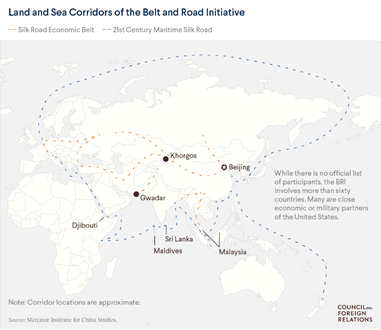
Currently, there are 72 countries that have official agreements with China under the BRI umbrella. Through these agreements, China has proposed a new strategic partnership framework through a five-pronged approach: policy coordination, infrastructure connectivity, unimpeded trade, financial integration, and enhancement of people-to-people ties. To build partnerships from this approach, China encourages a PPP model to build agreements and relationships with participating countries. China also encourages foreign investments in the country and Chinese companies to go abroad.
To finance the large amount of BRI projects, China has established the Asian Infrastructure Investment Bank (AIIB) and the Silk Road Fund. Domestically, the four state-owned banks (Bank of China, Agricultural Bank of China, Industrial and Commercial Bank of China, and China Construction Bank) are also in active participation of BRI projects. In addition, China Development Bank and Export-Import Bank of China are also providing funding for important projects.
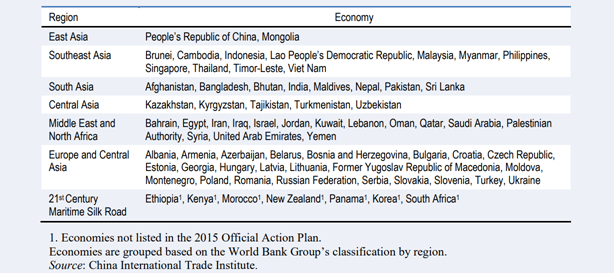
Internationally, financial institutions such as Standard Chartered Bank (SBC) and Citi Bank have also participated widely in BRI projects. In 2016, SBC had over 16 BRI projects and saw prominent results. Xi Junyang, the Departmental Head of International Finance at Shanghai University of Finance and Economics, pointed out that foreign banks have an advantage to domestic banks because of their locations are all over the world. Many large international financial institutions have already picked strategic locations for their international branches, providing critical financial services to countries that are along the BRI plan.
From various agreements to numbers of projects taken on through domestic and international financial institutions, China has been able to move forward with a few critical projects, some of which have been controversial. In later sections of this series of blogs, I will discuss a couple of them in detail.
There are many participant countries that have political issues home and abroad. There are also new areas and territories where China has not engaged before. All the uncertainties become risks for the projects to be completely successful in the participating countries.
Part II. Migration Inflow into China
While there are many projects in progress overseas, the largest group of migrants that inflow into China is students. According to Xiaohua Zong and Tingsong Li (2020), the growth of international students in China has experienced explosive growth since 1999, and is way beyond Chinese government’s plans and expectations. Zong and Li also presented a robust data analysis result in their article. They found that students from BRI countries grew by 45 times since 1999, when there were only 3,244 students. In 2017, the number grew to 145,000 students. Percentage wise, in 1999, only 28.27% of all international students studying in China come from BRI countries. In 2017, this number grew to 60.07% and is continuing to grow. 60.83% of these BRI students in 2017 came to pursue a graduate degree in China, meaning that this group is of higher educational quality. In the same report, Zong and Li pointed out that the biggest increase of student inflow into China is from Central Asia, followed by South Asia. Among the Central Asian countries, Kazakhstan, Turkmenistan, Uzbekistan, and Tajikistan all experienced a growth rate of over 30% from 2019 to 2017. Number wise, students from Central Asia grew from 96 to 16,700. [1]
While it is exciting news for China that an increasing number of students have come into the country to study, research pointed out there are many management problems within the higher education system. According to Shirong Jing (2019), there are five major problems in China. First, there is an incomplete management framework within each higher education institution that hosts students from abroad. Second, there is a lack of professionalism and training among management teams in higher education institutions. Third, there are no guidance and services designated to foreign students studying in China. Fourth, there are very few clubs for international students. Fifth, management of dorms is insufficient given the number of international students. [2]
In the past several years, China has loosened its work visa program and green card program to attract more talents to live and work in China. However, this does not mean that China is a welcoming destination for people living there. Social media platforms usually gear towards publicizing the negative side of students studying in China. In 2019, Shandong University was trending on Weibo (aka Chinese Twitter) for weeks because of its program to “match” female Chinese students with foreign male students. The program caused a dramatic scene online among the Chinese public, accusing the university’s favoritism to foreign students and calling for the foreign students to leave China and never come back. Although Shandong University apologized for its inappropriate program, the impact and the discussion online showcased a disturbing level of sentiment against foreign students studying in China.
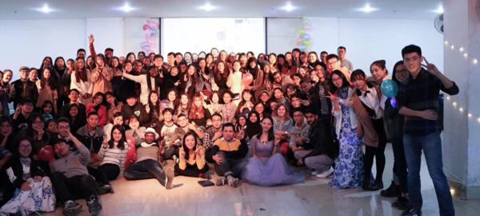
(Photo: student participants in the program, clearly showing more Chinese students than foreign students.)
While there are positive programs in China highlighting the success of foreign students, they are usually merely focused on their language skills. Chinese Bridge, an international competition that has been held for 19 years, is a program that highlights the success of students around the globe who are learning Chinese. This program is hosted through the Confucius Institute and is highly endorsed by mainstream media. However, little is known among Chinese about this program. Therefore, the hardworking students are not usually valued within the society as much as hoped.

(Photo: Semi-Final, Chinese Bridge Competition)
Part III. Chinese Migrants Abroad
It is no news that there are many Chinese workers abroad. Traditionally, there are two beliefs about the identity of Chinese migrant workers abroad. One is that they found a way to emigrate from China to another country and completely started on their own. The other is that they go abroad to work in construction with state-owned companies. Under BRI projects, the latter one has become more common. According to Xinhua Silk Road, BRI projects have created over 200,000 jobs overseas. These jobs are mostly created through international trade agreement and construction works overseas.
According to data from Ministry of Commerce in China, in 2018, 53.9% of Chinese migrant workers were in projects under partnership agreement, and 46.1% were under outsourced agreements. Leading industries of Chinese migrant workers abroad are construction, manufacturing, and transportation. “Yet, despite increasingly prominent political, economic, and security relations, China for most Central Asians remains a little known, poorly understood, and even feared country.” This is largely due to the rapid expansion efforts of BRI projects in Central Asia. Given the spike of increase of students from Central Asia, the region and China are going through a period of getting to know each other. However, as large amount of capitals being poured into these countries, it is perhaps inevitable that the countries fear the level of financial dominance coming from the rising global power and their neighboring country.
China is aware of its problems of lacking global competence despite of its ambition in the world. There are policy recommendations made on all levels pertaining to the problem of sinophobia. Huaon.com, a leading Chinese commerce and economics report institution, identified the need for training Chinese workers to work in higher level positions, and opening up opportunities for hosting countries to take over certain jobs by Chinese migrant workers in construction and manufacturing. The report also pointed out the importance of cultural competence training as BRI projects require a higher level of cultural sensitivity as Chinese workers come to work in a different environment from China.
In the past, Chinese migrant workers are heavily gathered in the labor-intensive industries. As China develops more BRI projects, it is critical for China to rethink its labor exporting strategy. Ideally, China would want to go into a BRI project with capital and knowledge to train local workers to be performing quality work. Bringing Chinese workers overseas is only a short-term solution to get the work started. The key should be investing in training and education for hosting country’s workers so that they benefit to the full potential from BRI projects.
References
[1] Zong, Xiaohua and Tingsong, Li. (2020). “一带一路沿线国家来华留学生分布演变与趋势预测’ (Distribution Changes and Forecasting of Foreign Students from Belt and Road Countries). 高教探索 (Higher Education Exploration).
[2] Shirong Jing. (2019). “一带一路背景下来华留学生的管理初探” (Initial Discussion of Management of Foreign Students from Belt and Road Countries). 研究与交流 (Research and Communication).
Hi Xin Li. I have heard of Chinese workers working abroad in BRI partner countries, but I had not previously considered the impact of hosting foreign students at Chinese universities. I am interested to read what you have to say about both of these issues. As you point out, the BRI is only seven years in the making, but it would be interesting to see data on where these Chinese-educated students end up working. Perhaps information on Soviet-educated workers would provide some suggestions.
Hi Xin Li, I really enjoyed reading your post and found the information fascinating. I especially like how you tied the demographic of student migration to China with Belt Road Initiative; I wouldn’t have thought there was such a strong connection there. You refer to some of the BRI projects as being “controversial”– I would like to know what you think of some of the more controversial BRI projects.