Identity in Exile: The Expansion of the Circassian Nation
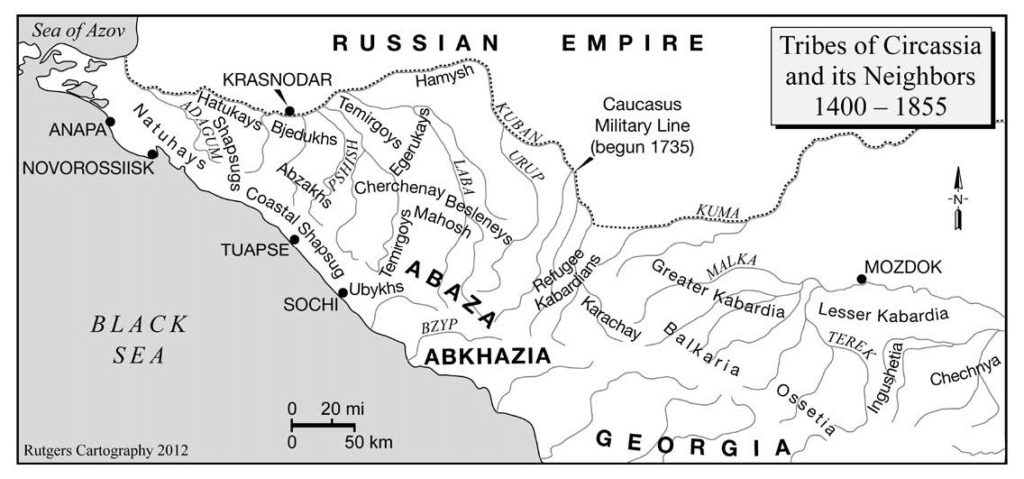
Prior to the expulsion of the Circassians, or Adyge, from their homeland in the North Caucasus in 1864, the 1 to 1.7 million Circassians lived as 12 distinct tribes along the northeastern shore of the Black Sea (Richmond 2). They did not have a strong or unified political structure, though language, culture, and history linked the 12 Circassian tribes (Yelbaşı 1, Richmond 3). Over time, the definition of who is Circassian has expanded, including both Ubykh speakers and later, following the expulsion and mass migration to Turkey, sometimes the Abkhaz and other North Caucasian ethnic groups like the Abaza, Chechens, and Dagestanis (Yelbaşı 2).
In this blog post, I am interested in looking at how this expansion of the Circassian identity came to be, and how it fits in with the ideas about culture and identity and diaspora that we have discussed in class and the readings — Why did Abkhaz migrants in Turkey come to join Circassian groups, rather than assimilating into mainstream Turkish society? Does this expansion of the term “Circassian” in the Turkish context reflect a meaningful cultural change or connection between Abkhaz and Circassians in Turkey, or is it just another way of saying “from the North Caucasus”? How do these groups fit into the conclusions we’ve read in class about ethnicity, identity, culture, and diaspora as they relate to migration? My ability to answer these questions is limited by a dearth of sources and my inability to read Abkhaz, Circassian, or Turkish, but I will do my best to interpret those sources available to me.
The traditional Circassian tribes (Abzakh, Besleney, Bzhedug, Hatuqwai, Kabardian, Mamkhegh, Natukhai, Shapsug, Temirgoy, Ubykh, Yegeruqwai, and Zhaney) are most likely descended from the Hattians, a group from Central Anatolia that migrated northeast fleeing invasion of Anatolia around 2000 BCE before settling on the Black Sea coast, and then dividing over time into the Abkhaz, Abaza, Circassians, and Ubykh (Richmond 3). However, according to Richmond, most Circassians today consider the Ubykh, who spoke a language (Ubykh) other than the two Adyge languages (Circassian and Kabardian) to be one of the 12 Circassian tribes (Richmond 3, Matthews 87). The Circassian languages, Ubykh, and Abkhaz form the Northwestern Caucasian or Abkhazo-Circassian language family (Matthews 87).
Ultimately, by 1864, half a million or more Circassians had arrived on Ottoman shores, forced deportees joining the Kabardian nobles that had fled earlier, and significantly adding to the Circassian population already in the Ottoman Empire due to, among other things, the significant slave trade (Richmond 100, Yelbaşı 14). Up to 250,000 other Circassians fled Russian advances in the Caucasian War to the Balkans initially, and then were forced to relocate a second time, again in a large part by the Russians (Richmond 8, 103). Many of these refugees also ended up in Ottoman care (Richmond 110).
Circassians initially fared poorly, but were considered equal, Muslim constituents of the Ottoman Empire (Richmond 100-126). This changed with the rise of Turkish nationalism and the collapse of the Ottoman Empire in the early 1900s (Richmond 126). The Young Turks attempted to assimilate Muslim minorities–rather than exile or deport them–including the Circassians, by eliminating their languages and cultural institutions, resettling populations to reduce the density of non-Turkish speakers, and forcing all citizens to take Turkish-origin last names (Richmond 128, Yelbaşı 8).
Similarly to the Circassians, following the Caucasian War, over half of the Abkhaz were pushed out of their historical homeland, Abkhazia, and into Turkey by the Russians (Markedonov, Tekushev, and Shevchenko 11). Also like the Circassians, smaller segments of the Abkhaz population had longer histories in the Ottoman Empire, as slaves and freed slaves in the harems and military (Yelbaşı 14-15). However, unlike the Circassians, towards the end of the Soviet period, they began an active effort to return to Abkhazia, in order to repopulate the area, which had become majority Georgia, with Abkhaz (Richmond 159). With Russian help they gained autonomy in 1993, and established institutions intended to bring back diaspora Abkhaz (Richmond 159). Interestingly, in the one book I found at the library on Abkhazia, Abkhazia: Between the Past and the Future, there is only one brief mention of the large proportion of the population that was exiled to Turkey, and no follow-up about their current situation or political leanings.
Four of Circassian tribes, the Abzakh, Natukhai, Shapsug, and Ubykh were known during the 19th century for accepting into their ranks other Circassians fleeing from Crimean, Ottoman, and Russian attacks, while broader Circassian cultural traditions regarding hospitality meant that no visitor could be turned away, and that hosts were obliged both to defend their guests with their life and not inquire about their background (Richmond 4-5). Perhaps this cultural tradition of hospitality and absorbing other people from close groups into their tribes contributed to the inclusion of the Abkhaz into Circassian organizations and society in Turkey.
Following the 1908 Revolution in Turkey, organizations such as the Circassian Union and Mutual Assistance Society, the Circassian newspaper, Ğuaze (The Guide), the Circassian Women’s Assistance Committee, and the Circassian Model Academy were started, though they were forced to close, along with nearly all minority organizations, by the new government in 1923 (Richmond 127). In the 1950s, as the Circassians of the countryside moved into urban areas, like many from Turkey’s rural areas, new organizations were formed, including the North Caucasus Turkish Association for Culture and Assistance (later the United Caucasus Association), the Caucasus Cultural Association, the Socialist Caucasus Association of Ankara (Richmond 130). This change, from explicitly Circassian organizations to broader Caucasian ones, could also imply increased feelings of unity amongst Circassians and Abkhazians, or simply that including more ethnic groups might result in larger, more effective organizations, though without knowing more about the environment for these types of organizations in Turkey, it’s difficult to draw any concrete conclusions from this.
In the 1920s, Abkhaz and Circassians in Turkey joined together in anti-nationalist efforts, leading a group of Abkhaz men to seize a government building out of concerns that the nationalist government was planning to kill Circassian and Abkhaz men in their region while making all of the women concubines (Yelbaşı 18, 58). This shows, at the very least, that the Abkhaz actors in this case believed their fates to be intertwined with those of the Circassians in Turkey. However, Turkish government figures at the same time are recorded as saying the Abkhaz are untrustworthy and unrepentant, in contrast with the Circassians, who they believed would come to regret their involvement in an attempt by Circassian notables, with Abkhaz support, to gain control over the Adapazari-Duzce region of Turkey in 1920 (Yelbaşı 57-58). Similarly, one of the leaders of the Circassian cell of anti-nationalists in Istanbul, Rauf Orbay, was actually of Abkhazian descent (Yelbaşı 187).
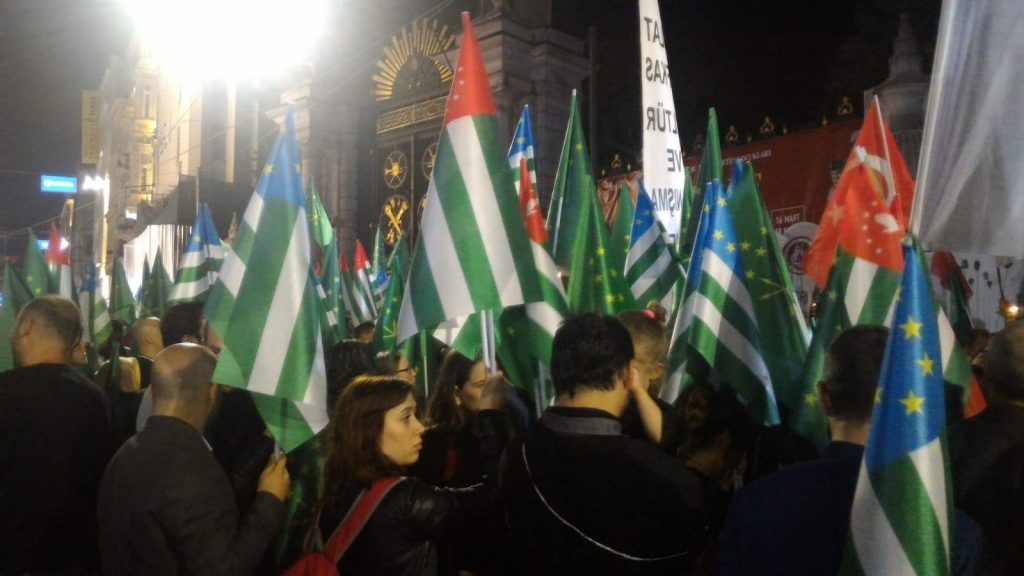
As illustrated by the photo below, Abkhaz and Circassian solidarity exists both historically and to the present. In the photo, Abkhaz flags (with the red rectangle with a hand and 7 stars) intermingle with the flags of Turkey, the Adyghe Republic, and the short-lived (1917-1922) Mountainous Republic of the Northern Caucasus, which included much of the North Caucasus and Abkhazia.
(https://www.cerkesfed.org/2018/05/25/21-mayis-1864-cerkes-soykirimi-ve-surgunu-154ncu-yili-anma-etkinlikleri-tesekkur-mesaji/)
As of 2019, there were about 5 million ethnic Circassians in Turkey, of whom approximately 2 million consider themselves Circassian and less than a million speak Circassian. There are no native Ubykh speakers left (Richmond 131). I could not find recent numbers for Abkhaz, but the population is significantly smaller. A source from 1996 shows a range between 30,000 and 3,000,000, a broad range showing, in part, the complicated nature of ethnic identity–is everyone descended in some part from an Abkhaz ancestor Abkhaz, or is it only people with continued connections to the land, language, and culture?
Russian support, military and political, for the breakaway regime in Abkhazia has also enlivened campaigns for the creation of a Circassian homeland, with the right to repatriation for diaspora Circassians (Richmond 149-150). In 1992, Circassians and Abazas protested together in favor of Circassians being able to secede from the republic of Karachay-Cherkessia (152). Also, in 1992-1993, Circassians (along with many Chechens and other North Caucasian volunteers) fought on the Abkhaz side of the war with Georgia. One Circassian fighter even said “We dreamed that in Abkhazia we would get our first independent Circassian state,” clearly indicating that feelings about the Abkhaz-Circassian relationship were beyond merely brotherly.
In 1990, Adyge-Hase, a Circassian group founded in the Gorbachev-era Soviet Union, argued, in a dispute about republican boundaries, that the groups defined by the Soviets as Kabardians, Cherkes, Adyges, and Shapsugs were all one people, and adopted “Cherkes” as a common name for the group (Richmond 150-151). This could be taken as an example of the Circassian nation opening up to include different groups for political reasons, but is more likely simply a response to ahistorical Soviet policies that broke up what was in fact a unified ethnic group.
In Russia in 2009, delegates from the Union of Abkhazian Volunteers of Kabardino-Balkaria attended a Forum of Kabardian (Circassian) Organizations, with delegates representing many Circassian groups, including Adyge Hase, the Circassian Congress, and the Kabardian Congress (Richmond 164). This could be evidence that the Abkhaz even in Russia feel as though they are in some way a part of the Abkhaz nation. This could be an argument against the idea that the shared experience of being exiled to Turkey created a new broader Circassian identity that included the Abkhaz, but it could also be evidence of the influence of the numerous Abkhaz that have been repatriated from Turkey.
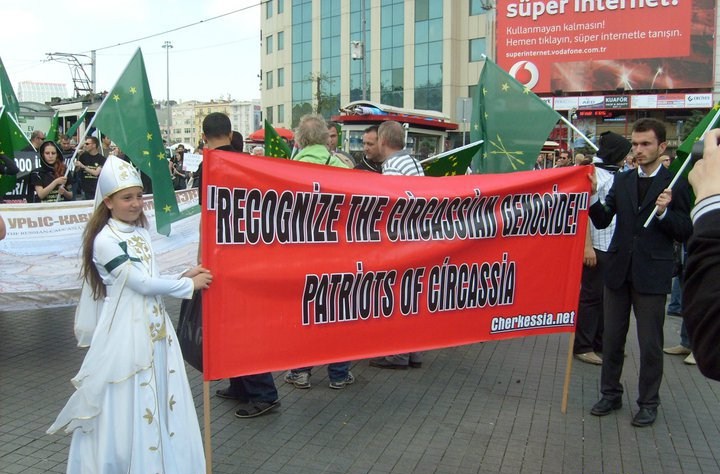
Interestingly, despite the connections between the Abkhaz and the Circassians, following the 2008 Russian-Georgian War and the loss of South Ossetia and the last parts of Abkhazia under Georgian control, the Georgian government began an effort to publicize material on the Circassian genocide and support the Circassian cause by opening state archives with records of the Caucasian War and organizing events on the topic in order to embarrass Russia (Richmond 168-169). Circassians today often refer to the killings and mass expulsions of their people during and after the Caucasian War and subsequent colonization of their homeland by Russians and Cossacks.
(https://en.wikipedia.org/wiki/File:%C3%87erkez_s%C3%BCrg%C3%BCn%C3%BCn%C3%BCn_an%C4%B1lmas%C4%B1_5.jpg)
At this point, it’s difficult to draw conclusions about the relationship between Abkhaz and Circassian identities, simply because there is very little information about it available. There is ample evidence that Abkhaz and Circassians have worked together for political ends in Turkey and in Russia, and that Abkhaz are often folded into the Circassian category in Turkey, but it’s not possible to tell if that is simply for convenience, as there aren’t enough Abkhaz in Turkey to have meaningful organizations, if it’s because of a shared identity, or if it’s due to some other reason or combination of factors–Turkish law only allows non-Muslim people to be considered “national minorities” and prohibits non-Turkish media and educatiion, and the Turkish term “Cherkess” refers to all North Caucasians. Perhaps in a future blog post or future research, it might be interesting to see what other research exists regarding two distinct but similar diaspora communities in the same region—Would studies looking at Iranian and Armenian diasporas in LA be comparable in any way? Or comparisons between Syrian and Palestinian refugees in Jordan?
The idea that globalization and transnational flows of people are homogenizing forces may explain some of this trend—perhaps it’s easier to merge into a homogenous group with another group that’s similar, as in the case of the Abkhaz and Circassians in Turkey, though it seems obvious that in terms of economic and political opportunity it would be simpler to move towards mainstream Turkish society. On the other hand, the restriction of flows of people and information that existed during the Soviet period might have brought the Caucasian people of Turkey closer, since they had limited abilities to contact and work with their co-ethnics across the border. There seems to be a reasonable amount of information on the political history of individual Abkhaz in the Turkish and Circassian context, but without research on identity, acceptance, and belonging, to make any strong conclusions about the meaning of that political collaboration in the context of identity and nationhood would be a bit of a stretch.
Sources:
Markedonov, Sergey, Islam Tekushev, and Kirill Shevchenko, eds. Abkhazia: Between the Past and the Future. Prague: Medium Orient, 2013.
Matthews, W. K. Languages of the U.S.S.R. New York: Russell & Russell, 1968.
Richmond, Walter. The Circassian Genocide. New Brunswick: Rutgers University Press, 2013.
Yelbaşı, Caner. The Circassians of Turkey: War, Violence, and Nationalism from the Ottomans to Atatürk. London: I.B. Tauris, 2019.
Please explain the use of the term “genocide” here. Is it that Circassians were forced to leave their homeland? Or something else? Is that a term used by Circassian activists?
Hi! I’ve added a little explanation of this to the post under the first mention of genocide–it usually refers to the expulsion and killings during/right after the Caucasian War, though I think some people also include subsequent efforts by the Russian and Soviet state to reduce the use of Circassian language and other similar policies in this.
Was Cherkess/ Adyghe always a sort of flexible identity, capable of incorporating rather different people? I’m interested in the ways that Circassian became a unifying concept in exile, possibly drawing in others like the Abkhaz.
Hi! I think (but am definitely not sure and am currently looking into it) that Cherkess/Adyghe was flexible in this way, because among the Circassians it seems like clan identity was more important, particularly prior to exile. The question I had hoped to answer in this blog post was whether the shared experience of the Caucasian War and exile had created the conditions for a broader sense of the words, but unfortunately I couldn’t find many sources treating this topic, even tangentially. One source I read mentioned that the three “unknown” tribes were known for incorporating members of other tribes that were fleeing from Russian forces or other circumstances that forced them apart from their own tribes, which makes it seem like there is space there for including other groups from the region, like the Abkhaz…
Hi Katharine! This parallel trajectory of “core” (I cannot emphasize those scare quotes enough) Circassian and Abkhaz groups in both Turkey and Russia is fascinating!
Is it possible to infer that the Abkhaz and Circassians had a decent relationship in the North Caucasus? If this weren’t the case, I might expect that there wouldn’t be this expansion of identity – the two groups might try to keep their distance from one another.
Also, is there an origin story that is common to the the Circassians and the Abkhaz? Or perhaps a set of tales that are similar throughout these various groups?
Finally, since I do not understand identity in Turkey very well, perhaps you can help me here: The images and information you shared about Circassians demonstrating in Turkey tells me that they are not in mortal/legal peril when they align themselves with a greater “Circassian” cause. Can Armenians do this? Do other minority groups do this? The larger question I am getting at here is: Is expanding the “Circassian” identity a strategy (conscious or not) to ensure its survival?
Hi Corrina,
Sorry for the late response to your insightful questions!
1. I believe that the Abkhaz and Circassians had fairly good relations in the pre-conquest North Caucasus, though I honestly know very little about the period. Their historical homelands are near each other and there is some history of Circassian rule over the Abkhaz but nothing I’ve read seems to indicate any lingering ethnic tensions or anything like that–their shared experiences seem to hold more sway than their differences.
2. As far as origin stories go, the two groups are believed by some scholars to have descended from the same Anatolian tribe, the Hattites, though origin stories and ideas abound. I wish I knew anything at all about the tales aspect of this though, I love that sort of thing, but I have no idea where I’d find it honestly.
3. Finally, regarding the ability of Circassians to organize, I think one very important thing that differentiates them from Greeks/Armenians/Kurds/other groups is the fact that the Circassian homeland, which has been the focus of much of this activism, is not in contemporary Turkey, which is a big difference from the claims of the Kurds, for example. The Circassians came to Turkey within (relatively) recent memory, and much of this political organizing is aimed at the Russian state, rather than the Turkish. So I don’t think that expanding Circassian identity is a means to allow these groups to survive in Turkey, though it might help them generally to have larger coalitions working together than each tribe/clan/ethnic group.
Katherine, I learned quite a bit from this post. I especially appreciate your analysis of the Abkhaz- Circassian relationship as it relates to migration. Would you mind clarifying something for me? How do Circassians fit into the Ottoman slave trade? What other groups were a significant part of this system? I was a bit surprised by your mention of Circassians as slaves (though, remember I knew nothing about this subject until reading this post), and their acceptance by the Ottoman Turks as fellow Muslims. This seems like it would be contradictory. Finally, I appreciate that you acknowledged the lack of resources you had in compiling your information (understandable; I too cannot read Abkhaz).
Hi Audrey!
Thanks for reading and asking, sorry I’m so late in responding. If you don’t know anything about Ottoman slavery, I’d begin by noting that this system was very different from the chattel slavery that Americans tend to think of when they read the word “slavery.” As far as I know (also not an expert, but I have taken some courses that touch on the issue) Ottoman slaves were not limited to one ethnic group, instead coming from the various peripheries of the empire, from the Caucasus and Balkans to Central Africa. Another important difference is that slaves could hold fairly high-ranking roles, including roles in the military and wives and mothers of sultans. Additionally, the Quran has passages dealing with the possibility for slaves to buy their own freedom and sharia has a number of provisions relating to slavery, in some interpretations saying that a Muslim can’t be enslaved, so an enslaved Muslim could conceivably convert and have free children–the lines between free and unfree were easier to cross than in the US. When the Circassians came to the Ottoman Empire they were very poor (as refugees tend to be), and they gained a reputation for selling their children (presumably a loophole in the enslaving other Muslims rule? Honestly not sure) and for having extremely beautiful women. I think most references I see to Circassian slaves refer to women in the sultans’ harems, some of whom became quite powerful, though there are also regular references to Circassian mamluks.
Sorry for the long, rambling response! It’s an interesting topic, and one I wish I could explain better!
Hi Katherine, I really enjoyed reading your post as I don’t know much about the Circassian and Abkhaz people and have learned a lot over your last two blog posts. You go over a lot of interesting history that shows the brotherhood between these two people and how their destinies have become somewhat intertwined through increased Turkish nationalism, which has tried to diminish their identities, and more recent Russian support for their ethnic homelands.
You mentioned that in the 1920s the two groups came together to fight off Turkish nationalism and some Abkhaz men even took over a government building. Do you know if that action resulted in more repression by the Turkish government or were they forgiven? The last question I have is regarding Russian support for a Circassian homeland. Do you think if a Circassian homeland was to be achieved it would combine with Abkhazia? The account you provided from a Circassian fighter makes it seem like Circassians would be happy in any situation that allows them to be with the Abkhaz.
I look forward to reading your next blog post and learning more about the history and situation of these two groups.
Hi Nick! Thanks for reading!
Regarding your first question, the groups involved in the anti-nationalist movement in the 1920s in Adapazarı-Düzce were met with military force and some were killed. Some level of resistance continued until the 1940s, when the leaders of the movement were stripped of their citizenship and deported, though I’m not sure which people exactly that includes. Definitely not forgiven!
As far as Russian support for a Circassian homeland goes, there’s one crucial difference between the this case and the Abkhaz: the Abkhaz homeland is in what is internationally recognized as Georgia, while the Circassian one is in Russia. I don’t think there is any Russian support for the establishment of a homeland there at all (though here we leave the bounds of research and have entered the realm of guessing). Regarding the fighter I cited, it seems as though this is perhaps a not uncommon perspective from the Circassian side, but not from the Abkhaz–I wonder if perhaps for Circassians it’s easy to see the Abkhaz as simply another tribe (they already have 12, what’s one more), while from the Abkhaz perspective, embracing Circassians at large is helpful politically, but might be a “demographic threat” if invited to actually come and live in Abkhazia… Definitely thought provoking!!