In my previous post, I introduced a Buryat folk song which described events which took place in 1727-1728. These events demonstrate the impact of imperial diplomatic policies and decisions on individuals and communities. In this post, I will provide an historical background for the geopolitical circumstances in which this folk song arose. I will also describe the form and content of the folk song itself, along with its variants and other records of its narrative. Finally, I hope to explain what the folk song reveals about the impact and intention of Russo-Manchu diplomatic policy and its relation to socio-ethnic minorities that inhabited the frontier region.
The Treaty of Nerchinsk, 1689
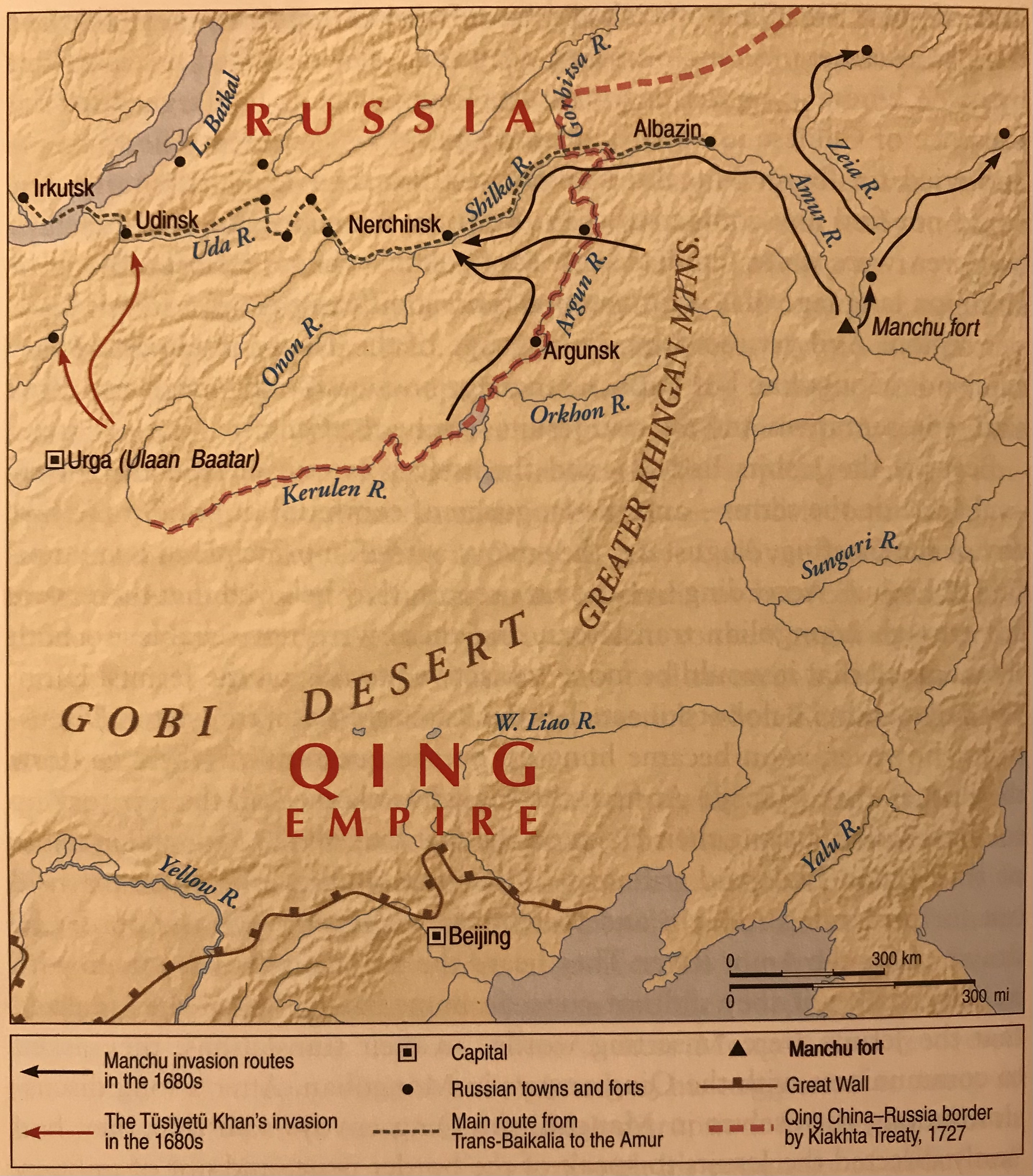
By the 1680s, the Qing dynasty under the leadership of the Kangxi Emperor had successfully consolidated control over southeastern China and Taiwan and had also suppressed a major military rebellion.2 After a series of Qing military incursions into territory claimed by the Russian Empire around the Amur river, including the capture of the fort at Albazin, Russia sent plenipotentiaries to negotiate peace. These diplomatic talks focused primarily on the regulation of trade trade and deliniation of borders, and they began in 1689.3
While trade between the empires, especially that of furs, was the eventual goal of these negotiations at Nerchinsk, the primary concern was peace. This peace hinged upon the effective control of groups of Mongolic nomads who inhabited the frontier region. Galdan Khan and his Western Mongol armies (made up primarily of Oriats and Dzhungars) was at the time taking control of large portions of Western Mongolia and South Siberia. Furthermore, he had engaged in a violent rivalry with Tushiyetu Khan of the Eastern Mongols (Khalkha), and the ensuing conflicts had displaced many minor Mongolic tribes into Qing territory. Manchu sources report the actions of these tribes as “raiding,” however, it is likely that common perception of nomadic peoples as “barbarians” poorly colored the actions of these people fleeing from war, who may very well be considered refugees by modern standards.4

It appears that Mongolic groups faced hardships on on both sides of the Russo-Manchu frontier; when a dispute arose at the Nerchinsk negotiations, the Qing plenipotentiaries accused the Russians of “mistreating the local people – killing them, taking their women, and extracting furs from them – forcing many of them to flee seeking refuge with the Qing.”6
Despite the view of Mongolic groups as “barbarians,” they clearly played an important role in the border negotiations. Historians largely agree that one of the most important objectives of the Kangxi Emperor in these negotiations was to find a solution to the “Mongol problem” by creating a well-defined border across the Russo-Manchu frontier in northern Mongolia. Among the concerns over Mongolic peoples was, for example, the case of “700 Mongols who had committed crimes and fled to Russian territory.”7 Manchu diplomats used fur trade access as leverage to pressure Russians into prioritizing these border negotiations, insisting that peace, and therefore trade discussions, could not occur without a defined border between Qing Mongolia and Russian Siberia.8
While “Mongol” is the most commonly used term to refer to the many nomadic tribes that lived on the Russo-Manchu frontier, there were many different ethnic groups that made up what the Russians and Manchus referred to as “Mongols” or “barbarians,” including but not limited to Dzungars, Khalka, Onguds, and Buryats. The so-called “Mongol problem” was not one of a monolithic people, but of a number of individual groups with their own needs and goals.9 As such, they each formed military alliances with stronger powers like Galdan Khan, as well as the Russian and Qing empires. With a more regulated border, the Manchus hoped to better control the loyalties of these groups and prevent coalitions, such as that of Galdan, from forming.
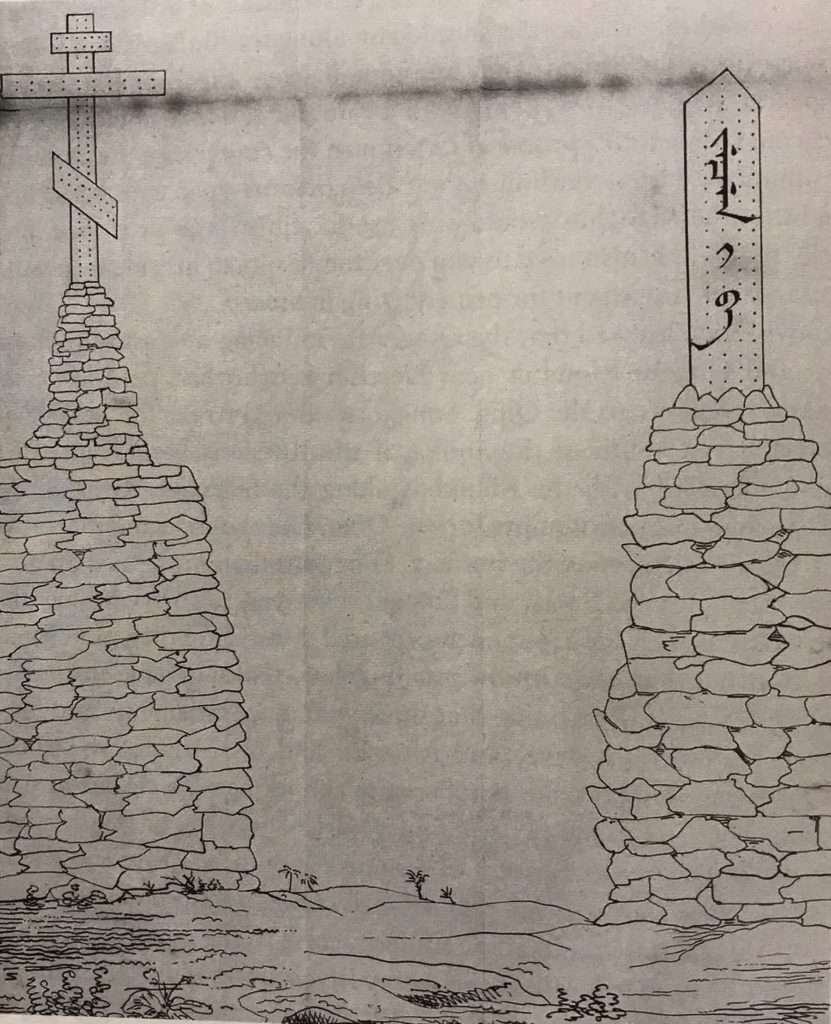
The negotiations which resulted in the Treaty of Nerchinsk were conducted primarily by Jesuit intermediaries, who used Latin as the language of negotiation. The Russians and Manchu plenipotentiaries were distrustful both of each other as well as of the Jesuits, to the point that some time into the negotiations, the Russians proposed to proceed with the negotiations in Mongolian.10 While the remainder of the proceedings still took place in Latin, the fact that this was even suggested demonstrates the importance of Mongolian people as a commonality between Muscovite and Manchu diplomats, who were both culturally and linguistically alien to each other. It seems somewhat ironic, then, that the border markers originally listed the provisions of the 1689 treaty only in Latin, Russian, Manchu, and Chinese, with Mongolian translations added “later.”11
The Treaty of Kiakhta, 1727-8
In the late 1690s, Galdan Khan’s forces were defeated by the Qing Empire, effectively consolidating Manchu control of Mongolia. With the resulting relative peace, the Qing again turned their attention to trade relations with the Russians. While Moscow sent plenipotentiaries to the Qing imperial capital at Peking in spring of 1727, the topography of the frontier in question was so unknown to both parties that the negotiations had to be conducted at Selenginsk, a Russian settlement east of Lake Baikal. While this lack of knowledge does demonstrate a certain amount of disregard for the inhabitants of the region, there was one Mongol that participated in the negotiations. However, he was an ethnically Khalkh prince who had married into the Qing royal family, and therefore argued on behalf of Manchu interests instead of those of the local Mongol groups.13 This does explain why the border portions of the treaty were written in “Russian, Manchu, and Mongol languages.”14
The negotiations which took place in Selenginsk resulted in the “Treaty of the Bura,” which determined the exact border between the Russian and Qing Empires, as pictured in the above map. It was signed on August 20, 1727, and further documents specifying topological details were signed on October 12 and 27, which also defined a neutral strip of land on either side of the border markers, which were similar to those erected after the 1689 Treaty of Nerchinsk.15
The Treaty of the Bura was ultimately incorporated into the Treaty of Kiakhta, which was signed in Peking in June of 1728. Kiakhta was a Russian guardhouse around 100 miles south of Selenginsk, although it would later become a major trade center as a result of the treaty’s stipulations.16
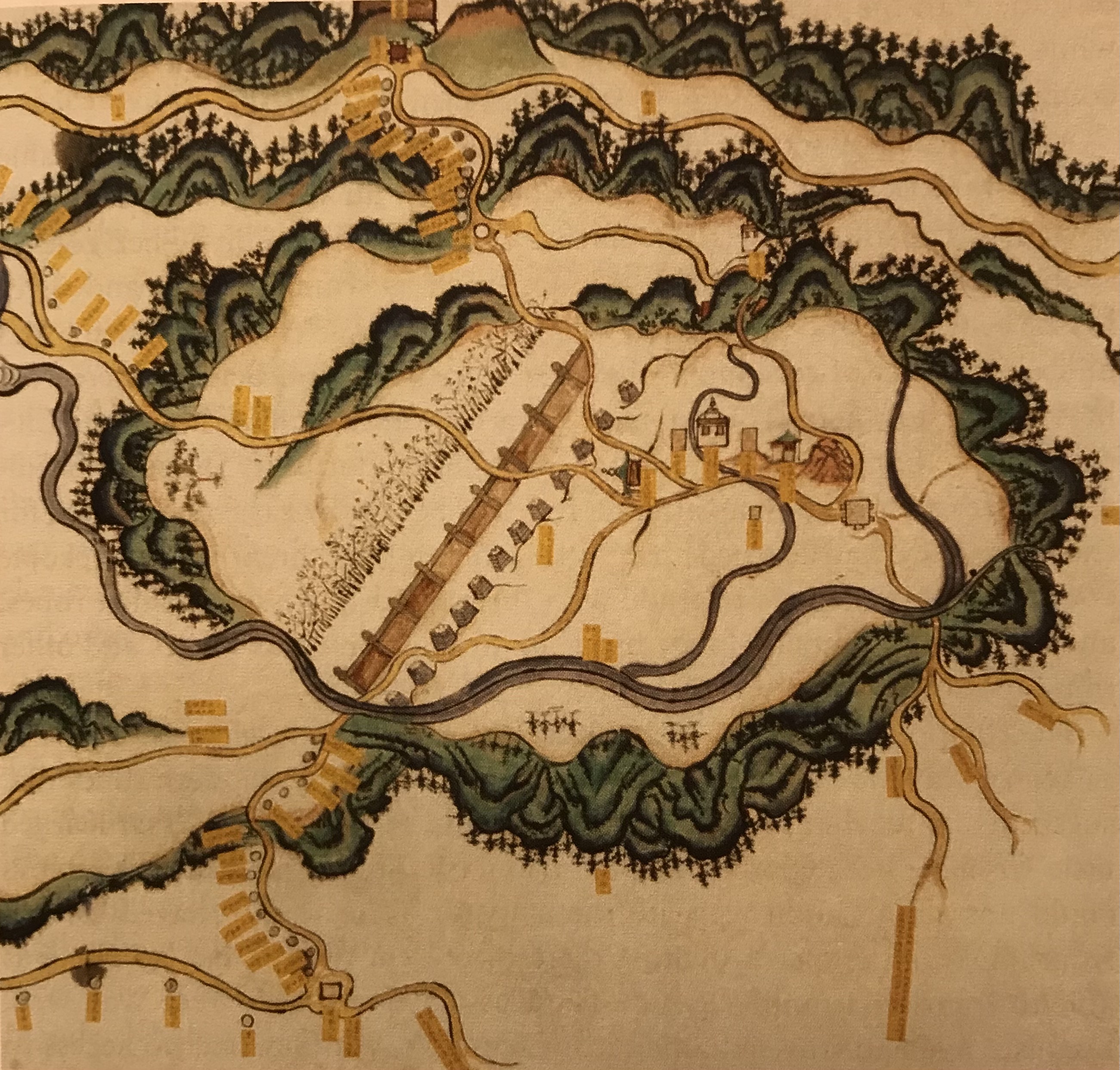
The most notable aspects of the Treaty of Kiakhta, in terms of its impacts on the native inhabitants of the frontier region, were the policies of fugitive exchange and creating legal regulations which complied with both Russian and Manchu societal expectations. These policies specifically prescribed death sentences for thieves, murderers, and deserters; and whichever side apprehended the fugitives were obliged to carry out the appropriate punishments. Though there don’t appear to have been any specific references to migrants in the legal section (Article X), it did state that any who carried weapons across the frontier and did not hold passports were to be “punished according to the customs of their own empire.”18
Along with establishing legal repercussions for crossing the border in a way that was undesirable to either empire, native Mongol groups were also inhibited by economic regulations. The Russians imposed a heavy tax on the export of horses and cattle to Qing China, due to concern over their use in military efforts against them. This policy had a major negative impact on the economy of Buryat tribes who had previously traded livestock across the Transbaikal region.19 These treaties had a major impact on the peoples that inhabited the Russo-Manchu frontier, economically and, as I hope to show with the analysis of the following folk song, culturally as well.
The Folk Song Shildei Zanggi
For my analysis of the Buryat folk song Shildei Zanggi, I am relying largely on unofficial English translations provided to me by György Kara. Russian translations exist for some variants.20 In Poppe’s version, the verses are usually alliterative (aaax, bbbx, cccx, dddx, eeee, ffff), with parallelism comparing a horse kept in hobbles to Shildei held captive by border guards, and comparing his large quantities of livestock to his great youth and foolishness in crossing the border. For example, from Verse “A”:
The three-year-old black [horse] / is tied for training for three days and nights. / Surrounded by three rows of soldiers, / Captain Shildei [stays] alone. //
And from Verse “C”:
When having many camels, / [he] built a corral [for them], / but being too foolish, / he trespassed the well-guarded frontier. //21
In Pozdneev’s version, the stone pillars marking the border are referred to as “cairns”:
When having many sheep, / oh yeah, oh yeah / I built dens and fences. / Being young and thoughtless, / oh yeah, oh yeah / I stepped across the cairn-marked border. //
When having many horses, / oh yeah, oh yeah / I built enormous fences. / Being young and stubborn, / oh yeah, oh yeah / I walked across the cairn-marked border. //
When having many cattle, / oh yeah, oh yeah / I built high fences. / Being young and spoiled, / oh yeah, oh yeah / I stepped across the cairn-marked border. //
When having many camels, / oh yeah, oh yeah / I built straight fences. / Being young and foolish, / oh yeah, oh yeah / I stepped across the cairn-marked border. //22
These border markers, erected directly as a result of both the Nerchinsk and Kiakhta treaties, clearly held a strong place in the culture of Buryats, and likely other native groups impacted by the maneuverings of the Russian and Qing empires. The story of Shildei Zanggi’s capture and execution for a seemingly innocent migration reflects the oppressive aspect of the treaties not seen in the simple historical documents.
The treaties of Nerchinsk and Kiakhta essentially created diasporas overnight, or, from another perspective, they forced exile without those who were exiled ever needing to travel. Shildei Zanggi was not forced from “Russia” to “China” before attempting to return, but rather he was left stranded in the Qing Empire, cut off from his relatives and pastures by a treaty that was not even written in his language. These events perfectly illustrate how international borders (and the migrations, exiles, and diasporas that come with them) are constructed in nature, but also have real, lasting impacts on people, especially those with no say in their creation.
Shildei Zanggi may or may not have been an actual historical figure. He was mentioned in Khobituev’s Khori Buriat chronicle from 1887.23 However, given the time that elapsed between the events of the song and the recording of the chronicle, it’s possible that he was recorded in the chronicle due to his presence in cultural memory as a result of the folk song. Either way, the many variants indicate that this song was meaningful to many people in the region, regardless of its veracity. By analyzing songs and other folk narratives, we can at least attempt to understand how large-scale historical events actually impacted people.
Notes
- Peter C. Perdue, China Marches West: The Qing Conquest of Central Eurasia (Cambridge, Mass: Belknap Press of Harvard University Press, 2005), 168.
- Perdue, China Marches West.
- G. Patrick March, Eastern Destiny: Russia in Asia and the North Pacific (Greenwood Publishing Group, 1996), 51-6.
- Perdue, China Marches West.
- Map Showing Wars between Qing Dynasty and Dzungar Khanate, September 16, 2018, https://commons.wikimedia.org/wiki/File:Qing_Dzungar_wars.jpg
- Peter C. Perdue, “Boundaries and Trade in the Early Modern World: Negotiations at Nerchinsk and Beijing,” Eighteenth-Century Studies 43, no. 3 (2010): 341–56, 347.
- G. Patrick March, Eastern Destiny: Russia in Asia and the North Pacific (Greenwood Publishing Group, 1996), 64.
- March, Eastern Destiny, 59-64.
- Perdue, “Boundaries and Trade in the Early Modern World,” 347.
- Perdue, “Boundaries and Trade in the Early Modern World,” 348.
- March, Eastern Destiny, 56.
- Perdue, China Marches West, 171.
- Mark Mancall, Russia and China: Their Diplomatic Relations to 1728, Harvard East Asian Series 61 (Cambridge: Harvard University Press, 1971), 246-7.
- March, Eastern Destiny, 66.
- Mark Mancall, Russia and China: Their Diplomatic Relations to 1728, 248-249.
- Mark Mancall, Russia and China: Their Diplomatic Relations to 1728, 246.
- Perdue, China Marches West, 163
- Mark Mancall, Russia and China: Their Diplomatic Relations to 1728, 253.
- va-Maria Stolberg, “Interracial Outposts in Siberia: Nerchinsk, Kiakhta, and the Russo-Chinese Trade in the Seventeenth/Eighteenth Centuries,” Journal of Early Modern History 4, no. 3–4 (January 1, 2000): 322–36, 336.
- Unofficial English translations by György Kara provided via personal communication, September 2020.
- N. N. Poppe, Buri͡at-Mongolʹskiĭ Folʹklornyĭ i Dialektologicheskiĭ Sbornik, Obrazt͡sy Narodnoĭ Slovesnosti Mongolov, Tom V (Moskva: Izdatelʹstvo Akademii nauk SSSR, 1936);
- Aleksej Matveevič Pozdneev, Obrazcy narodnoj literatury mongol’skih” plemen” (Tip. Akad. Nauk., 1880)
- G. Kara, “Notes Sur Le Folklore Mongol,” Acta Orientalia Academiae Scientiarum Hungaricae 11, no. 1/3 (1960): 271–91.
You give a clear explanation of the complexities of Russian/Qing border negotiations, and you have good use of maps here. In thinking about the longer selection from this folk narrative, I’m struck by something else in Shildei’s claim: not only that he crossed a marked boundary but that he was a builder of fences and walls (presumably to protect his many kinds of livestock). What do you make of that?
This is a great description of an incredibly tragic tale. It reminds me of modern conflicts with fledging nations attempting independence from a culture that may or may not regard them as people, let alone actual citizens. I appreciated your final comments: that borders, while invisible, have visible and sometimes greatly lasting effects on a people. Is there a visible effect on the culture of the Buryat people as a result of the division? Are these folk songs and other individual accounts of residents affected by exile and deportation still popular repeated among the current members of the community?
This is a really clear and well-told story. It’s ending does not surprise me as much as it maybe should since this has, unfortunately, happened to people all over the world since the very beginning. I’m particularly struck by the sentence “The treaties of Nerchinsk and Kiakhta essentially created diasporas overnight, or, from another perspective, they forced exile without those who were exiled ever needing to travel”. We often see forced migration as a movement that happens but what happens when people are just stripped of everything by simply existing? How has this affected the people that still live in this region, and do they still harbor resentment over this?