Before I begin, I would just like to say thank you to all the people who read my last post and left great comments. I hope that I have done an adequate job in exciting you to learn more about the history of the Meskhetian Turks and welcome you to this blog post, in which I am going to focus on their experiences post deportation.
I think it would be helpful for me to clear up some of the mistakes I made in my last post. When mentioning the ‘justifications’ behind Stalin’s deportation of the Meskhetians, I accidentally lumped them into the other groups who were “deported out of fear of potential collaboration with the Nazis”1. Unlike other groups, like the Volga Germans and Crimean Tatars, Meskhetians were “never accused of collaborating with the Germans” because there was no fear that the Germans would get near them and, more importantly, the German army was already retreating at the time of their deportation. 2
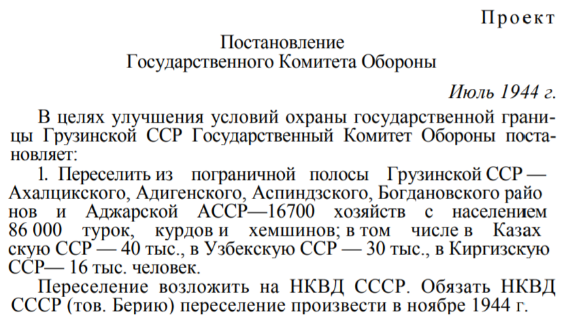
In reality, the decision to deport Meskhetian Turks was a mix of Soviet concerns on the Turkish border and irredentism by the Armenian SSR. I made mention of the Soviet fears in my last post, but an interesting addition to the story was Armenia’s desire to reclaim land that was lost to Turkey and this could be achieved by settling in land next to the Turkish border. In short, the 1926 census revealed that the region of Akhalkalaki, which makes up half of Meskhetia, “was overwhelmingly Armenian [and justified] traditional Armenian claims to this area” as well as motivated the Soviets to carry out this deportation against a potential Turkish threat.3 However, after World War II the Soviets declared both Georgia and Armenia as owners of the region, which was done to containing Georgian and Armenian nationalism. From here, I am going to analyze the initial outcome of the Meskhetian deportation and then provide commentary on their experiences in the various destination countries they were sent to.
Exile and Hopes of Return
When the Soviet Union removed the Meskhetian Turks from southern Georgia, they were sent to Kazakhstan, Kyrgyzstan and Uzbekistan “to live in special settlements” and mostly worked as agricultural laborers.4 When Stalin died in 1953 and Khrushchev took over in 1956, restrictions against deported groups were lifted and most were rehabilitated into their homelands except the “[Meskhetians and other small nationalities who] were not mentioned or offered apologies.”5 Soviet leadership refused to let the Meskhetians repatriate because their homeland “had become geopolitically important [due to its proximity to NATO] and the Georgian SSR refused them out of concern of potential “antagonism between the Christian Armenians and Georgians.”6 In addition, there was nowhere for them to move back to because their villages had been colonized by Armenians and ethnic Georgians.
On the bright side, the harsh treatment and repression benefited the Meskhetian Turks in a very important way. A nation, in the words of Joseph Stalin “is a historically constituted, stable community of people, formed on the basis of a common language, territory, economic life and psychological make-up manifested in a common culture.”7 Before the deportation, the Meskhetian Turks fulfilled the majority of the prerequisites as they “all spoke Turkish, they shared a well-defined common territory, all were Islamicized and all manifested a strong sense of türklük [Turkishness].”8 The only thing that hindered their ability to see themselves as unified nation was a lacking consciousness, but this was easily solved by the deportation which made the Meskhetian Turks into “a nation with a set of political demands.”9 Regardless of wherever they settled, the Meskhetian Turks were unified and empowered by a shared identity and strove to preserve it at all costs. Now we are going to analyze their history and experiences in a few countries, both in the few years following the deportation and more recently.
A NATION ABROAD
Kazakhstan:
The Meskhetian Turk population of Kazakhstan is between 90,000 and 150,000 with the majority in Almaty and Shymkent, which are near the borders of Uzbekistan and Kyrgyzstan.10 In a news video titled “A Family of Meskhetian Turks found their homeland in Kazakhstan” on Khabar News, Asiya Razhapova, a younger member of the family, explains that when the Meskhetians first arrived in Kazakhstan they had nothing: no homes and no food. However, the local Kazakhs fed them and would even invite them to stay as guests in their homes. The patriarch of the family, Rafik Nargilov, added that his parents and grandparents spoke very warmly about the local population and believes that without their help none of the deportees would’ve survived. Meskhetian Turkish families like the Narigilovs are quite common in Kazakhstan, as they see Georgia as “only a symbolic homeland,” while their real home is in Kazakhstan or Turkey.11
Uzbekistan:
There is around 10-15,000 Meskhetian Turks living in Uzbekistan today and are located mostly in the cities.12 Out of the Meskhetian Turks exiled to Uzbekistan, “50,000 people died [from starvation and cold]” before arriving.13 They usually lived in urban neighborhoods together and were better off financially compared to their Uzbek counterparts which caused some friction. According to one source, it was recommended for Uzbeks to not enter Meskhetian neighborhoods “because of the danger [with] the local youth” and sometimes “the Turks behaved provocatively and often bullied Uzbeks.”14 I would like to give a word of caution about this source because it has some grammatical mistakes, as it is the account of one person and no real evidence is presented.
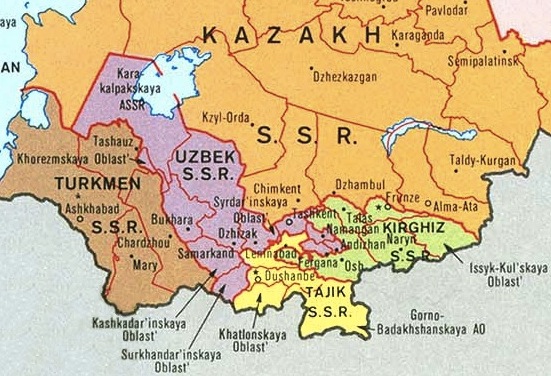
Relations between Uzbeks and Meskhetian Turks were relatively stable until 1989, when a pogrom broke out and “Uzbek mobs attacked [Meskhetian] Turks” killing 98 and destroying hundreds of homes and cars.15 Before the pogrom 109,000 Meskhetian Turks lived throughout Uzbekistan, but immediately after more than 16,000 were relocated to Russia by Soviet leadership and a large wave migrated freely behind them soon after. For those who remain today, “almost all… speak Uzbek… and have a good relationship with the majority community” but are still alienated to a degree.16
Russian Federation:
Following the Ferghana Valley pogrom, 17,000 Meskhetian Turks were relocated to Russia and a few thousand more arrived in the early nineties. Today, the Russian Federation is home to 75,000 Meskhetian Turks, with “around 18,000 in Krasnodar region [and] about 16,000 in Rostov region.”17 Similar to other countries, they work mainly in agriculture but have access to some of the opportunities present to natives. In Krasnodar Krai, “10-12,000 people have been denied propiska [registration]… making the population effectively stateless” and they are portrayed negatively as illegal immigrants.18 Their inability to receive registration prevented them from becoming citizens and was the result of local authorities not wanting to “accept responsibility for the forced migrants and provide them with necessary help.”19 This is also tied to an increase in nationalism that scapegoated the Meskhetian Turks. Thankfully, the majority of Meskhetian Turks outside of Krasnodar Krai were able to receive registration and citizenship with few problems. The main thing to note about Meskhetian Turks in the Russian Federation is that they suffer from similar discrimination and resentment, like other Caucasian and Central Asian groups.
Georgia:
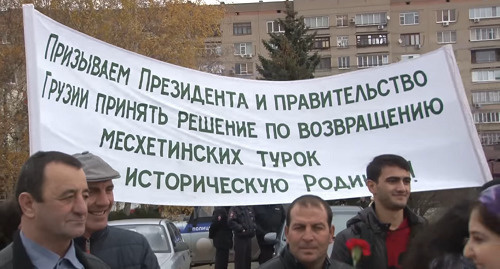
When Khrushchev came to power, many nationalities were rehabilitated in 1956 but the Meskhetian Turks were not recognized until 1974. By this time both the Soviet leadership and Georgian SSR had no interest in repatriated them and only a few hundred families returned to Georgia, but not in their home region. By 2001 only 644 Meskhetian Turks lived in Georgia and according to the UNHCR “no new Meskhetian Turks have resettled in Georgia since the end of 2000.”20 The few that remain in Georgia have been able to assimilate and preserve their culture and identity at the same time, but “feel that they live in a magnifying glass” because of the interest that surrounds them.21 In 2008, the Georgian Parliament adopted a law that opened repatriation to select groups that were deported in the 1940s, but at the same time didn’t guarantee them any rights or privileges of a citizen.22 You may be asking why they haven’t been able to resettle in their true homeland, and the quick answer is that the Georgian government doesn’t really want them back and the Georgian people prefer the Armenian population that replaced the Meskhetian Turks because they preserve Georgian and Armenian interests on the Turkish border.
Concluding Thoughts
From the experiences I have presented, which occurred all across Central Asia, we can see how difficult it was for the Meskhetian Turks to brave the storm and emerge as a united people and nation. Additionally, we have been able to see their resilience and can stand in awe of their ability to make the best of a terrible situation and find relative success and stability in whatever country they end up in. Hopefully as the international refugee regime continues to evolve and grow, the Meskhetian Turks will receive a full and open repatriation to their traditional homeland in Southern Georgia and will see their conditions improve in their current homelands.
1 Linfesty, N. (2020, October 31). Making Sense of Meskhetian Turk Migrations. Retrieved from http://mariannekamp.net/?p=1633
2 Kreindler, I. (1986). The Soviet Deported Nationalities: A Summary and an Update. Soviet Studies, 38(3), 387-405. Retrieved November 20, 2020, from http://www.jstor.org/stable/151700, 392.
3 WIMBUSH, S., & WIXMAN, R. (1975). The Meskhetian Turks: A New Voice in Soviet Central Asia. Canadian Slavonic Papers / Revue Canadienne Des Slavistes, 17(2/3), 320-340. Retrieved November 20, 2020, from http://www.jstor.org/stable/40866873, 325-326.
4 Форов, Е. (n.d.). Турки-месхетинцы-сложная судьба народа. Retrieved October 30, 2020, from https://travelask.ru/articles/turki-meshetintsy-slozhnaya-sudba-naroda
5 Coskun, U. (209). AHISKA/MESKHETIAN TURKS IN TUCSON: AN EXAMINATION OF ETHNIC IDENTITY. University of Arizona Department of Anthropology, 1-111, 15.
6 Aydıngün, A., Harding, Ç B., Hoover, M., Kuznetsov, I., & Swedlow, S. (2006). Meskhetian Turks An Introduction to their History, Culture and Resettlement Experiences. Culture Profile, (20), Ii-37. Retrieved October 30, 2020, 7.
7Stalin, J. (n.d.). Marxism and the National Question – Marxists Internet Archive. Retrieved from https://www.marxists.org/reference/archive/stalin/works/1913/03a.htm
8 & 9 WIMBUSH, S., & WIXMAN, R. (1975). The Meskhetian Turks: A New Voice in Soviet Central Asia. Canadian Slavonic Papers / Revue Canadienne Des Slavistes, 17(2/3), 320-340. Retrieved November 20, 2020, from http://www.jstor.org/stable/40866873,
10 Pentikäinen, O., & Trier, T. (2004). Between Integration and Resettlement: The Meskhetian Turks. ECMI Working Papers, 1-54. Retrieved October 30, 2020, from https://css.ethz.ch/content/specialinterest/gess/cis/center-for-securities-studies/en/services/digital-library/publications/publication.html/19696, 24.
11 Blacklock, D. (2005). Finding Durable Solutions For the Meskhetians. European Centre for Minority Issues, (56), 1-20. Retrieved from https://css.ethz.ch/content/specialinterest/gess/cis/center-for-securities-studies/en/services/digital-library/publications/publication.html/25902, 8.
12 Aydıngün, A., Harding, Ç B., Hoover, M., Kuznetsov, I., & Swedlow, S. (2006). Meskhetian Turks An Introduction to their History, Culture and Resettlement Experiences. Culture Profile, (20), Ii-37. Retrieved October 30, 2020, 14.
13 WIMBUSH, S., & WIXMAN, R. (1975). The Meskhetian Turks: A New Voice in Soviet Central Asia. Canadian Slavonic Papers / Revue Canadienne Des Slavistes, 17(2/3), 320-340. Retrieved November 20, 2020, from http://www.jstor.org/stable/40866873, 328.
14Johnson, D. (2020, January 27). “The Fergana massacre”: What pogroms staged Uzbeks in 1989. Retrieved from (http://www.globaldomainsnews.com/the-fergana-massacre-what-pogroms-staged-uzbeks-in-1989
15 Coskun, U. (209). AHISKA/MESKHETIAN TURKS IN TUCSON: AN EXAMINATION OF ETHNIC IDENTITY. University of Arizona Department of Anthropology, 1-111, 16-17.
16 Blacklock, D. (2005). Finding Durable Solutions For the Meskhetians. European Centre for Minority Issues, (56), 1-20. Retrieved from https://css.ethz.ch/content/specialinterest/gess/cis/center-for-securities-studies/en/services/digital-library/publications/publication.html/25902, 9.
17 Ryazantsev, S. V. (2009). Turkish Communities in the Russian Federation. International Journal OnMulticultural Societies, 11(2), 155-173. Retrieved October 04, 2020, from https://unesdoc.unesco.org/ark:/48223/pf0000188648, 168.
18 Pentikäinen, O., & Trier, T. (2004). Between Integration and Resettlement: The Meskhetian Turks. ECMI Working Papers, 1-54. Retrieved October 30, 2020, from https://css.ethz.ch/content/specialinterest/gess/cis/center-for-securities-studies/en/services/digital-library/publications/publication.html/19696, 22.
19 Ryazantsev, S. V. (2009). Turkish Communities in the Russian Federation. International Journal OnMulticultural Societies, 11(2), 155-173. Retrieved October 04, 2020, from https://unesdoc.unesco.org/ark:/48223/pf0000188648, 168.
20 Pentikäinen, O., & Trier, T. (2004). Between Integration and Resettlement: The Meskhetian Turks. ECMI Working Papers, 1-54. Retrieved October 30, 2020, from https://css.ethz.ch/content/specialinterest/gess/cis/center-for-securities-studies/en/services/digital-library/publications/publication.html/19696, 12.
21 Blacklock, D. (2005). Finding Durable Solutions For the Meskhetians. European Centre for Minority Issues, (56), 1-20. Retrieved from https://css.ethz.ch/content/specialinterest/gess/cis/center-for-securities-studies/en/services/digital-library/publications/publication.html/25902, 12.
22Кмузов, Б. (2018, December 13). Месхетинцы рассказали о сложностях при переселении в Грузию. Retrieved from https://www.kavkaz-uzel.eu/articles/356601/
Great research, Nick! The Meskhet case of deportation has some significant differences from other deportations. I’m interested in the claim that deportation itself consolidated their “national” identity.
Hello Nick!
I really enjoyed the organization of this post – it really helped me see the different situations Meskhetian Turks found themselves in before you tied it all together at the end.
I also love the video you included. I don’t know Russian, but it is still fascinating to see some of this footage and imagery. Also, since I don’t know Russian, I would have never come across this video on my own so… thank you!
I have a question about the movement of contemporary Meskhetian Turks – since those in Kazakhstan reside in areas near the Kazakh-Uzbek border, do Meskhets move a lot between these modern countries?
The next question is about information flows between Meskhets in different regions: What channels facilitated the maintenance of a shared identity, one which gave way for the Meskhets to emerge as a “a nation with a set of political demands”? Or, were they not separated long enough to “fracture” parts of a greater Meskhetian identity?
Thank you for your post and your thoroughness in research and its presentation. I hope to get on your level when it comes to footnotes. My blog posts could certainly learn from yours!
Very interesting post! I appreciated the use of different media–the combination of video, map, document scan, and photo shows the variety of ways to present information and is always helpful to break up a lengthy blog post.
In your conclusion, you say that the Meskhetian Turks “find relative success and stability in whatever country they end up in,” which left me with two questions. Firstly, you only mention success in the Uzbek case, and in the Russian case mention that the population was essentially stateless for a while and faces discrimination. Do you have more examples of their success outside of Uzbekistan? Second, and related, how did they go from starving deportees to successful and financially well off in Uzbekistan? I’d be interested in learning more about that transition, since it seems like it would have been difficult!
You also mention that the expansion of international refugee regimes might allow the Meskhetian Turks back to their traditional homeland in Georgia. I’d like to hear more about the group’s categorization as refugees, and also perhaps about their current interest in returning to Georgia — Georgia has seen such huge outmigration, to Greece, Russia, and elsewhere in Europe, and I wonder if Meskhetian Turks would prefer to move to somewhere with better economic opportunities, instead of to the place they have historical ties to…