This post is part two of my exploration into the educational outcomes of migrants and their children. You can find Part One here. I will be looking at this topic in the context of Russia. Are there differences in education attainment and achievement between native and migrant children? If so, what contributes to this?
Russia is the second highest immigrant-receiving country after the United States. These migrants are not homogenous but come from a variety of different countries and ethnic backgrounds. Following the collapse of the Soviet Union, over three million ethnic Russians migrated to Russia. Today, the country receives many temporary labor migrants thanks to opportunities in sectors like construction, many of which are from Central Asia.
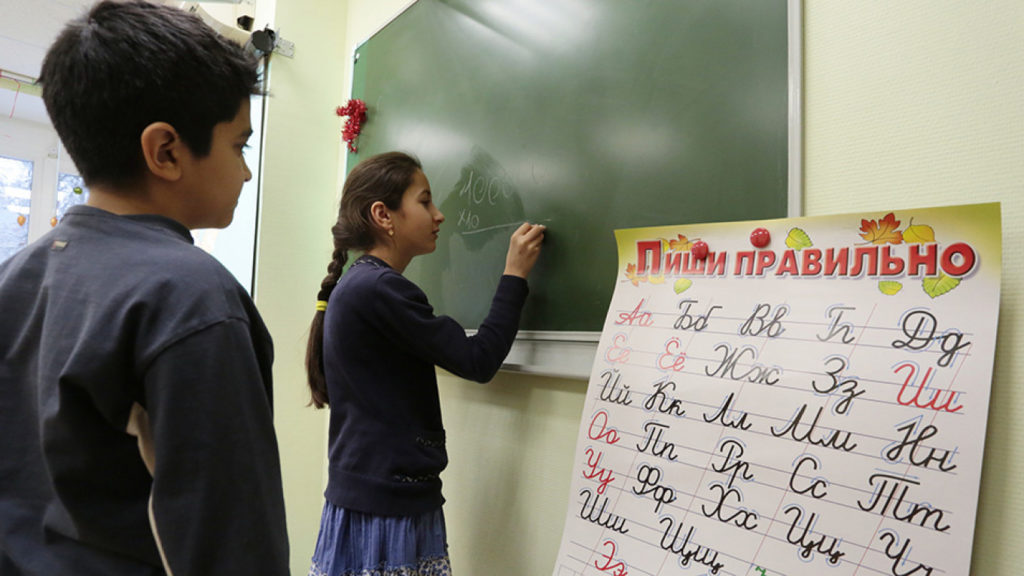
Russia’s constitution guarantees the right for education to all children. Article 78 reaffirms this right for foreign citizens residing in Russia, guaranteeing free preschool, primary, and secondary education.1 In practice, this guarantee is not enforced for migrant children. An order passed in 2014 by the Ministry of Education made evidence of a migrant’s legal right to stay in the country a requirement for enrollment in school, basically closing off the path to an equal education for the children of migrants. This order is enforced at the school level, meaning directors and teachers are the ones who make the choice to enroll or not enroll. These authority figures often interpret the 2014 order harshly, refusing enrollment to children who do not possess the right to permanent residency. Even the Russian Supreme Court has affirmed that this practice of refusing enrollment to migrant children is illegal.2 Despite this, the practice continues and affects the educational prospects of migrant children. While I was unable to find much research after 2014 on the topic, studies before the law change attempted to discover how educational achievement differed between migrant and native children.
The Data
There are several reasons why migrants may have difficulty getting access to education. These include language differences, lower levels of social capital, and reduced social status in the receiving country. Recognizing that these factors may have the effect of changing migrant children’s desire to pursue further education, Tiruikanova and Ledeneva explored orientations towards acquiring higher education in migrant children in Russia.3 The authors targeted migrant students in the 11th grade and their parents. They found that the desire to give their children an education in the Russian language was a main motivation for many parents to migrate in the first place, a motivation that the authors hypothesized would result in higher motivation on the part of the students. They did find that 91.5% of migrant students would like to acquire a higher education, about 12 points higher than native Russian students.
While their aspirations are high, around half of the students surveyed noted that they did not have the necessary resources to enroll in a university or would be required to go straight to work to make a living. Because of this reality, only 65% of migrant students intended to enroll in higher education. The authors found that “the chances of acquiring a higher education are directly dependent on the economic well-being of the parents.” Without the necessary resources, migrant families are more economically vulnerable and lack the ability to pay tuition, pay tutors, or defer earning an extra income. While 81% of children from higher-income families plan to enroll in higher education, only 49% of children from low-income families do. Because migrants are more likely to be economically vulnerable, this statistic affects them disproportionately.
Fluency in the Russian language was another variable that played a role in determining the chance of obtaining a higher education, with fluency being a positive indicator of enrollment. Lack of legal status, living in a rural area, and being a male were associated with lower chances of enrolling. These systematic differences that separate migrant students from native students make it so that obtaining a higher education becomes more difficult for students from migrant families.
A study done by the Center for Migration Research (CMR) found similar results.4 They found that there are differences in education levels throughout a child’s entire time in the educational system. According to these data, only 15-25% of migrant children attend kindergarten in Russia, while native Russian children attend about 50-80% of the time. After kindergarten, the attendance of migrant children increases to around 80%. Despite the increase, migrant parents still note that their lack of knowledge of the education system is barrier to registration, as is the informal requirement for legal registration papers. One parent recalls, “Without a registration, they will not be assigned anywhere, and they sit at home with their mother-in-law.” Regardless of these differences, the study ends on a positive note, claiming that the situation for migrant children is relatively optimistic.
The idea that migrants do not have equal access to education seems, as an American, obvious. The differences noted above between migrant and native students even seem small to the differences that exist in the United States. But another study, done by Edgar Demetrio, finds that migration background has, in fact, no effect on educational achievements in Russia.5 Even when controlling for the factors Tiruikanova and Ledeneva found as having negative impacts on educational achievement for migrants, Demetrio still found no difference. In fact, he found that 22% of migrant students obtain grades of ‘excellent’ or ‘very good,’ while the same is true for only 14% of native students. The author recognizes that this trend differs from that of Western countries, like the U.S. or Germany, where a large literature exists on the topic and finds that migrant children usually have lower levels of academic achievement than native children.
Possible Explanations
Demetrio’s hypothesized reason for this result is interesting. He attributes the difference between outcomes in countries like Germany and the U.S. and outcomes in Russia to the fact that “more than half of all international migrants to Russia are ethnic Russians.” Because of this, he says, having a migration background should not affect a student’s educational outcomes, presumably because ethnic Russians may have an easier time assimilating. The question then becomes, what about the migrants who are not ethnically Russian? I have not found a source that answers this question alone. Tiruikanova and Ledeneva’s study does not sample many different ethnicities. They do find that the potential for enrolling in higher education is higher among ethnic Russians than Georgians and Armenians (72% versus 50%, 58% respectively), but Belarusians have a higher chance than ethnic Russians (88%).6
Another reason beyond Demetrio’s explanation could be historical factors or the type of migration. Demetrio cites a study that I find particularly interesting, an article by Iztok Sori on immigrant students’ achievements in Croatia, Serbia, and Slovenia.7 Sori finds that the difference between migrant and native educational outcomes is larger in old democracies than in former socialist countries. This difference is relatively small in Serbia, Croatia, and Slovenia compared to Germany or Austria. Below is a table that includes the reading achievement differences in multiple old and new democracies.
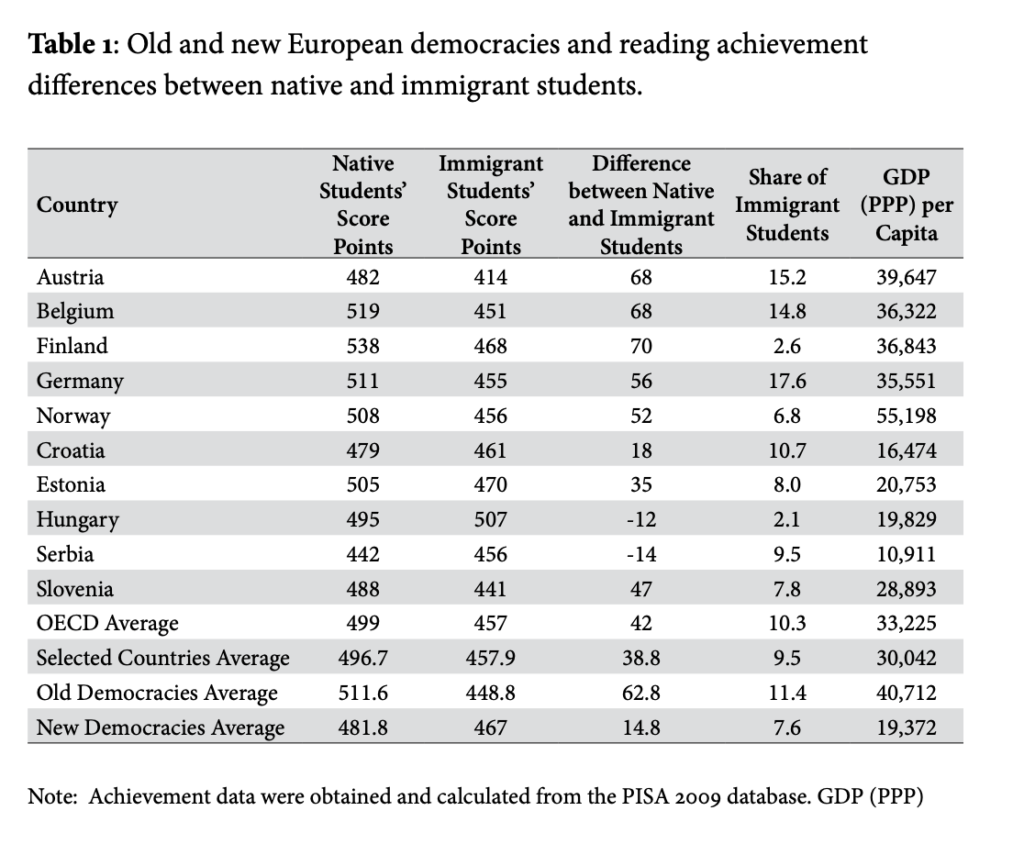
Sori poses a possible explanation here, which is related to the characteristics of socialism. Could the “socialist inclination towards equality” make a difference in immigrant student educational outcomes? We have previously discussed the Soviet attempts to welcome and celebrate difference ethnicities, or the “friendship of the peoples.” Maybe this official stance towards multiculturalism (official though not always felt in practice) has carried over after the fall of the USSR. This is a partial explanation given for Serbia, Croatia, and Slovenia’s smaller gap in educational outcomes.
Another distinction made in this study is between countries whose migration was primarily forced versus countries that had a “guest-worker” program. If you look at the table above, you can see that Slovenia has a larger gap between natives and migrants than Croatia and Serbia. Sori attributes this to the fact that most previous migration into Croatia and Serbia was forced and the migrants were comprised of mostly ethnic Croats and Serbs. Inclusion was less problematic because these migrants already spoke the language and the migration was part of ethnic homogenization. On the other hand, Slovenia had a guest-worker program much like that of Germany. Most migrants were not ethnic Slovenes, had a harder time assimilating, and were denied equal participation in the labor market. This historical difference in migration could be the reason why we see a smaller educational gap between migrants and natives in Serbia and Croatia.
Can we apply this explanation to Russia? If we are looking at migration immediately post-USSR, then maybe. At that time, there was an influx of ethnic Russians returning to Russia. They likely knew the language and had an easier time assimilating. It makes sense that they would not suffer as badly in their educational outcomes. But looking towards today, especially in light of the recent changes to Russian migration law, I’m not sure this argument would hold. In 2019, Kazakhstan and Tajikistan were two of the countries who sent the most migrants to Russia.8 Given the propensity of Central Asians to migrate to Russia for work, we can expect that racism, xenophobia, language barriers, and more would affect educational outcomes for them and their children. This is why the results of Demetrio’s study are so surprising to me. I have to think that the 2014 changes that make registration a requirement for enrollment would change these results. It is important to note, though, that while Demetrio’s study was published in 2017, the key variables he utilizes in his analysis (educational progress and migration status) were only collected in the Russia Longitudinal Monitoring Survey (RLMS) from 2010 to 2013, before the 2014 changes could have taken effect.
On the ground
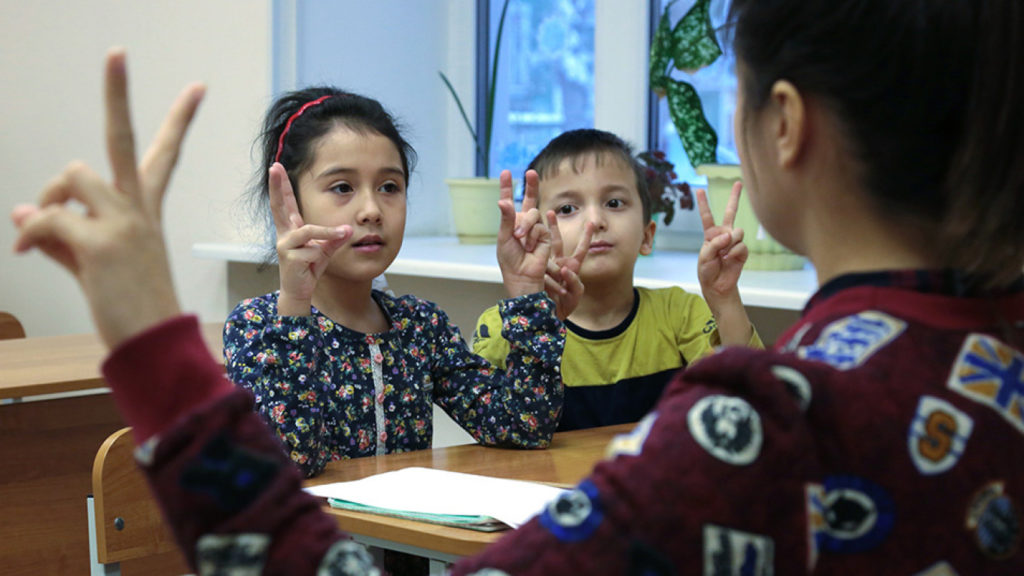
I’m not sure that I was able to concretely answer the question of whether or not there is a gap in educational outcomes between native and migrant students in Russia. But what is clear is that many migrant children are going without an education today. As mentioned before, migrant children without permanent registration are being turned away from schools. On top of the requirement for legal registration to enroll, there is also the fact that labor migrants must leave the country every three months to maintain their legality. If they overstay, they face an entry ban. Because of this, migrants who bring their children with them to Russia must cross the border several times a year, movement which may interfere with their children’s studies.
One article mentions that migrant parents are told, “We can enroll your child in school, but we will send information about [them] to the police.”9 This plays in with the xenophobia and nationalism that are common in Russia. A candidate for governor of St. Petersburg apparently said on television:
“In a school in a residential area, 70% are children of migrants who do not speak Russian, but they are obligated to accept them. Moreover, they cluster together and begin to beat our own. Guys, do we want to get a Paris? We will get it in a few years.” [rough translation from the article in Russian]
The article mentions that this quote seems to refer to the 2005 riots in France, in which two North African teenagers were killed. While the reference is not the most apt, this candidate is associating migrants with violence here. I’m not sure how educating children would lead to violence (seems like it would be the opposite in reality), but this type of rhetoric will only serve to reinforce the systematic barriers that exist for migrant children.
In my next post, I’ll be looking at these same questions in the context of Germany. Can we apply Sori’s argument to Germany, where there was a large guest-worker program? I hope I’ll be able to find a more concrete answer, as there seems to exist a large literature on the subject.
Sources:
1 Platonova, Anastasia. “Not in my classroom: Russia’s refugee children struggle to get to school,” Open Democracy, 21 September 2017. https://www.opendemocracy.net/en/odr/russia-refugee-children-school/
2 Leech, George. “Migrant Children Turned Away from Schools in Russia,” The Human Rights Watch, 9 February 2017. https://www.hrw.org/news/2017/02/09/migrant-children-turned-away-schools-russia#
3 Tiuriukanova, E.V., and Ledeneva, L.I. “Migrants’ Children’s Orientations Toward Acquiring a Higher Education,” Russian Education and Society (2006), Vol. 28, no. 5, 73-90.
4 Ю. Флоринская, “Дети мигрантов в России: доступ к образованию и медицине.” Demoscope.ru. 2010. http://www.demoscope.ru/weekly/2012/0515/analit02.php
5 Demetrio, Edgar. “Migration Background and Educational Achievements in Russia,” Migraciones Internacionales (2017), Vol. 9, No. 1.
6 Tiuriukanova, E.V., and Ledeneva, L.I. “Migrants’ Children’s Orientations Toward Acquiring a Higher Education.”
7 Sori, I., Gaber, S., and Susteric, N. “Immigrant Students’ Achievements in Croatia, Serbia, and Slovenia in Context,” Center for Educational Policy Studies, January 2011.
8 “Russia’s Migrant Numbers Surge to Highest Levels in a Decade, Study Says,” The Moscow Times, 23 July 2019. https://www.themoscowtimes.com/2019/07/23/russias-migrant-numbers-surge-to-highest-levels-in-a-decade-study-says-a66535
9 Ovsyannikov, Ivan. “Russia: it is difficult for children of migrants to get education and socialize,” eurasianet.net, 7 November 2019.
10 Gershkovich, Evan. “Russia Takes Baby Steps Towards Integrating the Children of Immigrants, The Moscow Times, 27 May 2019. https://www.themoscowtimes.com/2019/05/27/russia-takes-baby-steps-toward-integrating-the-children-of-immigrants-a65686
It may be that migrants who bring families to Russia are also the migrants who are likelier to pay the patent and have a registered place of residence. Those who know that lack of documentation will mean they either have difficulty enrolling their children or can’t enroll them may be less likely to bring their children to Russia. You found some interesting studies comparing educational outcomes.
Alexie, I really thought your blog post was excellent. Thank you, as well, for providing all of the images and hyperlinks, especially the hyperlink to your previous post.
This is such as important topic and you’ve managed to find many sources to explore. It seems as though there is no simple answer to your research question, yet migrant students obviously face many more risks that native students in Russia do.
Hi Alexie, I liked this two part post, with the introduction of education and then some specific examples. I was interested to see that migrant children in Russia were wanting to gain an education (college) more than Russians who live there. I think it is terrible to see discrimination from school officials as migrant parents decide to move there for their children (sometimes) to gain a better life. But, it is harder on the child as they see what they can not have without an education. I think of the idea of just “surviving”, as migrant children are often times not able to receive a (necessary) education, they are just living, and living is getting harder with sanctions and travel bans.