Research on Central Asia suggests that very few have written about women of the remote area of the region that live in the high Mountains of Badakhshan in Tajikistan also known as the Pamirs. Migration from the Badakhshan region to Russia and other parts of the world is prevalent. What I am interested in is writing about the impact of globalization, migration and other outside factors on the role of the woman in the society in Badakhshan. Before I get to that point however, there are a few parts of the history that I think will help me understand the issues a little better. The focus of the next three blog posts will be around portrayal of women in tales, myth and spiritual teachings in Badakhshan. Through a comparative analysis of historical literature, two dissertations on gender relations in the region, impact of fairly tales on women empowerment, translation of a guidance of a 14th century spiritual leader on women’s health and a translation of folk tales from 42 Pamiri languages:
1. It would be interesting to see in what ways are women mentioned in the historical accounts of Badakhshan?
2. It would also be interesting to see where did women get their understanding of their role in the society before, how did culture and tradition dictate their role and what was the impact of various political changes on the women?
3. It would also be valuable to look into the research and work of individuals who have travelled to the mountains in the recent years, how do they describe the woman?
4. I would also like to learn more about the portrayal of a female in the folklore, storytelling and how that has impacted women and the choices they have made or are making today.
Just as it was described in the BesKempir article as part of our class readings, in many cultures and traditions in Central Asia including Badakhshan, women are upheld high for their wisdom and their storytelling role. As it was broken down in the article, the word “pir” in kampir, means a guide, a spiritual leader. In order to understand the extent to which this tradition still holds true, it would be interesting to see where it is coming from. Badakhshan is a strictly oral society, consistent of 42 languages that pass on from generation to generation and these stories are told and retold in one form or another a myth, a poem, sometimes a short bedtime story.
In 2005, in dedication to 80th anniversary of the Mountainous Autonomous Region of Badakhshan, the Tajiki Academy of Sciences published the work of a number of scholars and editors; a two volume of history on the region, beginning from the ancient times to modern history. I would like to see if there is any mention of the oral history, the languages and the preservation of these languages and if any of this is credited to the women.
In 1976, a group of Russian scholars focusing on the “east” collected tales and myths in Pamiri languages and translated them into Russian. I am curious to read through these stories and look for the different ways a woman is described, how is her character being built and the perception it may/not have created about women in the culture and traditions.
I will also be translating from Farsi, a piece as part of a spiritual code of conduct for Ismaili Muslims of Badakhshan written by a 14th century philosopher, a poet and a spiritual leader known as the Pir – Shah Nasser Khusraw where he writes about women and the value of a female body. His works in particular devotional literature is recited for long periods of time by women in the Badakhshani traditions, these recitations are considered spiritual and ceremonial but the can sometimes last for as long as 2 hours. I am curious where women of the Pamir mountains derive a sense of empowerment whether it be spiritual or based on myth but how is empowerment socialized? Is that even a possibility?
REFERENCES:
- A.L. Griunberga, Skazki Narodov Pamira. Perevod s pamirskikh 42 yezikov. (Moskva: Izdatel’stvo Akademii nauk SSSR, 1976)
- M.A. Bubnova, Istoria Gorno-Badakhshanskoi Avtonomnoi Oblasti. Tom 1. S Drevneishikh vremen do noveishego perioda. (Dushanbe: Paivand Printing House, 2005)
- S. N. Tuichieva, Istoria Razvitia Gendernikh Otnosheniy v kulture Pamira (Konec XIX-nachalo XXI vv.) Dissirtacia na soiskanie uchionoi stepeni kandidata istoricheskikh nauk. Dushanbe, Institute Istorii, Arkheologii, Etnographii, im. A. Donisha, Akademii Nauk Respubliki Tajikistan, 2011)
- J. Zigman, From tales of enchantment to tales of empowerment: Finding women’s voices through fairy tale narratives. Thesis presented to the Faculty of Graduate and Postdoctoral Studies as partial fullfillment of a collaborative M.A. degree in Educational Studies and Women’s Studies.
- Featured Image
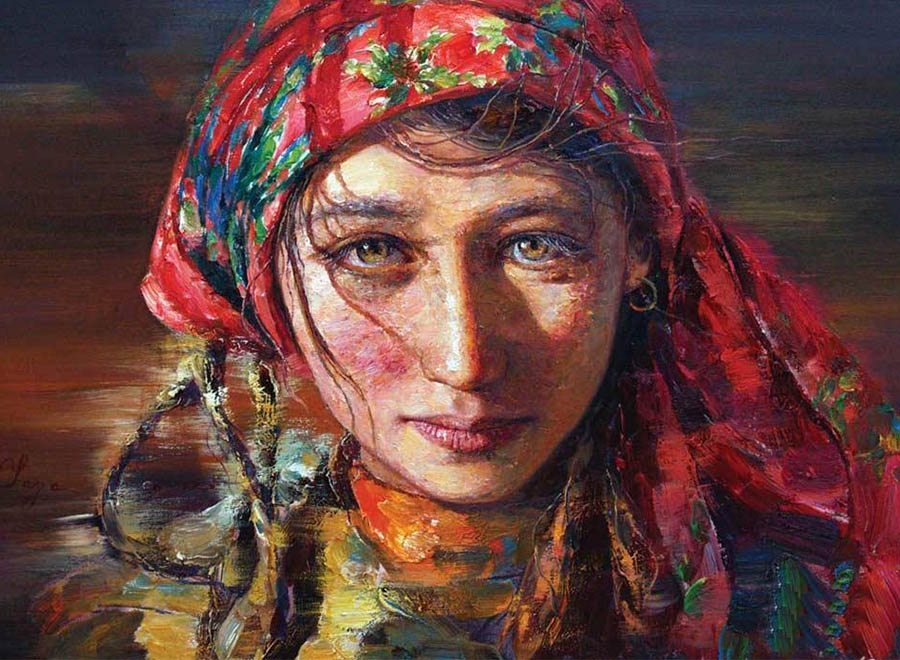
Great images. The painting is by Yan Yaya (a credit here would be a good thing, though one can find out from the link to the news article on AsiaPlus).
This is a very big topic, where you could go in many directions. I’m wondering how this will relate to migration.