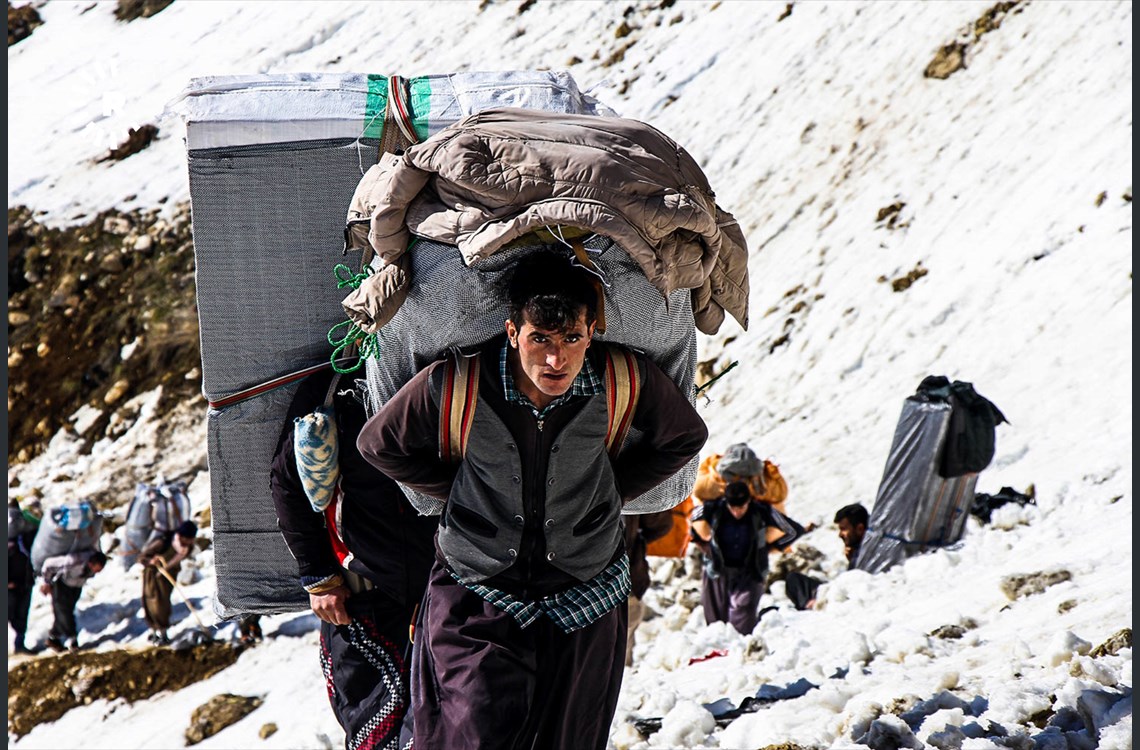
Kolbers or kolbars are Kurdish laborers who transport goods from Iraqi Kurdistan to the Kurdish region of Iran– what Kurds call the Rojhelat. The average kolber is between the ages of 13 and 65.5 While kolberi used to predominantly be made up of male breadwinners, the practice has recently expanded to include young teenagers. Some women have even joined the kolberi workforce as economic conditions of the Rojhelat have pressured them to do so.5 Kolbers come from a variety of educational and professional backgrounds. Some are men in their 80’s with little formal education, while others are ex-professional athletes5, and many are college graduates with BAs, MAs, and even PHDs.1 A kolber may make between 5 and 10 trips in a month.5 Traveling in large groups, kolbers traverse the Zagros Mountains by the dim light of the early morning. Once they reach Iraq, they meet traders who entrust them with the movement of hefty plastic-wrapped packages. After they have strapped up to 80 kilos (176 lbs) worth of goods to their backs, the kolbers must once again surmount the treacherous peaks, risking life and limb. Once in Iran, Kolbers hand off the packages to traders who will sell them in the Rojhelat.1 Facing both increasing economic strain and deadly marginalization from Iran, the life of a kolber has become more dangerous than ever.
Liminal Legality
Kolberi is often labeled as smuggling, which is a bit of a misnomer, as it is recognized as a quasi-legitimate practice by the Iranian state. To put it simply, kolberi isn’t entirely legal, but there is no Iranian legislation that criminalizes the practice. Kolbers transport what are classified as grey-market goods.6 The products are legally imported to Iraq but are then are brought across the border where they do not pass through Iranian customs nor are they taxed.6Many kolbers carry state-issued IDs, but it is ultimately up to the discretion of Iranian border guards as to whether they will be accepted or the kolbers will be shot on sight. Some Kurds view this as a failure on the state’s part to address the underlying fiscal situation affecting Iranian Kurds. A Kolber from Sardasht was quoted as saying, ‘”as far as I know, some of these MPs instead of eradicating this perilous thing from our region are trying to institutionalize kolberi. They want to make it even more prevalent by giving kolberi IDs and insurance.”‘ 5 Moreover, Iranian law does not provide protection or justice to those who are harmed as a result of their work. Besides the common practice of shooting Kolbers or throwing them off mountainsides, Iranian guards have also been known to cover up the rape, torture, and unlawful arrest of kolbers with no consequence. 5 The corpse of Shwane Rasuli was recovered in February of 2018 after the kolber had gone missing. His hands and legs were bound, and his body showed evidence of pari-mortem trauma (torture).5
History of Kolberi
It is important to realize that the Kolberi profession is not one created or encouraged by typical labor market conditions. Nor is it generated purely by economic factors, but religious and ethnopolitical ones too. The foundation for Kolberi is attributed to the events of the 1979 revolution when thousands of Kurds were massacred .5 The Iran-Iraq War that soon followed saw the bombing of Kurdish cities and the planting of millions of landmines in pastoral lands. Occupying forces seized land, and rivers were dammed and redirected. The Rojhelat agricultural economy was subsequently destroyed.5 After the fact there were no efforts by the Iranian state to rebuild nor invest in new infrastructure. There is one sugar factory in the entirety of the Rojhelat, and it was built in 1968.5
Kurdish citizens are marginalized in Iran at the constitutional level. The Iranian constitution legally bars any non-Shiite from holding upper-level governmental positions.5 Kurds, who are majority Sunni are therefore excluded from careers that could help economically and politically empower their community. If Kurdish individuals are able to surmount institutionalized barriers to get a higher education, discriminatory hiring practices prevent many of them from earning a disposable income. A kolber from Mariwan testifies to the institutionalized decrimination he experienced:
I have published several academic papers on city planning and management… and submitted them all to our city mayor and city council. I decided to apply for a PhD program and obtained the rank 12 in the admission exam for the Urban Planning.. However, the officials disqualified me despite my academic success… This was the beginning of the darkest days of my life… I started looking for jobs but all doors were closed on me. Our city’s mayor and the governor told me. they could not hire me…. I became a kolber just 9 months ago. I am not the only person whose entry to the universities has been barred. Many Sunni Kurdish youth share my fate.5
All of these practices by the Iranian state have created “three types of cheap and unskilled labor forces”, including migrant laborers, seasonal laborers, and kolberi. 5
High Risk, Low Reward
The Iranian government claims that kolbers are directly hurting the economy, but it fails to recognize what little the couriers actually receive for their labor. 2 The finance minister of the Kurdistan Regional Government (KRG), Rebaz Hamlan, claims that the market for goods carried by the kolbers is worth an annual sum of. $8 billion. 4 This may be so, but kolbers are merely transporters. They are only paid for what they can carry. At a price per kilo of 33 to 75 cents5, a kolber could make between $8.25 and $600 per month. For comparison, the Iranian poverty line was at an income of $600 per month in 2017. 5 Additionally, kolbers do not own the packages they carry. If any packages are damaged or dropped on the way to evade border guards, the kolber must pay for the lost revenue. 1 When one then factors in the cost of potential bribes to guards5, the final paycheck is what one interviewed kolber described as, “not sufficient to meet the needs of our families”.1 Yet, much of what little they make is fed back into the Kurdish community. After becoming disabled on the job, one kolber pledged, “I will donate $4 to indigent families that I know.”5 One group rallied to pay another kolber father of three’s medical bills after he from a mountain and dislocated his hip.1
Kolberi & Sanctions Against Iran
Kolberi has become more prevalent in recent years due to the sanctions imposed on Iran. Data from the Iranian government reported in 2019 shows that relative to the rest of the country, three of the provinces that make up the Rojhelat have higher than average unemployment rates.4This includes the Kurdish-majority Kermanshah province which has the highest unemployment rate at 21.6%.4 In addition, the nation is still reeling from the UN Security Council sanctions, and the recently reimposed sanctions by the U.S. are expected to worsen the ongoing recession. The sanctions caused extreme inflation which decreased the worth of the Rial from 300 to 2,000 Rials per U.S. dollar.6 The Rojhelat is highly underdeveloped with its occupants making up 10% of the Iranian population yet contributing only 5.2% of Iran’s GDP. 4 These factors ensure that work is incredibly difficult to come by, especially in eastern Kurdistan. The sanctions have also largely diminished Iran’s role in the global market. The partial deglobalization of Iran’s economy has created demand for a variety of imported goods that range from household appliances to cigarettes.1 Iraq is still able to import such goods; Iran is not. These conditions have generated a market for items that Iranian Kurds are desperate to courier. An estimated 20,000 additional Kurds join the Kolberi workforce each year.4
Between Life and Death
Kolberi has become even deadlier as a direct result of tightening sanctions and border controls. On the Iraq side of the border, the American-backed Peshmerga stand guard. They have been more vigilant as of late, as the U.S. goal has been to economically suffocate Iran. In attempt to evade these guards, kolbers often take more dangerous routes.4 These paths are known as Qatlga or “place where people die”. 1 Many of these paths are littered with uncleared land mines, which claim kolberi lives.5 However, the Iranian border is far more dangerous. Between the years of 2015 and 2020, 725 kolbers were shot by guards, leaving them wounded or dead.5 A significant number of kolbers are thrown from mountains by guards, and an increasing number of kolbers have gone missing as of late. They either get lost in the snow and freeze to death or are disappeared by Iranian officials.5

The following is a testimony to the harsh realities of kolberi life :
I never forget the day when a friend of mine, who was also married, fell on the ground with his load on his back… He was crying, shivering from the cold and exhaustion. His blood sugar level had severely dropped. The weather was frigid and biting, and his load was heavy. With a shaking voice, he said that he no longer wanted to live. He handed over his knife to me: “Please end my life with this knife…” I took his loads down and hid it somewhere to deliver it to the owner by the next day. Had not I stopped him, he would have killed himself right where we were.5
Bibliography
1“Documentary: Shadowing the Treacherous Treks of Kurdish Kolbars.” YouTube. Rudaw English, May 8, 2020. https://www.youtube.com/watch?v=bTcLRHI9Hc4.
2“The Gruelling Life of a Kurdish Smuggler – BBC News.” YouTube. British Broadcasting Corporation, February 15, 2017. https://www.youtube.com/watch?v=khgdcuS5YRI.
3Mohammed, Sarkawt. Kolbers_00005. Rudaw. Rudaw Media Network, October 2, 2020. https://www.rudaw.net/Library/Assets//Gallery/Photos/Photos2020/Others/Kolbers10022020/Kolbers_00005.jpg?scale=both&w=1140&h=750&bgcolor=2a2f33.
4Prada Bianchi, Andrea, and Sergio Columbo. “For Kurdish Smugglers, Iran Sanctions Are Starting to Bite.” Foreign Policy. Foreign Policy, February 24, 2019. https://foreignpolicy.com/2019/02/24/for-kurdish-smugglers-iran-sanctions-are-starting-to-bite/.
5Soleimani, Kamal, and Ahmad Mohammadpour. “Life and Labor on the Internal Colonial Edge: Political Economy of Kolberi in Rojhelat.” Wiley Online Library. London School of Economics and Political Science, March 10, 2020. https://onlinelibrary.wiley.com/doi/full/10.1111/1468-4446.12745.
6Wescott, Tom, and Afshin Ismaeli. “Sanctions and Smuggling, Iraqi Kurdistan and Iran’s Border Economies.” The Global Initiative Against Transnational Organized Crime. The Global Initiative Against Transnational Organized Crime, April 2019. https://globalinitiative.net/wp-content/uploads/2019/04/TGIATOC-Report-Sanctions-Iraq-Iran-05Apr1300-Web.pdf.
Your math doesn’t add up. A kolber makes 5 to 10 trips per month, carrying 80 kilos each time, at a rate of $.33 to 1.25 per kilo. So low end (5 times, .33), $132 in the month; high end $1000/month. If contextualized in terms of how much others in this province of Iran earn per month on average, we might see why kolbers do this. Or you could present this in the other way: one trip may earn a kolber as little as $26.25, and then we ask: why would anyone do that?
My apologies, I was using the numbers provided by the larger research study I referenced. I will be sure to edit that. I referred back to an academic lecture that was given by one the authors of this study, and the maximum is actually $0.75 per kilo. Additionally, the author said that a kolber “might be able to make $67”. I will do some math of my own.
You have some really good source material for this, allowing a multi-sided way of understanding the economic factors and political factors that drive this particular approach to cross-border trade. You explain both the lack of development in Kermanshah (is Rojhelat broader than Kermanshah? What other provinces of Iran are in this conceptual framework?) and the discrimination against Sunni Kurds in Iran. Well done. What about the relationship between Iraqi Peshmerga and Iranian Kurds?
Kermanshah is one of the provinces that make up the Rojhelat, including the Kurdistan, West Azerbaijan, and Ilam provinces. The Peshmerga’s loyalty is to the KRG, but the Kurdish traders in Iraq could be considered to be part of a larger diaspora network. Their connection with Kurdish traders on the Iranian side is founded on the solidarity of being Kurdish.