The oil crisis of 1973 had profound effects on the world economy and spurred trends in labor migration that have continued to amplify to today. The oil crisis began with the Yom Kippur / October War between Israel, supported by the United States, and Egypt and Syria, supported by the Soviet Union.1 In response to the United States providing $2.2 billion of financial support for Israel, Arab members of OPEC colluded to place an embargo on the United States and other states that were aligned with the US and Israel, artificially restricting the world supply of oil and increasing the price of oil so that by January of 1974, oil prices were four times their pre-crisis level.2
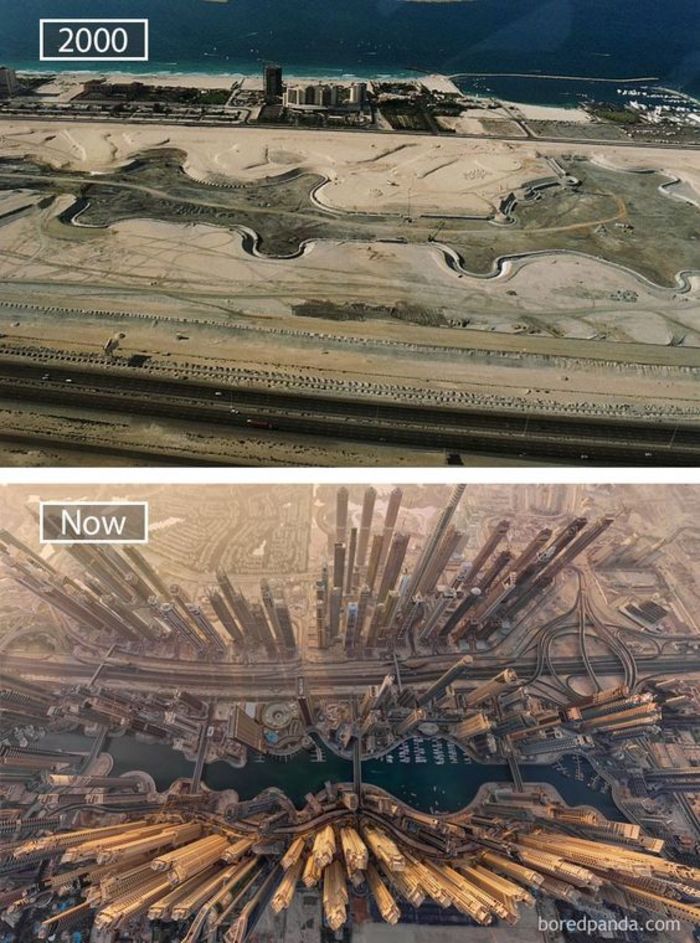
While most US sources primarily look at the domestic short-term impacts of the 1973 oil shock, such as severe increases in gas prices, gasoline rationing, and an impetus for greater energy self-reliance, the increased oil prices from the embargoes permanently enriched oil-producing countries in the Arabian peninsula, which has led to Gulf Cooperation Council (GCC) countries becoming one of the world’s largest destinations for migrant laborers.3 As Dr. Mohamed Attaitalla Abdalla puts it, “Following the 1973/74 oil price rise, AOPEC countries were able to accumulate considerable surpluses of money, and their governments considerable surpluses of revenue. Aiming at transforming these oil revenues into economic development, the governments were able to draw up huge economic plans for development.”4 The labor demand for these massive infrastructure projects combined with the relatively small and inexperienced populations in the host countries led to large-scale labor migration from Arab countries, and South and Southeast Asia.
https://stepfeed.com/these-old-photos-of-dubai-show-how-much-the-uae-has-changed-0441
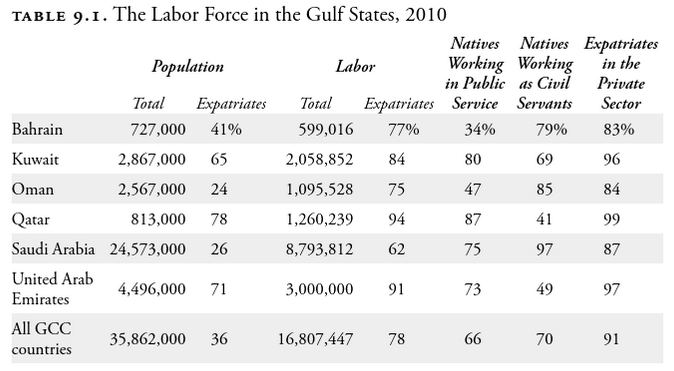
GCC member states have unique labor market trends regarding domestic and migrant laborers. Nearly all of the skilled and literate men who are employed are engaged in public sector work. With low labor force participation among women, and the majority of domestic-born workers employed in the military or civil service, Gulf countries have a massive proportion of foreign-born workers in the private sector.5 The following chart gives you a sense of the stunning degree to which migrant labor is employed in Gulf states.
Cammet, Melani, Ishac Diwan, Alan Richards, Josh Waterbury, A political economy of the Middle East (Boulder, Colorado: Westview Press, 2015), 337.
In addition to enriching GCC countries and instituting new migration routes from the Middle East and South and Southeast Asia, the 1973 oil shock led to labor migration trends into and out of non-oil-producing countries. For example, in the mid-1970s, as 40% of Jordanian domestic workers were employed internationally, opening up a new labor market for unskilled laborers, primarily Egyptians and Syrians to replace them.6 Additionally, the spike in oil prices led to increased migration to oil-producing countries in Africa.7 The oil shock led to major developments in labor trends both in and out of oil-producing countries, all besides its economic toll on countries subject to embargoes and the resulting trends in attitudes towards and practices of labor migration.
As I hope to have demonstrated in a cursory way, the oil crisis of 1973 had major, worldwide impacts on the economy, politics, and labor market trends. Because of the broad impact of this crisis, there are many directions I could go in for later blog posts, such as individual stories of migration, labor market conditions such as the kefala system that restricts worker rights, looking more closely into the conditions of countries that send laborers and specifically what these workers do once they arrive in Gulf states. The oil crisis also had major impacts on the Soviet oil market, and with reserves in the Caucasus and Siberia, so I could look into that and be more true to the Central Eurasian intent of the course. Furthermore, there have been more oil crises and broader economic crises since 1973, and it would be interesting to find similarities and differences in the circumstances of each crisis as it relates to labor migration trends.
- “The October War and U.S. Policy.” The National Security Archive, ed. William Burr, George Washington University, 2017, https://nsarchive2.gwu.edu/NSAEBB/NSAEBB98/.
- “1973-74 Oil Crisis.” Regional Oral History Office, The Bancroft Library, The University of California, Berkeley, 2011, https://bancroft.berkeley.edu/ROHO/projects/debt/oilcrisis.html.
- De Haas, Hein, The Age of Migration International Population Movements in the Modern World (New York: The Guilford Press, 2020), 10, 208.
- Abdalla, Mohamed Attaitalla, The push/pull factors in Sudanese migration to Arab oil countries (Khartoum, Sudan: Development Studies and Research Centre, Faculty of Economic & Social Studies, University of Khartoum, 1983), 3.
- Cammet, Melani, Ishac Diwan, Alan Richards, Josh Waterbury, A political economy of the Middle East (Boulder, Colorado: Westview Press, 2015), 336-340.
- De Haas 208-9
- ibid
I found your blog post to be quite interesting and I like the chart and photos you included. They really help the reader to conceptualize the size of the migration phenomenon and economic boom. Because oil is a nonrenewable resource and many nations are looking towards the greater utilization of renewable energy sources, do you believe we could see a shift in migration patterns involving the Gulf States in coming years?
I don’t have any citations for this opinion, but I don’t think we’re going to see the kind of systematic change in the way the world gets its energy for decades. This being said, oil is a nonrenewable source of energy, and once it dries up, people will again respond to the economic incentives that prompts migration everywhere.
I appreciate this overview because our readings have often mentioned the 1973 oil crisis and I only had a vague idea of what that meant. The rate of migrant labor in the private sector astounds me. I wonder how people in those countries feel about that? I could see some xenophobic sentiments existing there.
That is an interesting idea, and one would make a good assumption that there may be some nativist sentiment on behalf of the population. Gulf countries cast a wide net for laborers, and because the supply of foreign workers it so high, these countries can cut costs by paying very low wages. Futhermore, despite the huge competition for foreign labor, it is tolerated by native-born workers because in return for missing out on the direct gains of working in the oil industry, Gulf citizens in the public sector benefit from free social services, cheap energy and housing, and high wages in government employment. The asymmetry of employment by sector has basically become part of the social contract in GCC countries.
On a person-to-person basis however, there may be xenophobia. I didn’t read about any of that, but as far as the stability of the system goes, there seems to be a tacit agreement by workers foreign-born and domestic.
In many Gulf countries, the ordinary workers among labor migrants live in separate worker districts, so perhaps they don’t interact with citizens much. The professionals in some countries live in the same neighborhoods as citizens do, but in Saudi, for example, even the professional level migrants (oh, expats) lived in separate districts. Generally, these labor migrants come alone, for a specific contract period. They don’t bring children, so no mixing of foreign kids and citizen kids in most schools…A quick search comes up with this on xenophobia in Kuwait today: https://news.un.org/en/story/2020/07/1067652 but that’s today, and your research focuses on the moment nearly fifty years ago when labor migration to the Gulf began to explode.