
(https://eurasianet.org/turkeys-divided-circassians)
When people think about ethnic minority groups in Turkey, they usually think about the obvious cases—Kurds and Syrians today, Armenians and Greeks in the past. However, the country’s population of 83.4 million encompasses many other smaller groups, including significant groups that came from the Russian Empire during its expansion (World Bank). If one wanted to list all of the groups that fled during Russia’s imperial expansion, one might find an entire alphabet’s worth of ethnic groups, tribes, and communities, but for this series of blog posts, I will look at some of those that left from the Caucasus and the Black Sea region: Abazin, Abkhaz, Chechens, Adyghe/Circassians, Crimean Tatars, Georgians, Laz, and Ossetians.
Most of these populations are Sunni Muslim, and fled the Russian conquest for safe haven in the Ottoman Empire, part of what Brian Glyn Williams calls the “‘Great Retreat’ of Muslim ethnies from the Balkans, Pontic rim and Caucasus related to the nineteenth-century collapse of Ottoman Muslim power in this region” (Williams 79). I am interested in exploring the long-term results of this “Great Retreat” as it relates to Russia, Ukraine, and the Caucasus.
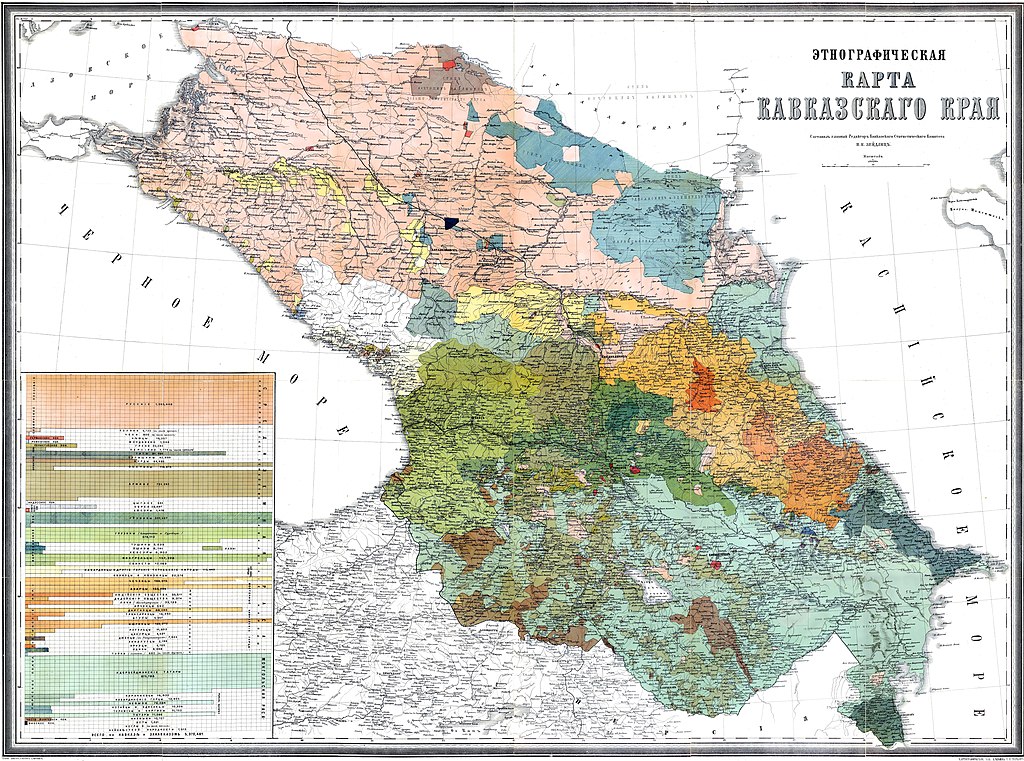
(https://commons.wikimedia.org/wiki/File:%D0%AD%D1%82%D0%BD%D0%BE%D0%B3%D1%80%D0%B0%D1%84%D0%B8%D1%87%D0%B5%D1%81%D0%BA%D0%B0%D1%8F_%D0%BA%D0%B0%D1%80%D1%82%D0%B0_%D0%9A%D0%B0%D0%B2%D0%BA%D0%B0%D0%B7%D1%81%D0%BA%D0%BE%D0%B3%D0%BE_%D0%BA%D1%80%D0%B0%D1%8F_(1880_%D0%B3.)..jpg)
Russian imperial forces began their entry into the Caucasus in the mid-16th century under Ivan the Terrible, though it was 200 years later during that reign of Catherine the Great that the Russians began a forceful campaign to push the Ottomans and Persians out and establish control of the area (Perović 21). The Russian conquest of the North Caucasus was completed only in 1864 (Perović 22), while the Ottomans lost Batumi to the Russians in 1878 (Rayfield 30). The Russians annexed Crimea earlier, completing the project for the first time in 1783 (Jankowski).
In 1783 and 1784, about 8,000 people left Crimea, including many Crimean Tatars with ties to the recently deposed leader and Ottoman subjects who wished to return. This was followed by a larger migration between 1785 and 1789 of approximately 20,000 to 30,000 Tatars (some estimates claim 100,000) (Fisher 78). Similar situations, with different groups of people, followed the Caucasian War of 1817–1864, the Russo-Turkish War of 1877–1878, and other conflicts. These people have contributed to the mosaic of ethnicities and languages of Turkey.
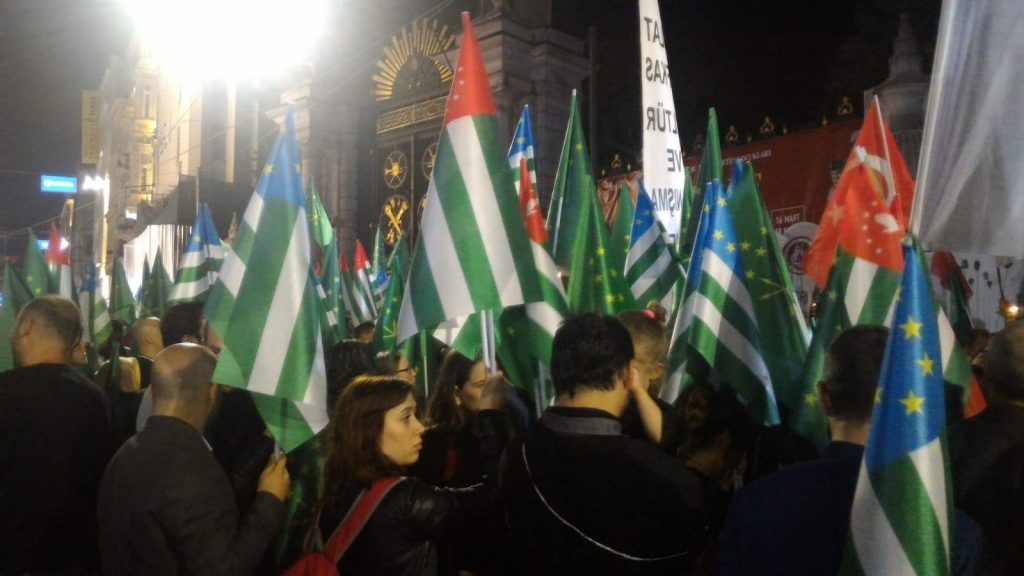
Our discussions of diaspora and identity left me wondering how these communities might exist today. Some sources I’ve encountered say that the Circassians of Turkey are almost entirely integrated, while others show a strong sense of Circassian pride and desire to maintain their cultural ties. I had never heard of Abazins before researching this blog post, despite having read quite a bit about the history of the Caucasus. Other sources I’ve encountered describe the Laz in Georgia as gone, with only a few dances and architectural contributions left, though they seem to persist in Turkey.
(https://www.cerkesfed.org/2018/05/25/21-mayis-1864-cerkes-soykirimi-ve-surgunu-154ncu-yili-anma-etkinlikleri-tesekkur-mesaji/)
In my future blog posts, I hope to look at some of these cases more in depth, to examine the continuity and connections that these diasporas have maintained in the 200 or so years since their communities first began large-scale migration to Turkey. I am interested in a few questions, and I will answer them as the information that I can find permits: Do these groups share a sense of common identity, as in the case of post-Soviet diaspora? What factors have impacted levels of integration? How do these groups interact with their homelands? What else can be learned from comparing these cases?
Sources:
Fisher, Alan W. The Crimean Tatars. Stanford, CA: Hoover Institution Press, 1978.
Jankowski, Henryk. “Crimean Tatars and Noghais in Turkey.” Posted with permission to the International Committee for Crimea web site in February 2002.
Perović, Jeronim. “Conquest and Resistance.” In From Conquest to Deportation: The North Caucasus under Russian Rule, by Perovic, Jeronim.. Oxford University Press, 2018. Oxford Scholarship Online, 2019. doi: 10.1093/oso/9780190889890.003.0002.
Rayfield, Donald. 2013. Edge of Empires : A History of Georgia. London: Reaktion Books. https://search-ebscohost-com.proxyiub.uits.iu.edu/login.aspx?direct=true&db=nlebk&AN=542945&site=eds-live&scope=site.
Williams, Brian Glyn. “Hijra and Forced Migration from Nineteenth-Century Russia to the Ottoman Empire. A Critical Analysis of the Great Crimean Tatar Emigration of 1860-1861.” Cahiers Du Monde Russe 41, no. 1 (2000): 79-108. Accessed November 2, 2020. http://www.jstor.org/stable/20171169.
World Bank. 2020. “Population, total – Turkey.” https://data.worldbank.org/indicator/SP.POP.TOTL?locations=TR.
Sources to Look Into:
Abdurakhman Avtorkhanov, ‘The Chechens and the Ingush during the Soviet Period and Its Antecedents’, in Marie Bennigsen Broxup (ed.), The North Caucasus Barrier: The Russian Advance towards the Muslim World, London: Hurst, 1992
John B. Dunlop, Russia Confronts Chechnya: Roots of a Separatist Conflict, Cambridge: Cambridge University Press, 1998
Ben Fowkes (ed.), Russia and Chechnia: The Permanent Crisis, New York: St. Martinʼs Press, 1998
Robert Seely, Russo-Chechen Conflict, 1800–2000: A Deadly Embrace, Portland, OR: Frank Cass, 2001
Sebastian Smith, Allahʼs Mountains: Politics and War in the Russian Caucasus, London: I.B. Tauris, 1998.
Alex Marshall, The Caucasus under Soviet Rule, London: Routledge, 2010.
Yaacov Ro’i, ‘The Transformation of Historiography on the “Punished Peoples”,’ History and Memory, vol. 21, no. 2 (2009), pp. 150–76.
Z.Kh. Ibragimova, Chechentsy, Moscow: Probel-2000, 2000.
Moshe Gammer, ‘Nationalism and History: Rewriting the Chechen National Past’, in Bruno Coppieters and Michel Huysseune (eds), Secession, History and the Social Sciences, Brussels: VUB Brussels University Press, 2002, pp. 117–40.
Aleksei Miller, ‘Between Local and Inter-imperial: Russian Imperial History in Search of Scope and Paradigm’, Kritika: Explorations in Russian and Eurasian History, vol. 5, no. 1 (2004), pp. 7–26, here p. 16.
Andreas Kappeler, Russland als Vielvölkerreich, Munich: Beck, 1992.
Kh.V. Turkaev (ed.), Chechentsy v istorii, politike, nauke i kulʼture Rossii: Issledovaniia i dokumenty, Moscow: Nauka, 2015
M.M. Ibragimov (ed.), Istoriia Chechni s drevneishikh vremen do nashikh dnei; V dvukh tomakh, 2nd edn, Groznyi: GUP ‘Knizhnoe izdatelʹstvo’, 2008.
Amjad Jaimoukha, The Chechens: A Handbook, London: RoutledgeCurzon, 2005
Amjad Jaimoukha, The Circassians: A Handbook, New York: Palgrave, 2001
Elza-Bair Guchinova, The Kalmyks, London: Routledge, 2006
Walter Richmond, The Northwest Caucasus: Past, Present, Future, London: Routledge, 2008
Robert Bruce Ware and Enver Kisriev, Dagestan: Russian Hegemony and Islamic Resistance in the North Caucasus, Armonk, NY: M.E. Sharpe, 2010.
Richard Sakwa, ‘Introduction: Why Chechnya?’, in Richard Sakwa (ed.), Chechnya: From Past to Future, London: Anthem Press, 2005, pp. 1–20, here pp. 4–8.
I found your blog post to be enlightening. I am a bit embarrassed to say that I hadn’t heard of some of these ethnic minority groups before, and I certainly had not heard of them living in Turkey. I enjoyed reading this, and I learned quite a bit.
Definitely don’t be embarrassed by not having heard of them–some of these groups are tiny!
In addition to the sources you have noted, find the online Journal of Caucasian Studies. It has quite a few articles on Circassians/ Adyghe before and after their emigration to the Ottoman Empire. They left southern Russia/North Caucasus between 1856 and 1864, and were by far the most numerous group that did so. Look for Seteney Shami’s work–she wrote a book on this and various articles. She’s an anthropologist and comes from a Circassian-descent community, maybe from Jordan?
This sounds like a really interesting topic, and similar to what others have mentioned, I haven’t heard of several of the ethnic groups you’ll be looking into. It is interesting how Anatolia seems to have been such a common place for people to be compelled to flee to or from. I suppose this is due to geopolitical factors like its location and the many ethnic tensions in regions surrounding it. I will be looking forward to reading your forthcoming blog posts.