Why do migrants work in jobs that natives shun? And why do natives resent them for it? In many of the cases we have studied so far, there seems to be a disconnect between the economic realities of a country and the attitudes of its citizens. In the case of Russia, we see that migrant labor is the only viable source of population growth available due to declining birth rates. Despite this reality, many Russian nationals want to limit or stop migration altogether – 57 percent support the idea of “Russia for Russians.”1 Migrant labor in Russia dominates industries like construction and retail trade, important sectors where labor shortages would presumably have a strong effect on the economy.
While it seems strange that 57 percent of Russians cannot see the importance of migrant labor in their country, we also see this dynamic at work in the United States. Mexican immigrants similarly dominate the agricultural sector and play an important role in feeding the country. Should migration halt, it’s unlikely that many white Americans would rejoice in filling these roles. They are “below” them, as are other roles typically filled by migrant labor. Perceptions like this only contribute to the exploitation of migrant labor, which we can see play out in the Russian construction sector.
The Dual Labor Market Theory helps to explain this phenomenon. The theory discusses the increasing segmentation of the economy into two labor markets, the primary market and secondary market. De Haas explains that certain economic trends contributed to this, including post-WWII “neoliberal” economic policies which “pinned their hopes on economic deregulation and flexibilization of labor markets.”2 This decreased regulation and state interference in the labor markets, which helped the informal labor market to grow – this included low-paid jobs in construction, retail trade, and agriculture.
Scholars that subscribe to this theory attribute international migration to the “structural and chronic demand within advanced economies for lower-skilled workers to carry out production tasks.”3 Lower-skilled workers find themselves working in service positions that are badly paid. These positions are known as “3D” jobs – dangerous, dirty, difficult. You can contrast this with the primary labor market, which includes highly paid jobs in finance and management. Overwhelmingly, jobs in the secondary labor market are filled by migrants who service those working in the primary labor market. Migrants and other minority groups within a country are mostly denied entrance into highly paid sectors for legal or social reasons. Legal reasons, which includes the lack of required immigration papers, further segment the labor market. Companies who wish to attract a cheap labor source can appeal to migrants without the legal right to work in a country. Because of their irregular status, employers have the ability to pay less and offer even more precarious working environments.
The increasing number of migrants in these “3D” positions contribute to certain sectors and jobs being labelled as “migrant” jobs. These lowly positions then become less attractive to native workers, despite their potential importance to the economy. While we can see examples of this in many of the cases that we’ve studied, I wanted to look further into construction workers in Russia. The Russian construction industry is overwhelmingly filled with migrant laborers, and they are vulnerable to exploitation and discrimination.
The Human Rights Watch (HRW) conducted a study that detailed this exploitation of migrant construction workers in Russia. Titled “Are You Happy to Cheat Us?”, the study followed and interviewed several migrants in the industry.4 The report details several first-hand accounts of migrant workers from Kazakhstan, Uzbekistan, and other Central Asian countries. The HRW discussed the changing Russian immigration laws, including migrant quotas, and how these contributed to further exploitation of construction workers and migrants in general. Despite the fact that a visa is not required for migrants from Central Asia to enter Russia, there are many legal requirements that make it difficult to maintain a legal status. For example, migrants are required to register themselves within three days of their entry, which is extremely difficult given the systematic barriers in place. Many migrants do not have housing or a job when they enter Russia, which makes registration impossible. A worker from Tajikistan recalled:
“It is really hard to get the registration done in three days. If you don’t have friends [to help you] then you can’t get normal housing. There were times when we tried to rent an apartment, but then the landlord asks, ‘Where are you from?’ and [when you answer] he replies, ‘I’m sorry, I can’t rent this apartment to you.’”5
When migrants are unable to register on time, their presence becomes irregular, and they are forced into the “shadow sector” of the labor market due to their irregular status. On top of this requirement, the new 2007 laws implemented strict quotas for work permits, the numbers of which are heavily influenced by politics and popular xenophobic sentiments. Despite the difficultly of obtaining a permit, many workers still entered the country and obtained work illegally.
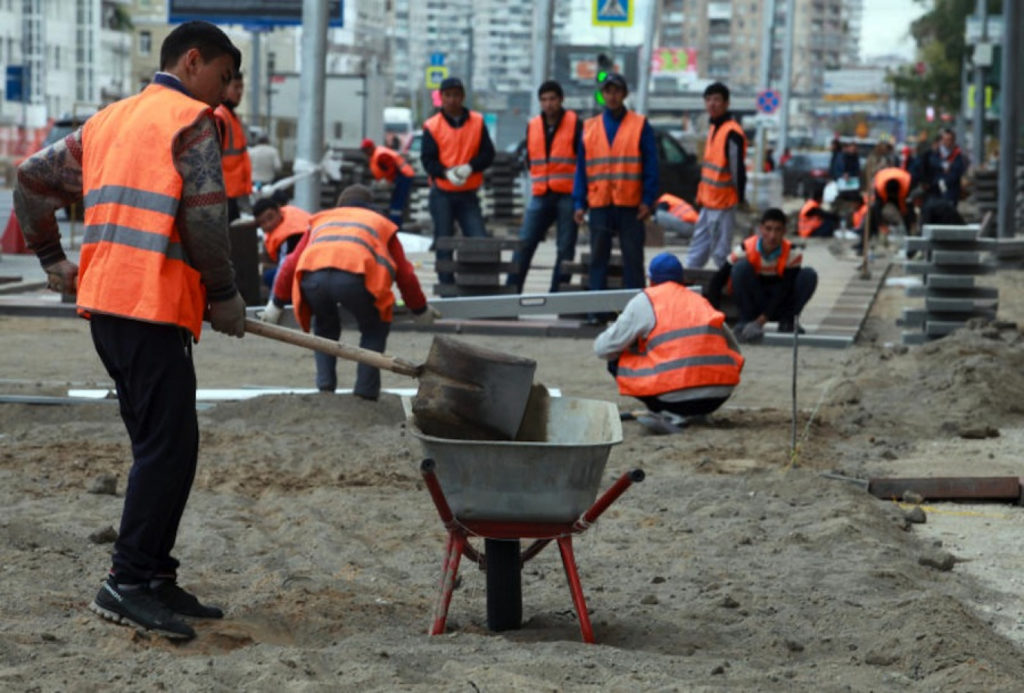
What these new laws accomplished was not necessarily decreasing the number of migrants in the country (as many Russians desired), but instead they managed to push more migrants into this shadow labor market where they can more easily be exploited. The fact that they do not have the necessary permits to work in the country dissuades migrants from seeking legal redress when their employer treats them poorly – they could receive fines or face deportation if they reach out to the authorities. Many migrant workers that the HRW interviewed also discussed the fact that they are often not offered employment contracts, which makes it difficult for migrants to prove employer relations should any issues arise.
The HRW report paints a sad picture of the situation for construction workers in Russia. Abuses include “confiscation of passports; failure to provide employment contracts; non-payment or under payment of wages, or illegal deductions from wages; long working hours; substandard living conditions and denial of food; as well as the use or threats of violence by construction site guards, police, or others, or denunciation to the police.”7 A worker from Kyrgyzstan described working conditions at a construction site:
“There is no such thing as a ‘working day,’ there is only ‘this work has to be finished.’ We slept at the site where we worked. We would wake at 5 a.m., work until lunch, eat instant soup for lunch, and then work again until very late.”8
These working conditions are common for construction workers in Russia. Employer’s ability to treat migrant laborers this way is thanks to several factors. First, as the dual labor market theory illustrates, the labor market is increasingly segmented and lower-skilled workers have little choice but to accept undesirable jobs in the service sector. This is compounded for migrants, who may not have the legal right to work in Russia and have little chance at legal redress in the case of workplace abuses. Migrants are often forced into these “migrant jobs” because native workers refuse to do them.
Second, racism encourages poor treatment. Because migrant laborers are often phenotypically different than Russian natives, they more likely to be profiled and treated poorly. In an NPR podcast episode titled “In Russia, Migrant Workers Live in Fear of Racism,” a migrant construction worker discusses how he is treated in Russia: “Tajiks in Moscow are slaves in the 21st century. We’re treated like animals. The police insult us, and our employers forbid us to even talk at work.”9 This racism becomes intertwined with the jobs that migrants fill. We see examples of this in our Sahadeo reading, Voices from the Soviet Edge.10 He discussed how ideas of “blackness” and foreignness became associated with trade – “dirty labor.”
These two factors do not stand alone but work with each other. Madeleine Reeves, in her article “Clean fake: authenticating documents and persons in migrant Moscow,” discussed how ideas around migrant illegality can exaggerate cultural differences. Reeves pointed out that skin color and other markers of ethnicity and culture became “markers of social status and signs of prospective (il)legality.”11 This connection between potential illegality and ethnicity encourages forms of violence, like radicalized language and profiling in the form of document checks. These document checks often end in violence or forced bribes, as documented in the HRW report.
All of these factors come together to make life in Russia quite difficult for migrants, especially for those who do not look ethnically Russian. Construction workers, the majority of which come from Central Asia, face difficult working conditions that they have little choice but to accept. The HRW report details many instances of abuse, including trafficking and forced labor, and I encourage you to read through some of it to get a better picture of the situation. These poor conditions are complicated by issues of legality, race, and xenophobia. The government has done little to discourage racism and xenophobia in the country, instead choosing to utilize it to garner political support.
Sources:
1 Schenk, Caress. “Open Borders, Closed Minds. Russia’s Changing Migration Policies: Liberalization or Xenophobia?” Demokratizatsiya 2010, 2: 101-121.
2 Hein De Haas et al., The Age of Migration: International Population Movements in the Modern World (New York: The Guildford Press, 2020), 125.
3 Hein De Haas et al., The Age of Migration: International Population Movements in the Modern World (New York: The Guildford Press, 2020), 53.
4 “Are You Happy to Cheat Us?: Exploitation of migrant construction workers in Russia,” Human Rights Watch, February 10, 2019. https://www.hrw.org/report/2009/02/10/are-you-happy-cheat-us/exploitation-migrant-construction-workers-russia#
5 “Are You Happy to Cheat Us?: Exploitation of migrant construction workers in Russia,” Human Rights Watch.
6 Matthew Kupfer and Bradley Jardine, “For Russia’s labor migrants, a life on the edge,” The Moscow Times, November 4, 2016. https://www.themoscowtimes.com/2016/11/04/for-labor-migrants-a-life-on-the-edge-a56018
7 “Are You Happy to Cheat Us?”
8 “Are You Happy to Cheat Us?”
9 “In Russia, Migrant Workers Live in Fear of Racism,” NPR.com. July 29, 2008.
10 Sahadeo, Jeff. Voices from the Soviet Edge: Southern Migrants in Leningrad and Moscow, Cornell University Press, June 15, 2019.
11 Reeves, Madeleine. “Clean fake: authenticating documents and persons in migrant Moscow,” Journal of the American Ethnological Society, August 9, 2013. https://anthrosource-onlinelibrary-wiley-com.proxyiub.uits.iu.edu/doi/pdfdirect/10.1111/amet.12036
You found some excellent sources, Alexie. The HRW study really highlights how illegality and being pushed into the informal sector without documents makes it easy for employers to cheat and abuse migrant workers. You also do a great job of laying out labor market segmentations, noting how this fundamental attribute of neo-liberal economies perpetuates the demand for migrant labor to fill roles that citizens won’t take.