For my blog post, I decided to watch a short documentary which I’ve been wanting to check out for quite a while titled, “Moscow’s Little Kyrgyzstan”. The documentary is approximately 25 minutes long and highlights the experiences of Kyrgyz migrants in Moscow. The documentary was produced by a UK-based company named Journeyman Pictures. All of the footage was shot in Summer 2016.
Kyrgyzstan is one of several migrant labor “sending countries”, and Russia is a “receiving country”. When the film was created in 2016, there were obviously many push and pull factors bringing Central Asian laborers to Russia. What has “pushed” labor migrants out of Central Asia have been low wages and poor economies, and what has “pulled” laborers into Russia is a clear need for inexpensive and abundant labor.
The documentary starts off with brief background information on labor migration to Russia since the collapse of the Soviet Union. The documentary is composed of a handful of interviews with Kyrgyz migrants from various points in life. Interviewees are both male and female. The majority of the individuals interviewed seem to be below the age of 40, but there are some individuals above 40 as well.
The purpose of the film’s interviews is to paint a picture of the lives and hardships of Central Asian migrants in Russia. What the film clearly exhibits is that migrants face countless social and economic barriers in Russia. These barriers lead to immense difficulties and migrants often find themselves in dangerous and exploitative situations.
The first person interviewed in the documentary is a young woman who works as a PR manager in Moscow. She first came to Russia to study and was originally only planning to stay for six months. She originally had the support of her older brother in Russia, but he was later deported, which forced her to quit her studies and find a job.
The same young woman then reemerges later in the documentary to discuss the barriers she and other migrants face when trying to obtain proper work permits and documentation. When her brother was trying to secure a work permit from a company he worked for, he faced immense corruption. She mentioned that even when using certain services to expedite the work permit process, migrants still need to go to an immigration office and stand in line for days. Even then, migrants still face discrimination and corruption, and therefore may be unable to legally make it through this deeply bureaucratic, corrupt, and confusing process.
Overall, a common theme in the documentary was the difficult lifestyles that migrants are often forced to live in. Since rent prices are so high in Moscow, migrants are often forced to live in apartments with 10-30 other people. An interviewee mentioned that it is common for a 2-bedroom apartment to house up to 30 people, and people often live in extended family units or with people from their same native countries.
Below is a similar image published in a recent New York Times which shows an apartment inhabited by 18 Central Asian migrants.

Moreover, the range in interviews clearly shows a complex, parallel society of migrant workers in Moscow. One interviewee notes with frustration that, which in other cities around the world, migrants are able to secure their own geographic locations (ie, “Chinatowns” in US cities), Central Asians in Russia are unable to form communities in any sort of official capacity. Instead, communities are formed around specific shops and businesses owned by Central Asians. An example of this given in the film was a beauty parlor. The beauty parlor was owned by Kyrgyz nationals, and there was a strong connection to the mosque which helped the salon thrive.
This parallel society also consists of migrants who capitalize off of the complex migration system by charging to help incoming migrants with Russia’s bureaucratic migration process. While I do see a need for these services, I cannot help but think of this as exploitative. One interviewee runs a migration research institution in support of migrant laborers. He notes that what cities like Moscow really need are more migration centers to help people navigate the system and adapt to life in Russia. I agree, but also think that more efficient labor migration laws would greatly help as well. Yet, so many politicians and researchers in Russia hold staunch anti-migrant sentiments.
Since the start of the Covid-19 global pandemic, difficulties Central Asian labor migants face in Russia have been compounded. The New York Times article, “For Migrants in Russia, Virus Means No Money to Live and No Way to Leave”, focuses on migrant lives in Russia since the start of the global pandemic. During economic turmoil, migrants are often the first to lose their jobs. They also seldom have a means of obtaining good healthcare. Yet, since the start of the pandemic, thousands of migrants have found themselves stuck on evacuation waiting lists due to closed borders.
Central Asian migrants have been getting stuck at airports throughout Russia:

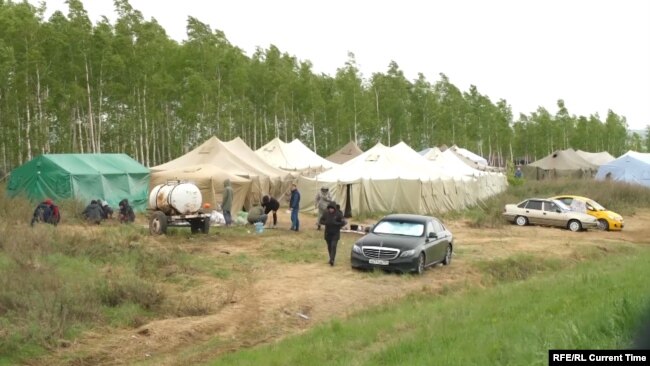
And migrants have also been getting stuck at borders such as the Russian-Kazakh border:
With the economic devastation of Covid-19, it is likely that Russian conservatives will continue to scapegoat migrants for Russia’s social problems and pass immigration laws which only make life more difficult. The 2009 economic crisis led to an increase in political conservatism. As a result, the Russian government reversed some of the advances it had made within 2007 immigration laws. The 2007 laws made it possible for migrants to apply for work permits without being bound to employers, but the 2009 laws reversed that progress and again made laborers dependent on employers and labor contracts (Tetrushvily, 2012). This, and many other factors, leads to a large number of migrants living without documentation, and therefore puts many migrants into exploitative situations.
Uzbekistan, Kyrgyzstan, and Tajikistan all heavily rely on remittances being sent back from laborers in Russia. The documentary, “Moscow’s Little Kyrgyzstan”, ended on a hopeful note with the mention of the Eurasian Economic Union partnerships which could aid the flow of migrant laborers into Russia. Unfortunately, when compared to the German guest worker system, this labor exchange has not been implemented in as formal or successful of an avenue, and will surely be exacerbated by the global pandemic.
Sources:
Moscow’s Little Kyrgzstan. Directed by Chingiz Narynov, Journeyman Pictures, 2017.
Najibullah, Farangis. “Stranded In Russia With No Money, Desperate Central Asian Migrants Face Tough Choices.” Radio Free Europe, 17 May 2020, https://www.rferl.org/a/centra-asian-migrants-stranded-russia-covid-no-money-desperate/30616792.html.
Nechepurenko, Ivan. “For Migrants in Russia, Virus Means No Money to Live and No Way to Leave.” The New York Times, The New York Times, 15 June 2020, www.nytimes.com/2020/06/15/world/europe/russia-coronavirus-migrant-workers.html.
Tetrushvily, Esther (2012): How did we become illegal? Impacts of Post-Soviet shifting migration politics on labor migration law in Russia. Region. Vol. 1 (1): 53-73.
This was a very engaging article that shed some new light on migration in Russia for me. I had never given much thought to the importance of ethnic areas of big cities, like ‘Chinatown’ in San Fransisco, and how it makes them feel apart of their new community and in control of their identity. For Central Asians, this appears to not be allowed out of conservative fears, so they just congregate around locally owned businesses. This reminded me of something in the Sahadeo reading when one of the interviewees mentioned that ethnic Russians would frequent the restaurants and businesses of Armenian or Georgian migrants but would never go to Central Asian businesses. Perhaps if the majority of migrants in today’s Russia were from Christian or ‘civlized’ countries, then the ability to have free passage and ethnic identity would be much greater. Regardless, I thoroughly enjoyed your article.
Of course, no government “gave” land for a Chinatown in the US. Entrepreneurs from China who came to the US bought land and buildings in growing cities and then worked to attract others who would build businesses and homes there. We often see comments like this in former Soviet space, where in the Communist period, the government did allot specific land to specific groups for development. Instead, in this film we see the more typical process of network formation that labor migrants create in many countries–meeting around specific religious institutions, eateries, and businesses run by people from home.
Russia’s approaches to regulating labor migration change repeatedly. Some 6-8 years ago they altered the system again: those workers who go to Russia without work visas apply for a short term ‘patent’–basically, a right to stay and work that the worker themself registers and pays for, rather than the employer. This permit can last for 1 month up to 12 months, and the applicant does not have to show proof of employment, but does have to say what their profession or line of work is. There is a universal patent for all of Russia, except for St Petersburg and Moscow, which control their own. https://migrantmedia.ru/trudovoy-patent-na-rabotu-dlya-inostrannykh-grazhdan-poshagovaya-instruktsiya-kak-poluchit-rabochiy-patent-migranta/
Some migrants want to save that money, so they don’t file for the patent. Many migrants know more about Moscow and St Petersburg than about other Russian cities through their contacts, and believe they will earn good wages there, so they go to one of the world’s most expensive cities, where their earnings won’t begin to pay for housing. Conditions are considerably different for migrants who go to smaller cities in Russia where housing is not at such a premium; it is less likely that they will be “forced” to live 30 to an apartment. Some of the things that look like force are the product of choices. We see in the film that there is a steep learning curve to migration.
And there I go, thinking like an American. For Central Asian workers in Moscow, the obvious designation of one of Moscow’s districts as Китайгород (sounds like China town) is linked with stories that hundreds of years ago that was a district for trade with China.