Once countries started recovering from the devastation of WWII, economies needed to be rebuilt. The USSR had built its command economy around the idea of high levels of extensive growth achieved by a division of labor between countries in Eastern Europe (Comecon) and industrialization. This depended on large amounts of labor as extensive growth meant optimizing efficiency through maximizing manpower to produce more raw materials.
In comparison, Western Europe had built its economy around intensive growth or being able to use resources more efficiently. The similarity between the two economies is that it was largely dependent on labor.
To do this, Western Europe had been incentivizing labor migration from countries like Turkey, Spain, Yugoslavia, and Italy to help stimulate their economies and advance industrial production. In comparison the USSR chose to advance industrial capacity from its own labor base, incentivizing women to join the workforce and rural to urban migration. Both systems stimulated large amounts of economic growth in both regions.

In 1973 the world went through its first oil shock. Through the Arab embargo, there was a 5% production decrease every month by oil-producing Middle Eastern Countries as well as a price increase from $3 dollars per barrel (dpb) to $12 dpb.
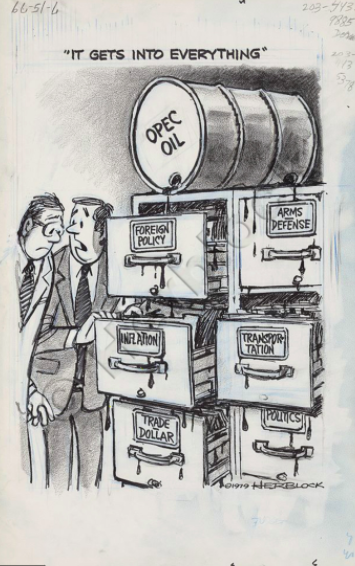
This sent most countries around the world into a panic due to the fact that oil to most countries was essential for day to day life. It was a part of foreign policy, influenced inflation, trade, politics, transportation, defense, and more. This oil shock pushed many countries into recessions and stagflation skyrocketed including most of Western Europe and the United States.
Although the economy of the USSR was starting to stagnate, The USSR wasn’t affected by the 1973 Oil Shock like most of the world due to its position at the time as a high oil-producing country. During the oil crisis, it continued to export oil to countries in the Eastern Bloc and other communist countries, exporting as much as 2.3 million barrels a day.
Even though the 1973 Oil Shock sent Western Europe into a recession, which had high levels of unemployment, migration didn’t stop. The formal process of recruiting migrant labor declined, but many foreign workers choose to stay which led to family reunion and overall growth of permanent migration.
Throughout the 1970s the USSR was also actively recruiting large numbers of temporary workers from other communist countries such as Bulgaria, North Korea, and Vietnam to work throughout the country. There was migration from inside the Eastern Bloc as well, the USSR received an influx of migrants from countries in 1975 in the Eastern Bloc that increased the population by 2.5 million (DeHaas p 126). These migrants were largely sent to West Siberia to work in the oil and gas fields.
Even though Western Europe went through a major recession, this created the dual labor market which stimulated a renewed labor immigration to Europe in the mid-1980s. Parallelly despite the stagflation of the economy of the USSR, migration continued to happen at a large rate. This goes to show that despite the belief that booming economies encourage migration, through a reliance on a guest worker’s economy migration happens even through economic downturns and even recessions.
Sources:
Carlson, Sevinc. “RESPONSES TO THE OIL CRISIS: THE U.S.S.R. AND SELECTED ASIAN COUNTRIES.” The Journal of Energy and Development, vol. 1, no. 1, 1975, pp. 84–92. JSTOR, www.jstor.org/stable/24806781. Accessed 14 Sept. 2020.
DeHaas, Labor and Migration, 2020
Yergin, Daniel. The prize: the epic quest for oil, money, and power. 1993
Hi Cat, I thoroughly enjoyed reading your blog post, and especially appreciated the photos you included. The question you asked was very interesting. I wonder if *when* migratory flows begin can be factored into this argument. The programs which brought workers into places like Germany began after WW2. Perhaps the reason why migratory flows continued into the ’80s had less to do with the economy and more to do with families and friends encouraging more migrants to move. Just a thought. Don’t know whether it makes much sense.
Your core question is one of the reasons that economists studying migration were ultimately forced to abandon a simple ‘push-pull’ model that was based on everyone trying to meet their economic needs. We will be reading about cumulative causation–factors like expanded knowledge about migration possibilities, family reunification, migrant networks–that stimulate migration seemingly regardless of whether an economy is booming or in recession.